In February 1981, as Spain emerged from Franco’s dictatorship and prepared for its first democratic vote for a new prime minister, Colonel Tejero and a band of right-wing soldiers burst into parliament and began firing shots. Only three men refused to take cover: Adolfo Suárez, the outgoing prime minister who had guided Spain out of authoritarianism; General Gutiérrez Mellado, a conservative general loyal to democracy; and Santiago Carrillo, the head of the Communist Party, which had just been legalized. In Anatomy of a Moment, Javier Cercas turns this extraordinary real event – the only coup ever captured live on film – into a groundbreaking documentary novel on a defining moment in Spanish collective memory. Combining the facts of history with the novelist’s flair, this landmark work by one of Europe’s most celebrated writers deconstructs the tense hours when democracy hung in the balance.
‘A brilliant reconfiguring of a key event in contemporary European history. Audacious and wholly fascinating.’
— William Boyd
‘Cercas writes that he originally tried to fictionalize the event and turn it into ‘a strange experimental version of The Three Musketeers; that’s exactly how the book turned out, and he didn’t have to fictionalize a thing.’
— New Yorker
‘A persuasive, brilliant and absorbing book that has more contemporary resonance than even he might have imagined.’
— The Economist
‘Always a nimble dancer on the edge of history and fiction, the Spanish writer returns with a closely researched but always dramatic account of the failed coup in 1981 that almost vanquished his country’s fragile post-Franco democracy.’
— Boyd Tonkin, Independent
‘Javier Cercas returns to another crucial episode in the history of his country in this dense but gripping, almost Shakespearean account of soldiers, politicians, mixed motives and the lust for power…. His subtle intelligence, narrative gifts and intellectual honesty are outstanding.’
— Anne Chisholm, Telegraph
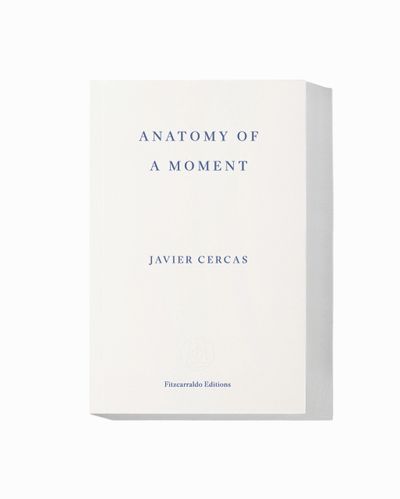
Anatomy of a Moment
Translated by Anne McLean
French paperback with flaps, 516 pages
Published 27 August 2026
Anatomy of a Moment
Translated by Anne McLean
PROLOGUE: EPILOGUE TO A NOVEL
I.
In the middle of March 2008, I read that according to a poll published in the United Kingdom almost a quarter of Britons thought Winston Churchill was a fictional character. At that time I had just finished a draft of a novel about the 23 February 1981 coup d’état in Spain, and was full of doubts about what I’d written and I remember wondering how many Spaniards must think Adolfo Suárez was a fictional character, that General Gutiérrez Mellado was a fictional character, that Santiago Carrillo or Lieutenant Colonel Tejero were fictional characters. It still strikes me as a relevant question. It’s true that Winston Churchill died more than forty years ago, that General Gutiérrez Mellado died less than fifteen years ago and, as I write, Adolfo Suárez, Santiago Carrillo and Lieutenant Colonel Tejero are still alive, but it’s also true that Churchill is a top-ranking historical figure and, if Suárez might share that position, at least in Spain, General Gutiérrez Mellado and Santiago Carrillo, not to mention Lieutenant Colonel Tejero, do not; furthermore, in Churchill’s time television was not yet the main fabricator of reality as well as the main fabricator of unreality on the planet, while one of the characteristics that defines the 23 February coup is that it was recorded by television cameras and broadcast all over the world. In fact, who knows whether by now Lieutenant Colonel Tejero might not be a television character to many people; perhaps even Adolfo Suárez, General Gutiérrez Mellado and Santiago Carrillo might also be to a certain extent, but not to the extent that he is: apart from people dressing up as him on comedy programmes and advertisements, the lieutenant colonel’s public life is confined to those few seconds repeated each year on television in which, wearing his tricorne and brandishing his new standard-issue pistol, he bursts into the Cortes and humiliates the deputies assembled there at gunpoint. Although we know he is a real character, he is an unreal character; although we know it is a real image, it is an unreal image: a scene from a cliché-ridden Spanish film fresh from the hackneyed brain of a mediocre imitator of Luis García Berlanga. No real person becomes fictitious by appearing on television, not even by being more a television personality than anything else, but television probably contaminates everything it touches with unreality, and the nature of an historic event alters in some way when it is broadcast on television, because television distorts (if not trivializes and demeans) the way we perceive things. The 23 February coup coexists with this anomaly: as far as I know, it’s the only coup in history filmed for television, and the fact that it was filmed is at once its guarantee of reality and its guarantee of unreality; added to the repeated astonishment the images produce, to the historic magnitude of the event and to the still troubling areas of real or assumed shadows, these circumstances might explain the unprecedented mishmash of fictions in the form of baseless theories, fanciful ideas, embellished speculations and invented memories that surround them.
Here’s a tiny example of the latter; tiny but not banal, because it is directly related to the coup’s televisual life. No Spaniard who’d reached the age of reason by 23 February 1981 has forgotten his or her whereabouts that evening, and many people blessed with good memories remember in detail – what time it was, where they were, with whom – having watched Lieutenant Colonel Tejero and his civil guards enter the Cortes live on television, to the point that they’d be willing to swear by what they hold most sacred that it is a real memory. It is not: although the coup was broadcast live on radio, the television images were shown only after the liberation of the parliamentary hostages, shortly after 12.30 on the 24th, and were seen live only by a handful of Televisión Española journalists and technicians, whose cameras were filming the interrupted parliamentary session and who circulated those images through the in-house network in the hope they’d be edited and broadcast on the evening news summaries and the nightly newscast. That’s what happened, but we all resist having our memories removed, for they’re our handle on our identity, and some put what they remember before what happened, so they carry on remembering that they watched the coup d’état live. It is, I suppose, a neurotic reaction, though logical, especially considering the 23 February coup, in which it is often difficult to distinguish the real from the fictitious. After all, there are reasons to interpret the 23 February coup as the fruit of a collective neurosis. Or of collective paranoia. Or, more precisely, of a collective novel. In the society of the spectacle it was, in any case, one more spectacle. But that doesn’t mean it was a fiction: the 23 February coup existed, and twenty-seven years after that day, when its principal protagonists had perhaps for many begun to lose their status as historical characters and enter the realms of fiction, I had just finished a draft of a novel in which I tried to turn 23 February into fiction. And I was full of doubts.
(…)
Javier Cercas was born in Spain in 1962. He is a novelist and columnist and he has received numerous international awards. His books include Soldiers of Salamis (which has sold more than a million copies worldwide), Anatomy of a Moment and The Impostor. His books have been translated into more than thirty languages. He lives in Barcelona.
Anne McLean studied history in London, Ontario, and literary translation in London, England, and now lives in Toronto, where she translates Latin American and Spanish novels, short stories, memoirs and other writings by authors including Julio Cortázar, Gabriel García Márquez, Juan Gabriel Vásquez and Héctor Abad.


