In 2021, Małgorzata Lebda ran the entire length of the longest river in Poland, the Vistula, from its source in the Beskid Mountains to its mouth at the Baltic Sea – a distance of 1,113 kilometres. She set out to run as a poet, not as an athlete, to use the rhythms of her own body as a means of understanding and connecting to the rhythms of the river’s body of water, under threat of environmental ruin. Mer de Glace, which won the Szymborska Award, is the introduction to her remarkable journey. A profound meditation on the porosity, reactivity and receptivity of both the body and the natural world, the collection reveals their deep interdependence.
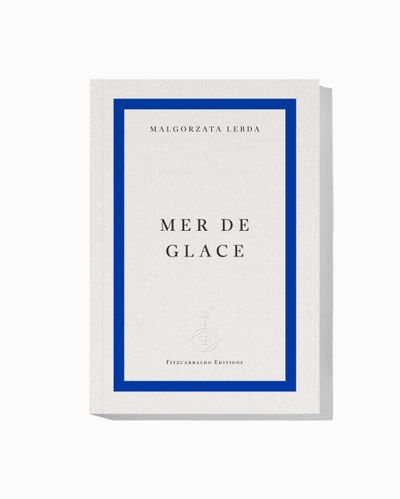
Mer de Glace
Translated by Mira Rosenthal
French paperback with flaps, 64 pages
Published 21 May 2026
Mer de Glace
Translated by Mira Rosenthal
THE FEEDING OF THE DOGS
Mornings here in the damp valley are good, the end of the world
that continues rarely comes to mind, since other matters
are more important: take euthyrox first thing, get a quarter
doxybactin in the muzzle of the cat. And also: feed the dogs,
tell the dogs your dream, take the dogs for a walk.
Mornings here are good, serene, reaching all the way to the dark.
FROM THE BODY: ONE
Today the body was obedient. Before setting off on a run, its memory
must be jogged about the route, the gravel, the roots, the arteries
of the earth. If the path cuts through the forest, it obeys.
After several hours, as promised, I cool it off in the stream
just below the house. A woman with a boy in her arms
points me out from the road and says: Oh, look
over there, a lady, she’s walking into the cold, brrrr.
The boy apes: brrrr.
FUCHSIA
The last house in the village emits something luminous. A woman
sets the table, cracks a window, sits on the sill, lights up,
looks out, catches sight of my body in silhouette (it must be
strong against the shiny road), raises a hand, as do I in reply.
Entering the woods, I wonder who she thought she recognized
in me. The night sharpens animal sounds and hornbeams
bow down, bow down. Running back, I notice the lights are higher
where she has moved from the ground floor to the attic.
I know a good deal about her: she tilts her head when smoking
and leans on the frame, she cares about diffuse light
for the fuchsia, chose to hang it in an eastern-facing spot.
She recognizes things. She eats alone. (…)
‘This is ecopoetry at its most profound and informal, challenging and pleasurable.’
— Fiona Sampson, Guardian
‘Małgorzata Lebda’s poetry never ceases to amaze the reader. Even a chance encounter with it imperceptibly creates an everlasting connection. As eternal as the bond between the frozen sea and the forest.’
— Olga Tokarczuk, author of Drive Your Plow Over the Bones of the Dead
‘What does a poet see when she runs along an entire river? In Mer de Glace, Małgorzata Lebda presents poems of extraordinary attentiveness to sensory experience, finding in tiny details such as the closing of an eyelid or the flesh of a greengage plum the same life force that courses beneath the glacier of the book’s title. Dense and luminous, these poetic missives from a body in motion amount to a radical act of presence that runs along the nerve between the intimate and the immense – rooted in landscape, language, and the rhythm of one foot placed in front of another.’
— Scotia Gilroy, writer and translator
‘“It’s the job of the senses to turn into words”, writes Małgorzata Lebda in “Geography”. Her poems operate like a dog’s sense of smell in darkness: they venture forth with a clarity heightened by a tender knowledge of the embodied quality of all things – human, animal, celestial, natural, unnatural and linguistic. From a culture with an unparalleled tradition of poetry, Lebda is another truly fine poet from Poland. Her poetic vision is so singular and her style so distinctive we already have in usage the term “Lebda-esque”.’
— Alice Lyons, author of Oona
‘Małgorzata Lebda’s startling Mer de Glace – so necessary for our ecological moment – connects the body to landscapes, reviving that ancient intimacy through language fertile as black soil, bright as sun on glacial ice, and urgent as a dog’s moonlit howl.’
— Michael Downs, author of The Greatest Show: Stories
Praise for Voracious:
‘Life and death are beautifully balanced in Lebda’s lyrical novel.’
— Olga Tokarczuk, author of The Empusium
‘A dark, gorgeous and haunting book about bodies, attention and care’
— Sarah Moss, author of Ghost Wall
‘Voracious is a visionary account of the lacework of interrelationships between people and the earth. It has a hallucinatory quality – passionate, disturbing, memorable – like a dream sent to us by a druid. Antonia Lloyd-Jones has rendered this dream in a breathtaking English translation that seethes and flickers like the scenes it depicts.’
— Sasha Dugdale, author of The Strongbox
‘Voracious is gorgeous, vivid, timeless, a novel about a small place and a small family as a microcosm of the human family and the whole world at this particular moment in time.’
— Sara Baume, author of Handiwork
Małgorzata Lebda is a Polish poet, fiction writer and ultramarathon runner. She is the author of seven poetry collections, including Mer de Glace which received the prestigious Wisława Szymborska Prize, and Dunaj. Chyłe pola which was awarded the Kościelski Foundation Award. In 2023, Lebda published her prose debut, Łakome (Voracious). The novel has been translated into English by Antonia Lloyd-Jones (Linden Editions, 2025), and a film adaptation will be released in 2027. Her books have been translated into numerous languages, including English, Spanish, French, Dutch, Italian, Czech, Serbian, Ukrainian, Slovenian and Danish. She grew up in a hamlet in the Beskid Mountains and still lives in the countryside, sharing her life between the Beskid Mountains and a meadow house in the Suwałki Gap. She is currently working on her second novel.
Mira Rosenthal is an American poet and translator of Polish-language writers such as Tomasz Różycki, Małgorzata Lebda and Krystyna Dąbrowska. Her work has received the PEN Award for Poetry in Translation and the Found in Translation Award, among other recognitions, and twice has been nominated for the Griffin Poetry Prize as well as for the Derek Walcott Prize for Poetry, the National Translation Award, and the Oxford-Weidenfeld Translation Prize. She is the author of Territorial, a Pitt Poetry Series selection, and The Local World, winner of the Wick Poetry Prize. Other honours include a National Endowment for the Arts Fellowship, a Wallace Stegner Fellowship from Stanford University, two Fulbright Fellowships, and residencies at Hedgebrook, MacDowell and the Jan Michalski Foundation.


