
In a family home in the north of France, a crime has been committed. But a crime of what order? Who exactly is the victim and who, if anyone, is the criminal? In Twenty Minutes of Silence, Hélène Bessette unleashes a polyphonic investigation, multiplying perspectives, contradictions, questions and doubts. Everything in this high-octane drama is subject to change, including the lighting and the basic facts of the case. Composed in her signature poetic prose style, Bessette’s novella builds a world punctured by startling disruptions and unexpected shifts, and in doing so destroys and remakes the crime novel, creating a form wholly new. Devastating and exuberant, Twenty Minutes of Silence is a vital interrogation of the powerlessness of childhood, the compromises of adulthood, and the conventions of the novel itself.
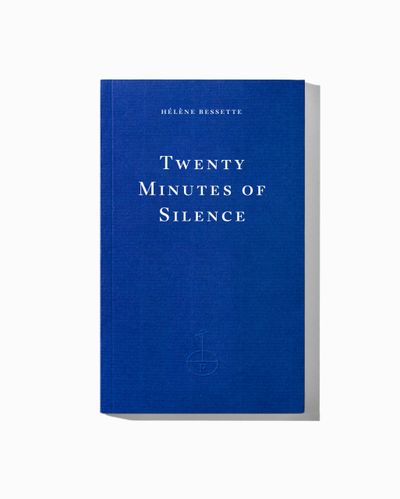
Twenty Minutes of Silence
Translated by Kate Briggs, with an introduction by Kathryn Scanlan
Fitzcarraldo Classic No. 13 | French paperback with flaps, 180 pages
Published 18 June 2026
Twenty Minutes of Silence
Translated by Kate Briggs, with an introduction by Kathryn Scanlan
Don’t be silly.
You’re not going to cry.
She’s crying.
She’s completely mad.
You’re mad, my girl.
There are more important things to cry about, I can assure you.
Great big reasons to cry.
Save your tears for another day.
Believe me.
You’re going to need those tears.
If you cry them now, what’ll you do on the day you need them.
The day of the worthy cause.
Don’t waste your tears.
A bit of common sense.
You’re not going to cry:
because the sun is setting,
because the year is setting,
because: October is setting.
You’re not going to cry over nothing.
In the street.
In among other people.
When you’re in other people.
And just because the day is setting
and the year is setting
and this month is floundering against November in a fug of fog and twinkling lights.
People cry out in the street when they feel immense grief.
No one bursts into tears because of a crowd passing by, pressing forwards hastily, silently
in a setting evening
in a slowed six o’clock,
in a finished year,
in a morose and moribund month.
The loose shapes of the crowd.
I am in other people.
And hanging over us:
the great setted day,
the great blown-out year
the great slanting sun
the disenchanted month.
You’ve never seen a train go by?
You’re like a cow in a field gaping at an autumn train.
You’re not going to cry just because a train is passing by.
There are far sadder sights in the world.
It’s the Paris train.
Already, it’s lit up, like a string of lights hung for a party.
You’ve never seen a train pass over the viaduct?
So watch my girl, take a good look.
But do stop crying.
No one cries because a train is passing over a viaduct.
No one has ever shed a tear over that.
Surely you’re the first.
And if there’s grey above the train lights and if there’s grey thickening under the viaduct’s arches – what of it?
Don’t be silly.
To look at you anyone would think that the man in grey is on that train and you’re watching him leave.
or the son and his father,
or the boy without a mother,
or the casketed father,
or Rose, Rose Hollyhock with her rose-pink colour,
with the setting day,
with the setting year,
with the setting month,
with the setting life,
with the setting love.
She turns away to cry.
Out here in the street.
Pull yourself together you’re infuriating me.
I can’t stand to see people cry.
I can’t stand to see a person crying in the street.
You’ve not seen the shop signs lit up before?
and why is the Hotel Bellevue red:
The Continental blue
The Globe green
The Lutetia violet
The Atlantic yellow
The Peace mauve
The surrounding grey – why is it growing darker?
I’ve no idea.
Is it because you cried?
Dry your tears now, come along, let’s go home.
No. She’d rather cry. They’re all the same: attached to what hurts them, strangled by emotion.
She has never seen anyone board a coach before, it’s the first time in her life.
And here’s the horn
to summon
to summon the last late passengers.
Shouts, final goodbyes, laughter, commotion.
For they’re not crying, they’re leaving,
on coaches that are starting to move off,
switching on their red lights,
advancing along the main road at the slow pace of a romantic evening stroll in the thickened grey
of the setted day,
of the setted month,
of the setted year.
The train is far off.
It’s quiet.
The lead-coloured silence has spread.
Let’s go home.
This is a story of candles.
The heroine is simply a candle.
It’s a novel to be read and that’s being written
by candlelight.
Which is why no one can make head or tail of it.
There’s a blackout.
A candlelit dinner.
In the dark.
At midnight? no, three o’clock in the morning.
It’s a last supper.
Lit only by the reflections from the chandelier.
made from copper.
It’s a tête-à-tête,
faintly sketched in the adjusted gloom.
(…)
‘Exhilarating… A haunting commentary on isolation and neurosis, speaking to contemporary voyeurism. What are we escaping? The novel leaves us with the language of violence, tragedy and death – and the vitalizing instruction to play with it.’
— Maya Kulukundis, Irish Times
‘Bessette brings poetry to bear on truth by showing how literalism leaves nothing true. She demolishes our social and legal constructions of innocence by playing upon the way we read and interpret language… The text gallops through multiple mouths, leaving us suspended between voices, rumours, media, legal questions, idioms and psychologism. The result is a continuous interrogation characterized by drastic shifts between speakers and narration.’
— Alina Stefanescu, Toronto Review
‘This riveting translation at once slays and reinvents the mystery genre…. The titular concept of silence, purportedly about the accomplices’ erasure of evidence, in fact represents a linguistic and structural red herring. The articulate, seemingly uncounseled testimonies of the deceased’s adulterous wife and abused son, along with biased speculations by the chief inspector, his deputy, the journalists and the bookseller, are replete with operatic revelations.’
— Thúy Đinh, NPR
‘Twenty Minutes of Silence is an impressive example of what Bessette can do with form and language, giving primacy to individual speech while also denying the idea that there’s ever a singular “I,” and always teasing out the reader’s attention and laughter…. Stripping the narrative down to its one-and-many voices, all blended and overlapping, is a mirror of how we account for the world today—with all its truths and mysteries.’
— Hannah Weber, Words Without Borders
‘Twenty Minutes of Silence is a sublimely rare thing: a feat of experimentation that defies comparison. Hélène Bessette’s phrasings (translated by the brilliant Kate Briggs) pulse with a bass drum and freewheeling speed, as she upends the sentence so that we can reconsider our relationship to language and the stories we tell with it. Thrilling.’
— Makenna Goodman, author of Helen of Nowhere
‘Discovering Hélène Bessette through Kate Briggs’ incredible translations has felt like having a light switched on. I can feel so many of us excitedly learning and re-exploring the potential of the novel, which as a form, multiplies in Twenty Minutes of Silence. The brilliant modernist and anti-commercial styles that run through it feel perfect for us now and I am grateful we get to write and think in the extraordinary milieu of Bessette and Briggs.’
— Holly Pester, author of The Lodgers
‘First published in 1955, the stimulating second novel by Bessette to be translated into English centers on a murder, though it’s no simple whodunit…. This slippery and satisfying novel probes the unresolvable mysteries of life.’
— Publishers Weekly
‘In this marvelous and sui generis novel, written in Bessette’s signature taut and stripped-back prose, the detective novel is turned inside out and wholly on its head.’
— Book Riot
Praise for Lili is Crying
‘Lili is Crying is stunning: a choral fever-dream of a book cycling through passion and despair, loyalty and betrayal. Bessette’s cadence and lyrical concision are bewitching and necessarily airless, much like the mother-daughter relationship they chronicle. It’s also a vivid and unforgettable portrait of place – a sun-drenched landscape with world war at its fringes, and the slow fade of one era into another. Kate Briggs’s translation is a powerful channelling of Bessette’s voice: distinct, unapologetic and eerily present.’
— Daisy Lafarge, author of Lovebug
‘I’m grateful to Kate Briggs for her translation of Lili is Crying – a tragic, comic, invigorating book with an eccentric staccato style that blurs speech and thought.’
— Kathryn Scanlan, author of Kick the Latch
‘A manic, brilliant maze of a book. Circular, cinematic, comic.’
— Sinéad Gleeson, author of Hagstone
‘This book is brilliant and bizarre, a Grey Gardens-esque tragicomedy, as if written by a sinister cousin of Stevie Smith.’
— Camilla Grudova, author of The Coiled Serpent
‘Lili is Crying is not straightforwardly tragic – as the title may initially trick us into believing – but darkly funny, marvellously strange, insistently performative and, somehow, truer than true.’
— Saba Sams, author of Gunk
Kathryn Scanlan is the author of Aug 9—Fog, The Dominant Animal and Kick the Latch. She is the recipient of a Pushcart Prize, the Iowa Review Award, the Gordon Burn Prize, the Windham-Campbell Prize for Fiction, a Literature Award from the American Academy of Arts and Letters, and fellowships from MacDowell, the Jan Michalski Foundation and the European Capital of Culture programme in Chemnitz, Germany. Her work has been published in Granta, The Paris Review, Another Gaze, Brick, The Yale Review and, recently, in exhibition catalogues for artists including Ed Atkins, Robert Therrien, Sam Contis and Mary Ellen Carroll; she is also a regular contributor to the literary journal NOON, edited by Diane Williams. Originally from Iowa, she lives in Los Angeles.
Hélène Bessette (1918–2000) published thirteen novels with Gallimard between 1953 and 1973, won the Cazes prize in 1954 and was twice in the running for the Goncourt prize and the Médicis prize.
Kate Briggs grew up in Somerset, UK, and lives and works in Rotterdam, NL, where she founded and co-runs the writing and publishing project ‘Short Pieces That Move’. She is the translator of two volumes of Roland Barthes’s lecture and seminar notes at the Collège de France: The Preparation of the Novel and How to Live Together, both published by Columbia University Press. This Little Art, her genre-bending essay on the art of translation, was published by Fitzcarraldo Editions in 2017. In 2021, she was awarded a Windham-Campbell Prize. Her debut novel, The Long Form, was published by Fitzcarraldo Editions in 2023 and shortlisted for the Goldsmiths Prize the same year.


