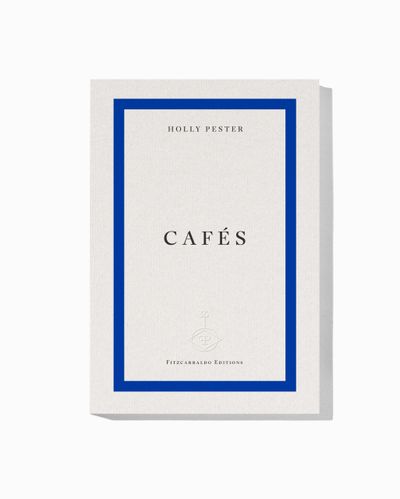
Welcome to Cafés! Somewhere to eat and forget about work, where we can meet friends and not think about love, where we can meet lovers and be too nervous to eat. In Holly Pester’s unique lyric, the café becomes a structure of fantasy and language exploring life at the pressurized edges. It becomes a form – a canto or a verse – unearthing what this space promises us in terms of freedom and thought, and what it holds back. In each iteration, the café remakes itself through the people who pass through it. A worker tries to run a café franchise. A lover sits in the corner, waiting. A woman mourns a friendship while contemplating age and childlessness. An artist tries to launch an art café and hosts an open mic. Both a stylish political intervention and an elegy for communal space, Holly Pester’s newest collection reaffirms her as one of the most exciting poets of our time.

Cafés
French paperback with flaps, 112 pages
Published 2 July 2026
Cafés
I have been studying cafés.
So have all of us. Anyone who has ever entered a café has wondered: what are we acknowledging? Whether in bohemia or on a street corner, the café wants us to consider things lightly. A good café focuses our attention away from the work produced. It confuses work with leisure. Now we’re sore, let’s reflect on our damaged life. Each café is civilisation’s averted conclusion. A powerless little proxy confuses me. Put it this way, sometimes I feel gargantuan, always powerless, made of public, like I’m all of it, before and after. Then I realize I’m yelling. Shrink to enter a swell. I get why there’s steam in my face, or is that the Enlightenment? Shocks quicken. One customer turns to another and says, you’ve become lost inside your head.
Today is a life and I find myself in the middle of a busy café. We’re in a book called Mankind with its tinkling, bloodcurdling doors. This may become strained.
WORKER’S CAFÉ
[SAME AMBIENCE AS A LETTER OF RESIGNATION]
To truly misconduct I needed training.
Every day puts a person in the same position as yesterday.
Tomorrow is a new day.
Let’s get to work, grub first!
A training day: Listen hard, my manager said as we gathered up, in the twentieth century this is how time lurked, harder, running his hand through our hair. Some people clapped. Harder! Folk met up regularly at the Kardomah or in the home of their leader. They had jobs instead of God, laying wasted to the working week. The memory foam of defeat. He concluded, The café is pain and pleasure, and like my bathtub it needs wiping. People laughed. They were motivated. From the back in my least powerful voice I cried out something unfortunate, I want to work alone. The note-takers shook. I mean run my own business. As if it was me. I believe I meant freedom or a sex life but it was too late. So, I will work
harder on my defeat.
My project forgot to hide. My little body was the premise. Episodic, scheduled to thin rips (the tiniest rips like between TV channels). I understood scope, time, cost, risk. You see how terrified I am of work? With its false spaces and mad spews. At last I vowed I’m going to open my own café. And be open about it. As was my business. (…)
‘Holly Pester’s café is a place to sink into the soft leather couches, eavesdrop, work and dream: a waiting room both strange and familiar, full of spillages (of coffee) and slippages (of language). A public space or a place to hide; to meet friends and strangers or to be alone; Pester’s brilliance builds this cafe up and invites us in to linger.’
― Francesca Wade, author of Gertrude Stein: an Afterlife
‘Holly Pester makes the world sing. The song is written by Victoria Wood, and it’s a happy-sad song about utopia. Figured not as a distant place but as a way of being with people and things, that might also be called friendship, that might also be called poetry. She reminds us that poetry is a social activity, an expression of faith in the possibility of connection – with other people, with the world, with happiness – that feels, in our historical moment, like a form of resistance.’
― Ben Eastham, author of The Floating World
‘Romance! Revolution! Happy work! Salad! In this ingenious and devastatingly funny work, the perky smooth surfaces of contemporary capitalism are vivisected to show fleshy conflicts and writhing contradictions. On life’s menu can we actually pick our options, rather than just onions? Can we dare to experience one another outside of the transaction? Cafés is a striking and vital work of dreaming and dream interpretations, a clarion call for interruption that will ‘make thoughts paddle’. Enter the café, scooch closer and awaken your critique!’
― Lila Matsumoto, author of Two Twin Pipes Sprout Water
‘Holly Pester is one of my favourite contemporary poets and Cafés is her strangest and maybe best book (so far). Narrative fragments emerge and recede, characters coalesce and dissolve, sentences threaten to topple their own grammar, and the subject matter shifts near-constantly – from work to love to friendship to aging to art. Pester has a special ability to thwart literal sense while sustaining emotional sense, even when the feeling is subtle. Like a café, the book makes space for the pleasures of barely structured time: time spent in reflection, conversation, and maybe even hard work, but without an overarching aim that’s clear to oneself. A simpler book would symptomatise such pleasures, but Cafés meets them openly, with ambivalence and love.’
— Steven Zultanski, author of Help
Praise for The Lodgers:
‘Holly Pester is a genius and The Lodgers gets into everything that matters.’
― Kate Briggs, author of The Long Form
‘There is no one better than Holly Pester at communicating the eerie, sometimes hilarious and often hallucinatory experience of modern precarity. This is a novel for the age and for generation rent: a captivating and unforgettable account of how economic circumstance can lead to a feeling of being only half alive.’
― Nathalie Olah, author of Bad Taste
‘With tang and pith in every sentence, The Lodgers speaks to a generational epidemic of rootlessness and porous selfhood with vital wit and utter originality.’
― AK Blakemore, author of The Glutton
‘A sad strange lyrical story of shame and displacement but whose strength will not let you go.’
― Sheena Patel, author of I’m a Fan
Holly Pester is a writer and Senior Lecturer in the Department of Literature, Film and Theatre, University of Essex. Her books and works include Ecloques for Idle Workers (BBC Radio and Distance No Object, 2018), Comic Timing (Granta, 2021), which was shortlisted for the Forward Prize, and The Lodgers (Granta, 2024).


