
Theodor Herzl, novelist, journalist, playwright, and the father of political Zionism, was also the father to three children: Pauline, who died from her drug addictions; Hans, who converted to Christianity and committed suicide on the eve of his older sister’s funeral; and Trude, the youngest, who perished in a Nazi camp. Only one of these Herzls had a child: Trude’s son Stephen, a British Army captain who leapt to his death from a bridge in Atomic Age Washington DC, thus ending the Herzl line. From the salons of imperial Vienna to the debauchery of interwar Paris, from Blitzed-out London to the final days of the British Mandate in Jerusalem, Dead Herzls tells this nearly-unknown saga as a continent-and-century-spanning fiction written with millennial compression, compassion, grace, and even wit. A classical tragedy as well as a poignant psychological case study of how the familial becomes the political, it is Joshua Cohen’s most important novel to date, and a brilliantly dark prehistory of our violent present.
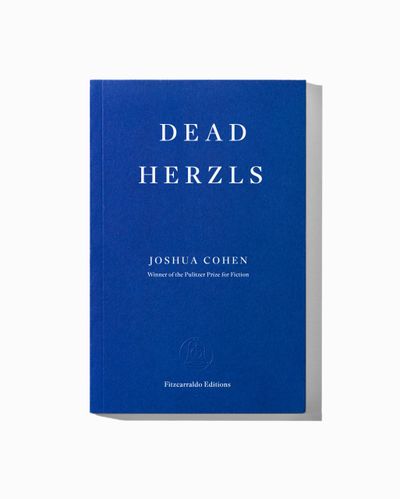
Dead Herzls
French paperback with flaps, 300 pages
Published 11 February 2027
Dead Herzls
I. STEPHEN NORMAN, PALESTINE, 1945
Years they were, years of service, years of his life, spent (enjoyed, wasted) in places that despite the years never ceased to be exotic, places that at every beggar-crammed, litter-piled corner reminded him he was a stranger, places that even should he live another hundred years he’ll never visit again. Ceylon. Kotte and Colombo. Colombo and Kotte. The lake and the sea, the hectic ports, the articulate and one could or should even say overarticulate streets with the icons of the gods, the idols of the gods, posted at the intersections, not because the denizens are particularly religious, but just to prevent the destitute among them from relieving themselves in public, piss and shit, shit and piss, with the hope that even the poorest agnostic, even the poorest atheist, would not void their bladder or bowel atop a god… the spice markets, the poultry and produce markets, the padda boats up the currentless canals… the stately wooden homes with the propped-up wide verandahs set with hammocks and rattan chairs and the punkah fans that go around and around and around in mimicry of the endless routine of the bureaucratic days in Panagoda, so close to Kotte, so close to Colombo, but also, on some trips, so distant from all, the tours to the field, to Battenburg at Fort, Galle Face, Mutwal, the training at Trincomalee, the disciplining of the Ceylon forces they were supposed to regard as “undisciplinable,” and then, suddenly, but in the type of suddenly that takes years and years and a full generation dead, there is a victory declared in the East and Europe is saved, Europe is vanquished (whichever), and he was told that he was going home, wherever that was… apparently, he’d gotten into that British habit, if not merely that army habit, of saying “Europe”—must stop that…
—
He could rush through his memory like an actor past multiple backgrounds mothballed from old stage productions: here’s the set we used for India… here’s the set we used for Ceylon… This shimmering fabric is water. This wobbly wooden prop is a tree. He was the actor passing by them. Or he was standing still and they were passing by him, tugged on ropes and pulled and pushed by locals whose names he often confused, whose languages he never learned to speak. It was with a certain sense of guilt that he was leaving them. He was told he was going home and he accepted that. It seemed the army knew where his home was even if he didn’t, and in the absence of any suggestions of his own, he was willing to accept the army’s determination. He’d be there a month. Perhaps more, perhaps less. And then the next posting. Or else a civilian life and all that entailed: no officers to tell you what to do, no army to hold responsible for your failure to rise. England. He was going back to England, to which all roads led, and yet given that abundance of roads and route options, he was assigned the one—the one out of countless—he’d secretly wanted. That he’d wanted it was a secret even from himself, so that when he was informed as to what his travel plans were, he found within himself a hidden joy. It was enough to cause him to think, for just a moment, that the god he’d never believed in, the singular God, actually existed and had actually intervened, or else that through the sheer force of his unconscious will he had caused some sort of scramble or malfunction in the grinding inner logistics of the British Army and so had brought this makeshift itinerary and schedule into the world: a flight to India, refueling in Madras, refueling in Bombay, and then from Bombay to the RAF station at Habbaniya, and from there over the desert, which might as well have been the moon, to Lydda.
It was a bumpy stubborn Dakota for this stretch: a short flight that like all short flights felt so long to him, because he could never sleep. They followed the pipeline through the sepia desert: a straight line over flatness, through time suspended, Arabia barren and brown, barren and red, barren and there orange and there yellow and there white, sands sometimes like sugar and sometimes like salt, as the day lengthened, as they raced the sun, which though they departed before it had risen had already caught up with them by the Jordan Valley and its twisting river. He’d expected the Jordan to be larger, but then that’s how it is with everything you read about and imagine as a child: it’s always going to be smaller in adulthood, whether it’s a river or a sea or a desert or a city and especially a person. Coming again to the cockpit he could see Jerusalem over in that direction and the coast just ahead and the new city of Tel Aviv and the ancient city of Jaffa and between were patches of green, groves of citrus, and young forests of young trees looking like stunted lost children.
The aerodrome at Lydda was vast and demonstrated against his bias the colonial power: he was in Palestine, he kept having to remind himself he was in Palestine, but the base could’ve been anywhere in the East, a cold stone building just a breath away from crumbling, held up by slapdash scaffolding. He deplaned and awaited his fate. With each of these stops, there was always a degree of uncertainty: How long would the stopover be? A few hours or a few days? Enough time just to refuel, maybe shower, maybe dine? Or enough time for tourism that ended in prostitutes and other souvenirs? These decisions were made at levels far above his rank: decisions, coincidences, divine interventions of the air trooping draft. These were issues of the higher angels, wings bound tight under the uniforms of central command. It was impossible to know in advance. It was always possible to ask, of course, though it wasn’t always possible to get an answer and often any answer you did manage to get would be the wrong one, more likely accidentally misinformed than purposefully misinforming, and because of that, or only partially because of that, he hadn’t planned anything at all, he hadn’t even tried to notify anyone of his arrival, preferring anyway to remain incognito, and he hoped, should his time here be sufficient and his presence be found out, that they—whoever they were, he really didn’t know: the people who found out, the people who would be interested—would understand the circumstances and not be affronted.
Such arrogance, such hubris… frond-strewn paving and shadeless lanes between the Nissen huts…
No sooner had he submitted his papers to the commanding officer at Lydda than he was told—his entire planeload was told—there was some delay: mechanical, technical, or merely something to do with the necessity of waiting for connecting personnel or freight. Mail, parcels, citrons, milk and honey. “It seems they’ve called a halt for acclimatization,” the officer told him, an older officer with some Scottish remnant in his voice, “a few days I’d say, but dinnae hold me tae it.” This was delivered to him as a dry-bone fact that surely didn’t warrant the smile with which he received it, a wide and inadvertent smile that evidently discomfited the Scottish colonel, who went muttering vaguely about a jam-up and malarial pilots, damn pilots, damn mosquitoes, dinnae ask me why they call it acclimatization… and throughout it all, he kept smiling that smile that remained fluttering in the air, he felt, even after his face was gone and he’d left the room, feeling that everything here in this land must be providential and conspiring to make him into some kind of believer.
Though what variety of believer would choose Tel Aviv over Jerusalem? Tel Aviv first, Jerusalem later, if there was time. Tel Aviv first because there was a ride offered in that direction. Jerusalem later and if I forget thee, may my tongue cleave or crack or how did it go? He was driven along the clean new road paved through the clean new fields trying to remember that line but interrupted by the beauty, thoughts of how everything around him looked so young, perhaps it wasn’t too late. Perhaps if he stayed here long enough he could look young too. He had intended to come and stay here upon the completion of his studies, but the German Reich had other plans for him, and so here he was visiting upon the completion of his war, a temporizing tourist feeling suddenly so old, so worn out, like one of the gnarled Arab trees bent over at the corners of the new Jewish gardens.
Rows of green, budding, blossoming, fruited, then dusty intervals that in their speeding by didn’t advertise their status, whether intentionally fallow or the victims of neglect. Regardless, there was an order that prevailed, and though the landscape was serene in the most superficial sense, one could feel the effort pulsing underground, the energy it took to tame, to regulate and rule. The road was flat, straight, paved but without paved points of ingress or egress, just dirt tracks that tracked their dirt onto the tarmac and then drifted off toward the horizon, wind-scrambled into semblance with the soil. Coming up on the first paved intersection at what must have been the outskirts of the city that from a distance rose like a city made entirely of outskirts, he saw his first sign in that other language he never learned, that language that unlike Sinhala or Tamil he should have learned, the language he had a few words of, a few phrases he could produce with his tongue cleaved or cracked and recognize with his ears, but when the eyes became involved, the eyes were dubious. This was the language of his ancestors, the language of his people who though they lived here presently were so foreign to him that he couldn’t help but think of them as his ancestors living in parallel, survivors of some miraculous historical transference that brought them out of the past to now, where if he wanted to speak with them in their native tongue, he could only bless the god who made wine and the god who made bread, conversation barely sufficient for the poorest supper. As they approached, as they slowed, he tried to recall the letters, tried to compare them with their translations that said in English “Tel Aviv,” which was apparently located straight ahead, with something else to the left and something else to the right, either less or more important because untranslated, and as they passed the sign he tried to understand the excitement he was feeling, the childish excitement that shamed him. Who gets excited about a street sign? Was this how patriotism, if that’s what it should be called, created imbeciles? By Jingo, indeed. Swear to Jingo to refuse it.
The fields grew smaller, the buildings closer together, stone structures with an Ottoman cast, large stones mortared with small stones if just cramming small stones into the cracks between large stones counted as mortar, ruined palaces for buzzards and goats to roam that gave way rather abruptly to “Europe”—there’s that word again, which in this usage, he realized, bore no resemblance to historical reality. Europe was gutted, Europe was bombed, Europe was a hole in the ground, Europe was a hole bombed within a hole in the ground, whereas this was intact and simple, intact and clean, white gleaming boxes of an astounding modernity compared to where he’d come from, sewerless Ceylon and Madras and Bombay. The streets were immaculate, but not unused: they were immaculate and crowded, they were pristine and bustling, filled with asses towing carts laden with brass or bronze junk, candelabras, candlesticks, chandeliers, braziers, sheets of glass and busted windows without glass, splinters of Biedermeier furniture, automobiles impatient behind the asses honking as the junkdealer cried his wares, or just cried at the drivers, the ass plowing on ahead oblivious, and between them, slipping around them, almost jumping atop them, children, so many children, he’d almost forgotten children existed, he’d certainly gone extensive stretches having forgotten he’d once been a child himself, and they were romping, jumping, yelling, impeding the progress of the colonel’s jeep, whose driver, a Lancashire boy, was the only motorist refusing to use the horn or his voice out of either temperament or policy. He was headed to some garrison mail depot, apparently in Jaffa, but Stephen asked to be left off here. He told the driver he would walk and find his own way back either to Jaffa or straight to Lydda and the driver looked at him with worry and then said something Stephen could barely hear, he assumed a needless warning. He couldn’t explain his confidence. He wouldn’t explain his confidence. He didn’t need any warnings, they didn’t apply to him. He got off and slapped the rump of the jeep, like it was his own mule, and took to the pavements. Allenby Street, the sign said, a street filled with shops, some of which he recognized as branches of shops in London, and he found himself wondering whether the prices had gone as high in London too. He browsed the streets and browsed the people, who were young generally and healthy generally, shockingly so, to his mind, and it was only occasionally that he encountered a stooped sallow figure with the pogroms of Russia or the Nazis written all over him or a weathered Arab who as he passed spit to the pavement spittle and the husks of sunflower seeds and he wondered to himself as he walked in his uniform whether the disdain he found in the faces of those he passed was the same disdain, a disdain for the uniform he was wearing, and whether the Jews and Arabs both would have hated him all the more had they known that he too was a Jew, hiding behind an Anglicized name and a captain’s stars.
He walked in the direction of the sea, natural enough for anyone who came through the desert, and was surprised to find how the city was built right up to the edge, teetering right on the dunes before the crash to the flat placid sea, in its way as flat and barren as the sands.
The Mediterranean—what to say about it? He wasn’t Homer. He wasn’t the prophet Jonah. He didn’t have his own words or even the words of others to understand the feeling it gave him, no prose, no poems, just a long unenjambed line of promenade up to London Square, a strip of open-air cafés and restaurants that wound toward Jaffa. He had that British folly of thinking he should choose the best of these cafés, but then realized while he was inspecting them that the waiters all darted back and forth in some continuous squabble between management and labor, and that whatever was served, if and when it was served, was being brought to what appeared to be different establishments all from some common bar and kitchen. Only the surfaces of the cafés were different, the striping of the awnings, the tables and chairs from wood or metal, the napkins paper or cloth, but the menu was the same, or there was no menu, and the same accordionist and violinist came in and out making their rounds and singing sad Slavic songs in hoarse strong tenors. He sat facing the sea, swatted away the musicians, tried to flag down a waiter, then just gave himself over to the breeze and the world, or this remnant of the world, passing him in parade-review, Jews of types he’d never seen before, speaking languages he’d never heard before over the czardas and waltzes, and there he sat waiting for whatever he’d managed to order as the sun came down and the sky became a rainbow, and with the sun’s descent there was also a weight falling from him, from his head to the pen he was holding, from his pen to the pocket diary he was holding, bringing him the sense that maybe these puerile jottings he’d become habituated to weren’t for his old age but for some posterity more invasive, though having had that thought he reminded himself that his thoughts on this place and its subjects didn’t matter and carried less import than those of the woman pushing the pram on the promenade, even less than those of the shrieking baby in the pram being pushed by the woman, and especially less than those of the gamin Arab scrutinizing her intensely as she passed with something that included lust but wasn’t merely lust…
[…]
‘This novel tells a great, tragic story using immersive grace and brilliant sentences. Joshua Cohen’s sense of place and period is superb, as is his skill with character and motive. The writing sets the book apart with its astonishing cadences, its wit, its pacing, its richness, its verve, its tone. Dead Herzls further establishes Joshua Cohen as one of the most exciting and original novelists working now.’
— Colm Tóibín, author of The Magician
‘An extraordinary stylist, Joshua Cohen is also a profound observer of the human condition. Dead Herzls exhilarates, surprises, and ultimately breaks your heart – a remarkable tour de force.’
— Claire Messud, author of This Strange Eventful History
‘What to make of a man whose descendants, every last one of them, turned out mad or broken in spirit, each in a different way? And what to make of his ideas? Dead Herzls is a hall of mirrors set amid the horrors of the twentieth century and, at the same time, a great, tragic family novel by one of the finest and most exciting writers working today.’
— Daniel Kehlmann, author of The Director
‘Dead Herzls is a masterpiece. The unfathomable tragedy at the novel’s heart is leavened by Cohen’s signature comic style, even as the weight of historical force is brought to bear on the Herzl siblings. The inevitability of the final outcome and the grip of familial determinism does not preclude exhilarating passages of suspense or levity. The early twentieth-century context is lustrously realized, shot through with a contemporary sense of irony. I read this novel with horror and awe.’
— Fiona Mozley, author of Elmet
‘A haunting expression of political and personal convergence, supremely powerful, evocative and troublingly timely.’
— Philippe Sands, author of East West Street
‘Very seldom has it been my pleasure to have the dual terror of time and history more beautifully depicted.’
— Christian Kracht, author of Air
‘A remarkable, ambitious novel, richly pleasurable and hugely intriguing. It resonates in the mind.’
— William Boyd, author of Cold Sunset
‘The house of Atreus fell, and Greece with it. The house of Herzl fell, and left behind a reborn nation. Dead Herzls is Joshua Cohen’s King Lear, and in scope, clamour and grief stands worthy of it.’
— Cynthia Ozick, author of Foreign Bodies
‘A major American writer.’
— Dwight Garner, New York Times
‘No one writing in English today is more gifted than Joshua Cohen.’
— Nicole Krauss, author of Forest Dark
‘Cohen is an extraordinary prose stylist, surely one of the most prodigious in American fiction today.’
— James Wood, New Yorker
Joshua Cohen was born in 1980 in Atlantic City. His books include the novels Moving Kings, Book of Numbers, Witz, A Heaven of Others and Cadenza for the Schneidermann Violin Concerto; the short fiction collection Four New Messages; and the non-fiction collection Attention. Cohen has been called ‘a major American writer’ by the New York Times, and ‘an extraordinary prose stylist, surely one of the most prodigious at work in American fiction today’ by the New Yorker. He was named one of Granta’s Best Young American Novelists in 2017 and awarded the 2022 Pulitzer Prize for Fiction for The Netanyahus. He lives in New York City.


