Bartholomew Port, known to all as Mew, steps into the bushes in a London park and steps out of the bushes in a Dublin one. Not only that – there are no cars; there are moving footpaths; there is no church; everything seems quite queer. Mew has arrived in a Dublin that is alive with song, with rumour, with ghosts, and with an unmistakable sense of insurgency. In this suspiciously timeless city that breathes an old revolutionary air, Mew fiercely misses his beloved Mootie, back home in London. An unravelling, an impossibility, a gathering of voices and a single dream, Dooneen is the layered, allusive and wildly original new novel from Keith Ridgway, ‘one of Ireland’s best writers, in a country with no shortage of them’ (The Times).
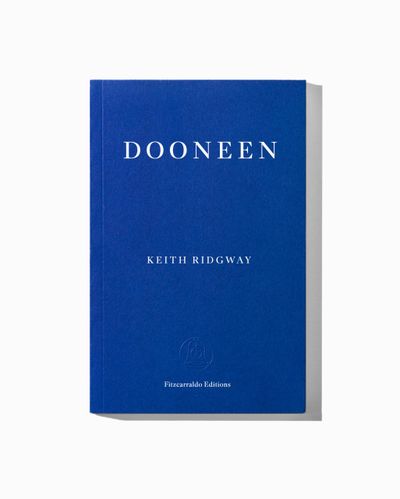
Dooneen
French paperback with flaps, 328 pages | Audiobook read by Barry McStay
Published 4 June 2026
Dooneen
LONDON
Two men strolled beside the Thames, east along Bermondsey Wall. For stretches they walked arm in arm, in close conversation. Or separate, in silence, glancing at the passers-by. Or they pointed across the choppy water to Wapping, and made jokes. A police boat moved up-river. At Cherry Garden Pier a small red dinghy fidgeted on the muddy waves. Dusk, and the lights coming on. They stopped in front of The Angel and debated for a moment, and went inside.
By the window in a corner they leaned towards each other. It was quiet. They talked, and laughed, and talked, and touched, and watched the darkness growing.
They talked about their landlord. About their rent. They sighed and reassured each other. They spoke of Gaza. They shook their heads and fell silent. They peered across the river and tried to imagine where Execution Dock might have stood. They talked about law, and government, and luck, and faith. They checked their phones. They talked again of Gaza. They fell silent. Then they talked about money. They talked about work. They laughed often. They gossiped about friends, housemates. They talked about the next day. About Dublin. Rent, again. The hot weather.
They left. They linked arms through Southwark Park and caught a bus to Peckham and walked to Havil Street, and home. Their names being Mahmoud Habib, and Bartholomew Port. Known to each other as Mootie, and Mew.
They slept with the window slightly ajar, their legs entangled, Mootie snoring lightly on his back, Mew on his side, his eyes sometimes opening to stare down a thought, or to worry perhaps, who can tell? Then he too drifted away. And around the house the wind ran its fingers and mumbled, and ghosts tugged at the windows and pushed at the doors, and a single spirit found a way into their room, and it climbed, this spirit, this presence, this invisible noun, this eye and ear, it climbed into Mew’s head because Mew was nearest, it climbed into the gentle folds of his personhood and it settled there and stayed.
The next day they slept late and woke into a panic. Mew was due in Dublin. He had packed nothing, had nothing ready, was utterly disorganised. He slipped into a sort of furious anxiety. Mootie was patient, calming, serene. He spoke gently, found a bag and helped Mew pack it, was encouraging, made Mew laugh. Mew became himself again. Mootie asked about his lunch date with Dinny in Dublin. About whether he was sure he didn’t want to visit his family. About when he was coming back.
— I’ll miss you.
They kissed at the front door.
— I’ll miss you too.
He scurried down Havil Street and on to Wells Way towards Burgess Park. He checked his pockets repeatedly. He carried his bag in his hand, then hoisted it onto his back, then carried it by hand again. The park was not busy. Bright green flashes screeched overhead – parakeets, chasing each other. He took the path through the trees.
A man walked towards him, a holdall slung on his shoulder. Mew slowed slightly. So did the man. Then the man left the path. He turned to his right, and went into the trees, disappearing amongst the bushes and the undergrowth. Mew stopped. He frowned and sighed. He checked his pockets again, lifted his backpack onto his back, glanced at his trousers, and followed.
(…)
‘It’s thrilling to watch Ridgway play with clarity and certainty; the linguistic energy and variety of the prose gives us plenty of sustenance to keep going as we clamber through the shadows. And there are laughs too: slapstick digressions about split trousers, little disquisitions on the best way to make a crisp sandwich and scheming military horses are all part of Ridgway’s wonderfully absorbing and offbeat comedy. The most lucid and affecting element of this appealingly labyrinthine novel is Mew’s longing for his beloved Mootie. In a world of political turmoil and botched plans, the desire for human connection, and the desire to commemorate that connection, transcends everything. ’
— Michael Donkor, Guardian
‘It has an immersive quality that is hard to shake once you’ve emerged – and Ridgway’s line-by-line writing is as good as ever…. But where the book stands out most is Ridgway’s writing about love…. [W]hat Dooneen leaves us with, after its eccentricities and unfathomables, is a simple understanding, as expressed by Philip Larkin – that what will survive of us is love.’
— John Self, The Times
‘When I think of undervalued great writers, Keith Ridgway is one of the first names on my list…. His phrasing is memorable, his imagination extraordinary. He can be eerie, uncomfortable, hilarious, deranged and heartbreaking. Dooneen, which is all those things, takes place in a world like ours…. I found myself admiring its determination to leave the questions it poses unanswered – as well as casting doubt over what those questions could be. Dooneen steps outside consensus reality and goes deep into defamiliarization to convey just how weird and chaotic life feels right now.’
— Chris Power, Observer
‘The powerfully imagined world of Dooneen is a telling testimony not only to Ridgway’s compulsive interest in the possibilities of creative prose but also to the capacity of great writing to bear witness to the corrosive cant of the entitled and the subversive decencies of the maligned.’
— Michael Cronin, Irish Times
‘There’s a Kafkaesque quality to his bewilderment in these mordantly funny early scenes where everything feels charged with foreboding… ingenious.’
— Rory Kiberd, Irish Independent
‘Fragmented, alien, beautiful… Ridgway demonstrates how the places we love are changed by time and distance, transformed into landscapes we barely recognize, like fragments of some half forgotten dream.’
— John Livesey, Brooklyn Rail
‘Comparisons become ridiculous at the level where Ridgway is working, but I will just say that for me there is a sense-memory of Kafka’s The Castle and Ishiguro’s The Unconsoled in my experience of the intimate and dreamlike Dooneen. The feeling is that of seeing fiction’s power of implication stretched before your eyes.’
— Jonathan Lethem
‘Ridgway has written a near perfect dream – a rebellion against reality, against space and form – but the blood is real, the panic, the love and friendship are there in front of you, can almost be touched. They don’t like you to say “masterpiece” in the endorsements, but read it, and tell me, what else can you call it?’
— Ben Pester, author of The Expansion Project
‘A hugely accomplished, politically acute, and strangely, intensely touching novel. Ridgway shows us – again – how it’s done.’
— Isabel Waidner, author of As If
‘Dooneen is surreal and unsettling, and will subvert your understanding of what time and reality – and even consciousness – is. It is also a poignant love story, and is Beckettian in its melancholy, wit and – most especially – its humanity. Keith Ridgway is a writer whose primary concern is the suffering of others, and his great skill is how quietly and subtly he evokes psychic pain.’
— Mary Costello, author of A Beautiful Loan
‘Dublin through-and-through but universal, timeless yet punctual to the world right now. Ridgway’s uniquely questioning, epigrammatic voice picks out the personal, the political, the absurd, the deeply serious, strobing away at how to read, how to write, the dangers of narrative and other oppressions, how to find meaning and how to resist, how to live. In this mysterious, miraculous novel Ridgway’s prose has the unarguable lucidity of genius.’
— Richard Beard, author of Sad Little Men
‘Call it Ursula K. Le Guin’s speculative vision in the voice of Samuel Beckett amidst the Dublin housing crisis – or The Repossessed: An Ambiguous Dystopia. A love letter from the end of the world – and to the difficult possibilities after old worlds end.’
— So Mayer, author of Bad Language
‘A strangely transporting fever-dream of a novel.‘
— Simon Okotie, author of After Absalon
‘Dooneen is an engrossing queer-in-all-ways thriller, an insurgent near-future haunting of our present, a vivid reimagining of Dublin, and a love and loss story.’
— David Hayden, author of Darker with the Lights On
Praise for A Shock
‘At first it seems we might be in a book of interlinked stories, but discovering you aren’t quite where you thought you might be is part of the deliberate disorientation of A Shock. It soon becomes clear that the sections in the novel don’t interlink so much as echo and rhyme. The observation is acute, the dialogue sparkles, the movement between interiority and surveillance is deft. It is a novel of in-between places that keeps the reader off-balance to surprising, intelligent and sometimes eerie effect.’
— Kamila Shamsie, author of Best of Friends
‘A Shock is formally dazzling, stylistically plural and impeccable, and pulsating with meaning. In an overcrowded field that often feels like looking into a full box of matches, it’s like opening one such and discovering a diamond inside. Make no mistake, Ridgway’s the Real Thing.’
— Neel Mukherjee, author of Choice
Keith Ridgway is a Dubliner living in London. His novels include A Shock, which won the 2021 James Tait Black Memorial Prize for Fiction and was shortlisted for the Goldsmith’s Prize; Hawthorn & Child; and Animals. His first novel The Long Falling was filmed by Martin Provost as Où Va La Nuit in 2011. He has been awarded the Prix Fémina Étranger and Premier Roman Étranger, the O Henry award and the Rooney Prize for Irish Literature. Dooneen is published by Fitzcarraldo Editions and by New Directions.


