When Brian Dillon was sixteen his mother died and he simply gave up all schoolwork. While he courted exam failure, his real education was going on elsewhere: with books, music, films and television. When at last he made it to university, his head was already full of avant-garde writing, art and ideas. Could academia live up to the hopes and dreams he had invested in it? Halfway through college his father died, and the stakes of reading and writing seemed even higher. Ambivalence explores what learning meant to its author, what it enabled and denied, between the ages of seventeen and twenty-six, when he left his native Dublin. It’s at once a memoir of that city in the 1980s and 1990s, an uncynical portrait of the adolescent and early-adult mind, and an intimate defence of radical thinking about literature and life. In vivid present-tense fragments, Dillon describes his first encounters with writers such as Virginia Woolf, Walter Benjamin, Samuel Beckett, Roland Barthes and Jacques Derrida. He recalls being seduced by ambivalence, ambiguity and androgyny – on the page and in the life he hoped his reading would transfigure. The era he describes seemed to demand new ways of thinking about aesthetics and politics. Today, when rights are fragile, arts and humanities attacked, and students dismissed as radicals or narcissists, Ambivalence is an argument for the poetic and revolutionary force of changing yourself and even the world by changing what you know.
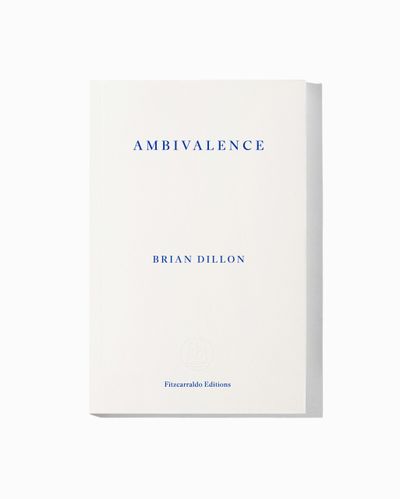
Ambivalence
French paperback with flaps, 172 pages | Audiobook read by Brian Dillon
Published 7 May 2026
Ambivalence
1986/1987
¶ A boy stands at the crossroads, considers his limited options. In one direction, whose topography looks arduous but dully familiar, lie the determinations expected of him: to face the realities of learning and working and making his way in the world—which is to say, acquiescing to the world, its conventions dressed as opportunities and responsibilities. Duty, his father likes to say about everything from homework to mass-going to getting yourself a secure job to obeying the commands of an exhausted, scared and sarcastic father. Is that all? Are there no larger duties, such as his father might once have felt? On the other side, in B’s mind, there is the flight from facts at hand, which he has been pursuing now for years, mostly alone. One day at school he approached two of his friends and asked what they were talking about. What’s it to you, Dillon? All you care about is what’s in the ‘hit parade’. It is not exactly true: a lot of the music he loves will never make it into the charts. He cares also about the magazines in which he reads about new music; certain music critics there, whose pronouncements he carries around in his heart like prayers; the writers and books he first came across in the pages of those same magazines, or in the lyrics and interviews of David Bowie, with whom he used to be obsessed. (Primal scene of this fixation: he is about twelve years old, and a boy behind him in class prods him in the back and points to a large Bowie badge on his jumper. Is that a man or a woman? He simply cannot say. Exactly, it’s David Bowie.) To say he cares means he cannot, when he is not longing for love, stop thinking about these subjects from one end of the day to the other.
He cares, but what does he know? He has grown up, as they say, in a house full of books. Aside from a year or so in his early teens when, under the influence of boys at school, he bluntly refused to pick up anything more demanding than ‘novels’ spun off from the TV series Grange Hill, he has never stopped reading. At seven or eight he loved Enid Blyton’s Five Find-Outers and Secret Seven series, which turned him into a child detective, equipped with notebook and binoculars, pushing through bushes at the end of the garden, in search of clues to unknown crimes. A little later, the prep-school adventures of the reckless Jennings and his myopic friend Darbishire—here (unlike the Blyton books) the author, Anthony Buckeridge, was irrelevant. There were the west-of-Ireland novels—The Lost Island and The Island of Horses—of Eilís Dillon, who came from Galway like his grandfather, and whom he thought must be distantly related (no evidence). When he was ten or eleven he read The Scarlet Pimpernel by Baroness Orczy; afterwards he copied out in red ink a line drawing of the little red flower from which the hero took his nom de guerre, then stuck this picture on a tiny golden badge he’d got from a bubblegum machine—secret insignia, never worn in public. Dickens, Defoe, Stevenson: he read these at his father’s suggestion, but around the age of twelve his literary imagination collided with his taste in television, and he was gripped by science fiction and fantasy. On the day of his Confirmation, offered the rare treat of a trip to the cinema, he insisted, because he had read the novel by Arthur C. Clarke, that the whole family sit mystified through a revived screening of 2001: A Space Odyssey. Less dizzying, less portentous: the adventures of a grifter and thief in Harry Harrison’s wry pulpy novels.
In the five years since, he has gone from The Stainless Steel Rat to The Psychopathology of Everyday Life. From The Sands of Mars to Subculture: The Meaning of Style. In the realm of ideas, he knows the barest facts about existentialism, gleaned from a Pelican paperback in the mahogany bookcase his father has had built into a corner of the infrequently used dining room. He has read quite random pages by Ernest Jones on psychoanalysis, and some passages from Freud himself. Somewhat misunderstood: concepts of self-fashioning and situation, the second of which he has confused with something else, called Situationism. He has not read his father’s slim blue copy of The Communist Manifesto, but he has read ‘The Soul of Man Under Socialism’ by Oscar Wilde and a lot of his maxims on art and life. He believes, consequently, in style as its own kind of revolution. He knows a little about semiotics, enough to believe that the science of signs, with its attention to the surface of things, shares something with his own commitment to style. But his reading in this field has taught him to think about desire and pleasure—he knows the French word jouissance, but not its ordinary usage—as a kind of dissolution and surrender, so far solitary, so far discovered mainly in the texture of, and the talk around, music and books and movies he loves.
(…)
‘The book is a page-by-page pleasure…. So strong is [Dillon’s] passion for his way of finding himself in the world, so dedicated is he to be true to his idols, that we long for him to make it. And this book is proof that he did.’
— John Self, Financial Times
‘I still believe that the songs or books we love contain blueprints for how we hope to live, and Dillon’s memoir embodies how these personal canons inflect the way we understand and express ourselves…. Ambivalence is a story of solitude, patience and faith – qualities that contemporary culture seems to militate against.’
— Hua Hsu, New Yorker
‘Brian Dillon’s fascinating bildungsroman Ambivalence tells the story of a mind making itself up, hanging, deleting, willfully transforming itself. Every book every friendship, every conversation mark our anti-hero B, who feels compelled to create himself, while the eponymous title assures me he is aware of failure, the frailties of the intellectual life, and how knowing is also always unknowing and unlearning. His resistance, disillusions and embraces create a completely engaging world in which grows an amazing virtual library of necessary readings and investigations. This reader trusts people who doubt themselves and their ideas, and Ambivalence honours a productive and essential trust between writer and reader. This is an exceptional work.’
— Lynne Tillman, author of Weird Fucks
‘Brian Dillon is a stimulating intellectual companion, quietly heroic in his determination “to pursue a life in words and ideas.”’
— Blake Morrison, Guardian
‘What emerges [in Ambivalence] is a defence of ambivalence itself, understood as a refusal of fixed meanings and inherited certainties. Dillon’s memoir suggests that to read deeply is to change oneself, and that such change is both personal and, potentially, political…. Ambivalence ultimately makes a compelling case for the intellectual life as a lived practice, one that takes seriously the possibility that thinking and reading might alter not only how one understands the world, but how one lives in it.’
— Luke O’Reilly, New Statesman
‘Dillon is capable of supreme linguistic precision…. By the end, despite considerable personal tragedy, he has accessed an open-minded way of thinking through books that, in their complex variety, carry “the promise of promise itself”. This is a surprisingly hopeful book.’
— Sarah Moorhouse, Spectator
‘Renowned for his elegant excavations of the units which compose contemporary literary culture such as the essay, the image and the sentence, in his newest work Dillon forays into less discrete and indeed potentially “ambivalent” terrain: the story of an education…. To be ambivalent is to resist making up one’s mind, and to waver between fixed positions, yet Dillon here makes it an intimate art form.’
— Alice Blackhurst, Irish Times
‘This is a brilliant book, which I couldn’t put down. It tells the story of an education that reads like the evocation of an entirely dead world of philosophy, theory and letters in the late 1980s and 90s. It works because of its steadfast refusal of sentimentality. Dillon writes about himself as if he were someone else, someone not in any way clearly visible. Just feint lines on a page. Yet somehow, in its impersonality and distancing, Dillon conjures an intimacy, a compelling and genuinely shaking pathos rather than sham authenticity. Dillon, asks, “Does education still keep its promises?” On the evidence of the prose of this book, it does. And for us, as confusing as one’s intellectual formation always looks in retrospect, it must.’
— Simon Critchley, author of On Mysticism
‘Brian Dillon is one of the true treasures of contemporary literature – a critic and essayist of unmatched style, sensitivity and purpose.’
— Mark O’Connell, author of A Thread of Violence
‘Brian Dillon is always invigoratingly brilliant. His sentences, his stylistic innovations, the range and potency of his intellectual adventures; he is a true master of the literary arts and a writer I would never hesitate to read, whatever his subject.’
— Max Porter, author of Shy
‘Brian Dillon’s essays match discernment and critical thinking with a sense of pleasure in finding a work of art that speaks to him and lures him into contemplating its mystery and intricacy. His writing is exact and calm; rather than explain he explores, playing what is tentative against what is certain.’
— Colm Tóibín, author of The Magician
Brian Dillon was born in Dublin in 1969. His books include Ambivalence, Affinities, Essayism, The Great Explosion (shortlisted for the Ondaatje Prize), Objects in This Mirror: Essays, I Am Sitting in a Room, Sanctuary, Tormented Hope: Nine Hypochondriac Lives (shortlisted for the Wellcome Book Prize) and In the Dark Room, which won the Irish Book Award for non-fiction. His writing has appeared in the Guardian, New York Times, London Review of Books, the New Yorker, New York Review of Books, frieze and Artforum. He has curated exhibitions for Tate and Hayward galleries. He lives in London.


