What can a scrap of embroidery tell us about how to live? How can the past help us imagine unconstrained lives when not all traces remain? To explore these questions, Alice Hattrick turns to the embroidery designer May Morris and her circle, including her father William Morris; her mother Jane, an artist’s model and embroiderer herself; and MF, May’s gender non-conforming partner of twenty years. Through this queer encounter with the Arts and Crafts movement, Hattrick shifts attention from dominant narratives of design towards intimacy, labour and domestic life. Looking to May – alongside others who have found in textiles a means of resistance – Hattrick traces connections between these histories and their own queer identity, family ties and precarious working conditions within an ableist society. Expansive in thought, form and time, Fancy Work stitches together archival fragments, domestic spaces and ongoing sites of struggle, insisting on the political force of often overlooked acts of defiance.
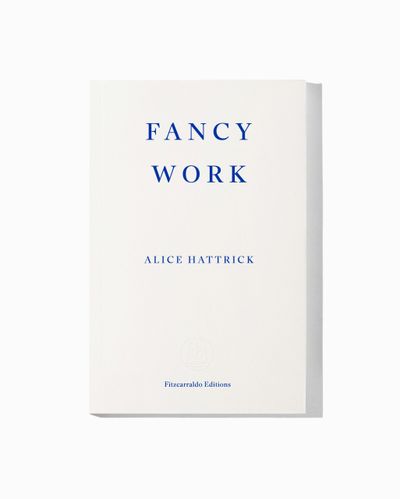
Fancy Work: Unpicking Past Lives
French paperback with flaps, 320 pages
Published 18 June 2026
Fancy Work: Unpicking Past Lives
¶ Unknown Needleworker
To transfer an embroidery design onto linen before stitching, the Unknown Needleworker first pricks into paper with a sharp needle-like tool, following the pattern they have drawn. They pin the paper to the fabric and apply a charcoal ‘pounce’ to make a dotted line underneath, just as painters do when transferring drawings to canvas, a technique known as prick and pounce. They shake the white powder off and draw over the design, now transferred to the fabric, which will eventually be completely obscured by red and green silks, and gold and silver threads. Only then does the unknown needleworker stretch the fabric onto the frame, thread their needle, and begin to stitch.
They outline the forms with split-stitch, in which the needle pierces the thread of the preceding stitch, creating a fine line. For thicker lines, they use chain-stitch, where the needle returns to the loop made by the previous stitch, piercing and tacking the ground inside the loop, and emerges a stitch ahead, the thread wrapped under the needle, which is then pulled through to make a new loop. They are also expert in underside couching, securing silver or gold thread to ground fabric with a second thread, pulling it in tiny loops through to the back of the fabric so that they are barely perceptible from the front. They then fill in the forms with split-stitch or a tiny form of stem-stitch, sculpting the flesh of a figure – cheekbone, forehead, nose, ball of the throat – with two colours of thread. Split-stitch is ideal for expressing emotion and for capturing the spirit of a scene in a biblical story. For the vestment they are working on, a type of ceremonial cloak worn in church services and processions known as a cope – the most significant commission they will ever contribute to – the Unknown Needleworker must make the stitches in tightly expanding circular spirals with the most inconceivable minuteness. Finally, they use gilded silver thread, made by wrapping fine strips cut from wafer-thin sheets of silver around a silk core, to pick out details on the figures and contrasting silver on the body of the crucified Christ.
They are working on a single figure, one of many, which will be appliquéd to a large piece of linen, and then stitched all over in underside couching. For this type of stitch, they need two threads, one laid onto the front of the piece and another to fix it. First the thread that will be seen from the front of the piece – usually metal, silver or gold – is laid onto the fabric. A second thread, usually in strong linen, fixes the thread from the underside. The needle is first pushed through to the front and over the laid thread. When inserted back into the same hole in the fa–
bric and pulled taught, the linen thread pulls the silk through to the back. Here, very unusually, on the instruction of cope’s commissioner, the laid thread is silk.
Nothing they make will ever be more important than this embroidery. Their stitches will bestow meaning on the wearer of the cope, not just because it depicts the Life of the Virgin, the Passion of Christ and the figures of the Apostles, including Saint Michael overcoming Satan
and Saint Thomas in his incredulity, with winged seraphs and angels and kneeling clerics, possibly representing the priests for whom the vestment is made, the figures radiating out so that they appear to be standing within the folds of the cope when worn around the body, but because the inconceivable labour of its making glorifies the church itself. Their labour creates meaning. Embroidery – not the embroiderer, it should be said – is so significant to the church and noble class that in fifteen years’ time, a law will be passed forbidding all persons below the rank of knighthood or with a yearly income of less than £200 from wearing the embroidered garments they produce.
The Unknown Needleworker works by day or candle-
light. They often work at home when the object is small and therefore easier to keep clean. They also sew linens for the house. When they’re working on a large commission like this – a vestment made with incredibly expensive materials, the metallic thread imported from Italy and Cyprus – they embroider in the workshop under the watchful eye of the (almost definitely male) workshop manager. With each new loop, they think about the embroiderer who taught them how to stitch during their seven-year apprenticeship, and all the people they have taught themselves and are yet to teach. They think about the children who were not born, and the children who might still be born, and the Bridgettine nuns who will smuggle the vestment out of England so that it is not burned during the Reformation in 200 years’ time.
Their body knows the stitches, but they also have full knowledge of the materials and tools they use. They understand the value of lines and masses, having been called upon to think and create their own work and interpret someone else’s designs. Some of their fellow embroiderers will be named and remembered well into the future – Christina of Enfield, Catherine of Lincoln, Maud of Canterbury – but as time goes on, they will have less and less of a place in the historical records of embroidery, and embroidery less of a place in the Arts. Each Unknown Embroiderer is an invisible stitch, barely perceptible to history. The work they produce will teach others in the future how to make unified and coherent works of their own. They are part of a webbed storehouse of body-memory, extending through countless generations, with each embroiderer going back to past work for reference. At times, their knowledge will seem lost to history, but future embroiderers, named and unknown, will unpick their stitches to learn how it was done.
(…)
‘This illuminating, expansive and intricately connected book on embroidery made me giddy with the ideas and knowledge it reveals. In detailing so diligently the histories, practices and techniques of needlework, insights into craft as a whole open up. Fancy Work shows how fluency in non-linguistic forms enriches language, sharpens political thought and articulates some of the most radical ways of living.’
— Holly Pester, author of The Lodgers
‘There are so many layers to this book; every page left my mind brimming with detail, colour and affection. Fancy Work somehow contains multitudes while remaining clear, intimate and curiously joyful. I knew at once it was a book I would treasure and return to.’
— Sara Baume, author of Seven Steeples
‘I loved this book. Alice Hattrick writes with luminous beauty about textile craft as a mode of resistance, and about the radically creative lives of artist May Morris and her partner MF. Fancy Work presents a fascinating history of stitchwork as an embodied practice, from Gee’s Bend quilts stained with menstrual blood to the meticulous embroidery of nineteenth-century lunatic patients. This is a book about patience, repetition and generative unproductivity – about the human desire to make things and the loss inherent in all textiles. It is curious, smart, fierce and tender; I will be thinking about it for a long time.’
— Maddie Ballard, author of Bound
‘The quaint stereotypes that surround embroidery cannot survive after this. Alice Hattrick’s intervention is not just a history of maligned “craft”, but a study into the imperialistic and misogynistic forces that have caused and perpetuated that derision. Fabric, it turns out, is infused with life. It is an overlooked witness to and participant in our collective story. You will be hooked.’
— Nathalie Olah, author of Bad Taste
‘Fancy Work is a queer stitching of time — a reclamation of living, of historical losses, of queer temporalities. But more than anything it is permission: to rework, to backstitch our own fancy work, to realize we are made of scraps.’
— Tash Walker, Bittersweet Review
Praise for Ill Feelings:
‘Ill Feelings is a deeply personal and deeply political reckoning with the nature of illness, inheritance, time, silence, bodies and invisibility. Alice Hattrick offers both a radical redefinition of the dominant narratives surrounding health and pain, and the knowledge we need in order to name, understand and resist them. Hattrick has found a voice and form which open up new and exciting possibilities for writing the self and making sense of the collective past: I read this remarkable book with outrage, fascination and immense admiration.’
— Francesca Wade, author of Gertrude Stein: An Afterlife
‘I love the quality of attentiveness that Alice Hattrick brings to their poised and pointillistic exploration of the mysterious aetiologies and affects of chronic fatigue. They excel in listening out for echoes and whispers, their narrative of illness wriggling into uncomfortable places that medicine dismisses or ignores. Their book makes you pause to think – and rethink – page by page.’
— Marina Benjamin, author of Insomnia
‘Ill Feelings defies neat conclusions as well as easy categorization of the book itself, so that attempting to describe it here seems like misdiagnosis, and to try and name the paradox at its heart seems like a betrayal of its rewards. But the thrill of Alice Hattrick’s writing stems from its struggle to be free of its constraints, communicating with unspooling fury the mutability of lived experience rather than presuming to define it. In doing so, they remind us that the undefined – our own ill feelings – reveals not weakness so much as our inherent capacity for resistance.’
— Olivia Sudjic, author of Exposure
‘I read Ill Feelings with a sense of wonder at the courage required not just to live with a medically unexplained illness, but to write about it with such descriptive clarity and probing intelligence. Alice Hattrick’s book is a powerful cure for ignorance or indifference about a complex form of suffering.’
— Edmund Gordon, author of The Invention of Angela Carter
‘Ill Feelings is a necessary, urgent book that I feel I have been waiting my whole life to read. A beautiful combination of memoir, reportage and razor-sharp analysis, it made me think very deeply and critically and feel powerfully understood all at once – a testament to what truly accomplished non-fiction writers can achieve. This book makes me excited for the future of literary non-fiction writing and its power to change the world and how we see it.’
— Lucia Osborne-Crowley, author of The Lasting Harm
‘Hattrick’s ability to reflect life with ME in form and language is complex and brilliant. The structure of Ill Feelings appears initially as haphazard, perhaps, but the more you read, the more it clarifies: this is not a book of simple narrative, of gradual progression.’
— Connor Harrison, Review 31
‘Ill Feelings belongs on the shelf with Susan Sontag’s Illness as Metaphor, Ben Watt’s Patient, Anne Boyer’s The Undying and Jenn Ashworth’s Notes Made While Falling, because, quite simply, it’s that good.’
— Steven Long, The Crack Magazine
‘Ill Feelings offers spellbinding reality unlike anything I have ever read. It conquers the sense of grief that we have to learn to live with; this deep guttural fear in humanity is addressed compassionately.’
— Billie Ingram-Sofokleous, Buzz Magazine
Alice Hattrick is a writer and lecturer based in London. Ill Feelings, their non-fiction book on chronic illness, intimacy and mother-daughter relationships, was published by Fitzcarraldo Editions in 2021. Alice’s criticism has been published in Art Review, frieze, The White Review and TANK, among other publications. They are the co-producer of Access Docs for Artists, made in collaboration with Leah Clements and the late Lizzy Rose, and teach at University of the Arts, London.


