Rose and Solange are lifelong friends, growing up together in the Basque region of France in the 1980s. Their paths are intertwined, yet they enter adulthood on radically different footing: Rose, who prizes stability above all else, moves to Bordeaux to study psychology and remains committed to her childhood sweetheart, Christian; rebellious Solange shakes off her old connections and moves from Bordeaux to Paris to London in pursuit of a life on the stage. In How to Make a Woman, we follow the young women’s experiences of adolescence, love, sex, work and motherhood, as they negotiate their places in the world and find their own versions of fulfilment. Written with humour and heart, Marie Darrieussecq’s latest novel is an electrifying, sometimes brutal portrait of female friendship and of two identities under construction, by ‘one of the most original voices in contemporary French literature’ (Times Literary Supplement).
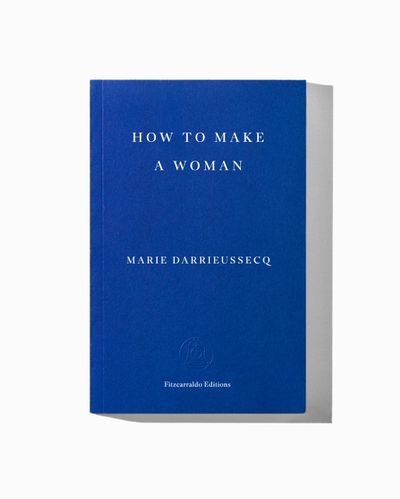
How to Make a Woman
Translated by Penny Hueston
French paperback with flaps, 256 pages | Audiobook read by Tamsin Joanna Kennard
Published 13 August 2026
How to Make a Woman
Translated by Penny Hueston
I.
ACCORDING TO ROSE
She types the name into the search bar and finds gossip, photos. Solange is holding the hand of a good-looking guy, blue sky, palm trees, he’s evidently not a star, isn’t even named in the caption, biceps tight in his T-shirt. Solange is drinking out of a straw in a huge goblet. She’s gazing straight at the camera over the top of her black sunglasses. It looks as if they’re coming out of her place; behind the open gate the royal-blue water of a swimming pool is visible. The curve of her still youthful thighs is visible below her artfully frayed shorts, and her short-sleeved shirt knotted over her navel reveals a taut, golden abdomen beneath firm breasts, no doubt implants. Solange has that air of boredom and good health, like free-range poultry, happy to be paparazzied while digesting her drink.
It’s a French website. Browsing social media, Rose has noticed that, for the most part, Americans pay no attention to Solange. Nevertheless, Rose always finds herself transfixed by the metamorphosis of the village ugly duckling into this Hollywood babe.
It’s terrible, she’s a child, what a shame, what a shame. Maman can’t get over it. She’s worrying herself sick, so everyone else has to worry themselves sick.
Solange is going to have a baby!
Rose feels as if she’s paralyzed. All she can think of is a memory: the two of them, already best friends, playing with cushions under their jumpers, little girls prancing around pregnant. And Solange knew it came out from there, because she’d seen the neighbour’s dog give birth.
It must hurt a lot.
So who’s the father? The father of this baby – who is he?
Rose has decided who she’ll have children with, one day. With Christian, the boyfriend she’s had since primary school. She’s already chosen the names: Emma and Gabriel.
But fifteen is obviously far too early. Solange has really messed up, her parents are out to lunch, and as for who she hangs out with, I’m not sure… But the poor thing doesn’t deserve what’s happened to her.
Christian is good looking and intelligent, with a bit of Matt Dillon around the jawline. And he listens to David Bowie. Rose’s father calls him a Basque bum, but that’s just to annoy everyone. Christian is different, he’s a poet. Once she’s married to him, she’ll be Rose Goyenetche. Taking your partner’s name can be considered as a token of love. Except that guys don’t do it. And in Solange’s case, the baby will probably have her name, won’t it? Which is actually her father’s name. It’s ridiculous.
Love – what is it? Where do you feel it? In the heart? In the belly? In the head? Can you really die from love? Is it normal that she doesn’t feel love as a part of herself – the love she nevertheless feels for Christian?
She told him about Solange’s pregnancy. He was horrified. She told him about their girls’-day-out shopping trip and Solange in her changing room and Rose’s mother opening the curtain and that’s when everything spun out of control. Rose had never seen Solange in such a bad way, nor her mother, what a drama. And way too late for an abortion. Rose always tries her hardest to do everything right, but it’s as if Solange was always more interesting – it was Solange who became Maman’s project.
Papa was the one who had the idea of giving her a stroller. Maman bought a top-of-the-range model and they made Rose get all the girls’ friends to sign the card. At first it really annoyed her, but the more signatures she collected, the more she wanted – everyone in her class and even in Christian’s class. The complete set.
Rose can tell, by the sound of Christian’s voice, exactly how much he loves her.
‘But I always love you the same,’ he protests.
‘I don’t believe that’s possible,’ says Rose. ‘There are always ups and downs when you love someone.’
‘When you broke up with me in secondary school, I was completely lost. I was like your shadow, I was like the missing half in Plato’s story.’
‘I broke up with you because you were hitting on Nathalie.’
‘No way. She was hitting on me.’
‘You told Boursenave and Bidegarraï she was a virgin and that was the only reason she wouldn’t sleep with you.’
‘What? Did I say that?’
They’re standing in the lobby of the college, their usual spot – the others call it their ‘burrow’.
‘If you loved me like I love you, you’d hear my voice in your head.’
‘You don’t really hear me.’
‘I can hear you, for real. I’m telepathic when it comes to love. But not if you don’t love me enough.’
Speaking about their love is like the high point of their love. Christian is not the same as all the other losers – Bidegarraï, for example – who only think with their dicks. (She and Solange don’t talk about their friendship because Solange is not meta enough.)
Of course, Christian wants to do it. So does she, when she’s ready. Christian understands completely. It’ll be the first time for him too. He’s frightened of hurting her. They both love talking about it. (…)
‘Darrieussecq is one of the most prolific and distinguished living writers in France with a truly impressive body of work.’
— Samantha Harvey, Guardian
‘In sharp-sighted prose, seamlessly translated, each section charts the same events from changing perspectives. As much attention is paid to minor details as to the bigger picture: a ceramic bird, a stolen pair of Doc Martens. How to Make a Woman is a glorious exploration of the transient identities of youth and the complicated nature of friendship; the condition of loving and loathing a person both at once.’
— Sara Baume, Irish Times
‘Fans of Annie Ernaux’s books and Eric Rohmer’s films will enjoy Darrieussecq’s ability to sketch a microscopic view of a macroscopic life…. [How to Make a Woman] is a fascinating exploration of a friendship that is constantly in limbo.’
— Oonagh Devitt Tremblay, Financial Times
‘[O]ne of the most original novels I’ve read. Its heroines charmed me: Darrieussecq writes about them with real affection, and no judgment…. How to Make a Woman is a novel about becoming, and, as the de Beauvoir-ish title implies, the way an accumulation of experiences shapes you.’
— Lucy Thynne, Daily Telegraph
‘Darrieussecq has delivered an excoriating feminist work, as raw and sensitive as sunburn on the skin.’
— Catherine Taylor, Observer
‘[A] thrillingly alive depiction of sex, love and the perpetually unfinished business of selfhood.’
— Claire Allfree, Daily Mail
‘This may seem like a familiar story, the kind of double bildungsroman told by Elena Ferrante in her Neapolitan Quartet. But Darrieussecq adds some fascinating twists…. [A] glittering and moving novel.’
— Sagar Castleman, Literary Review
‘Susan Sontag once wrote: “To be a woman is to be an actress. Being feminine is a kind of theatre”. In How to Make a Woman Marie Darrieussecq explores this proposition, pulling back the curtain on the charades of femininity with clarity and empathy.’
— Alice Blackhurst, Times Literary Supplement
‘Visceral and cerebral, with echoes of Simone de Beauvoir, it describes what it means to live in a world apparently created by and for men.’
— Lee Langley, Spectator
‘[T]ender and biting… Written in a riveting double narrative, the story follows the women through Bordeaux, Paris, London, and Hollywood as they come apart and together, bringing to mind both Simone de Beauvoir and Elena Ferrante.’
— Sophia June, Marie Claire
‘I found it funny, shocking, energizing, occasionally brutal and at times almost uncomfortably relatable. Darrieussecq captures the chaos of being a woman without trying to explain it away…. A brilliant, exhilarating read.’
— Amy Ford, Buzz Magazine
‘A lucid, clear-eyed and strangely comforting novel about the paths two friends take away from each other. Rose and Solange are like bright stars burning in the night sky.’
— Amina Cain, author of Indelicacy
‘I read this novel fast, I love how it moves swiftly through a decade of life. It made me think about time and how we spend it, about being a girl, and about the different ways two people experience the same moment. It also has the truest childbirth scene I’ve ever read, and a glimpse of Prince.’
— Daisy Hildyard, author of Emergency
‘Marie Darrieussecq courses through dark places with such buoyant energy that you emerge exhilarated.’
— Helen Garner, author of Monkey Grip
‘How to Make a Woman is so addictive that the temptation to read it in one sitting is strong, though slow readers might be even more rewarded. Would you risk missing how gracefully Marie Darrieussecq embeds Solange’s and Rose’s personal narratives into the transformations of French society at the turn of the twenty-first century ? How subtly she weaves together their shifting point of views? And how powerfully she questions the construction of masculinity and femininity in her era? How to Make a Woman is all at once intelligent, insightful, mischievous and tender.’
— Albertine
Marie Darrieussecq was born in Bayonne in 1969 and is recognized as one of the leading voices of contemporary French literature. Her first novel, Pig Tales, was translated into thirty-five languages. She has written more than twenty books. Text has published Tom Is Dead, All the Way, Men, Being Here: The Life of Paula Modersohn-Becker, Our Life in the Forest, The Baby and Crossed Lines. In 2013 Marie Darrieussecq was awarded the Prix Médicis and the Prix des Prix for her novel Men. She has written art criticism and journalism for a number of publications, including Libération and Charlie Hebdo, and is also a translator from English and has practised as a psychoanalyst. She lives in Paris.
Penny Hueston’s translations from French include novels by Emmanuelle Pagano (One Day I’ll Tell You Everything), Patrick Modiano (Little Jewel), Sarah Cohen-Scali (Max) and Raphaël Jerusalmy (Evacuation). She has translated eight books by Marie Darrieussecq: All the Way, Men, Being Here: The Life of Paula Modersohn-Becker, Our Life in the Forest, The Baby, Crossed Lines, Sleepless and How to Make a Woman. She has been shortlisted for the Wingate Prize and the Scott Moncrieff Prize, and twice for the New South Wales Premier’s Translation Prize. She was the winner of the 2020 Medal for Excellence in Translation.


