In 1933, Gertrude Stein published her groundbreaking memoir The Autobiography of Alice B. Toklas, which gained her instant celebrity. The following year she was invited to return to the United States for the first time since she left for France in 1903, to give a series of lectures on art and literature. Newly famous, Stein delivered her lectures, which double as a manifesto for her own, notoriously difficult work, to packed audiences at universities, galleries, members’ clubs and public spaces up and down the country. The lectures are vital and provocative works which articulate the legendary writer’s thoughts on the effect of modernism on literary form, the relationship between narrative and history, and between a writer, their work and its audience. In her trademark style she meditates on the creative possibilities of repetition, as well as her ambivalence toward her own literary fame and the destabilizing effect that notoriety had on her daily life. Listen to Me brings Stein’s sparklingly witty, illuminating lectures together in one volume for the first time, selected and introduced by her acclaimed biographer, Francesca Wade.
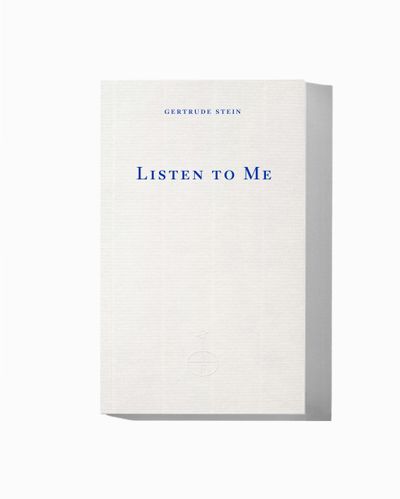
Listen to Me
Selected and introduced by Francesca Wade
Fitzcarraldo Classic No. 15 | French paperback with flaps, 328 pages
Published 5 November 2026
Listen to Me
Selected and introduced by Francesca Wade
Composition as Explanation
There is singularly nothing that makes a difference a difference in beginning and in the middle and in ending
except that each generation has something different at which they are all looking. By this I mean so simply that anybody knows it that composition is the difference which makes each and all of them then different from other generations and this is what makes everything different otherwise they are all alike and everybody knows it because everybody says it.
It is very likely that nearly every one has been very nearly certain that something that is interesting is interesting them. Can they and do they. It is very interesting that nothing inside in them, that is when you consider the very long history of how every one ever acted or has felt, it is very interesting that nothing inside in them in all of them makes it connectedly different. By this I mean this. The only thing that is different from one time to another is what is seen and what is seen depends upon how everybody is doing everything. This makes the thing we are looking at very different and this makes what those who describe it make of it, it makes a composition, it confuses, it shows, it is, it looks, it likes it as it is, and this makes what is seen as it is seen. Nothing changes from generation to generation except the thing seen and that makes a composition. Lord Grey remarked that when the generals before the war talked about the war they talked about it as a nineteenth-century war although to be fought with twentieth-century weapons. That is because war is a thing that decides how it is to be when it is to be done. It is prepared and to that degree it is like all academies it is not a thing made by being made it is a thing prepared. Writing and painting and all that, is like that, for those who occupy themselves with it and don’t make it as it is made. Now the few who make it as it is made, and it is to be remarked that the most decided of them usually are prepared just as the world around them is preparing, do it in this way and so I if you do not mind I will tell you how it happens. Naturally one does not know how it happened until it is well over beginning happening. (…)
‘This is the perfect Stein book for those who have been formed by Lectures in America since their first encounter, and for those who’d like to get acquainted with an inimitable and on the hoof presentation of the writer who changed twentieth century literature and beyond, plus a few other Stein gems. It’s all here in this exquisite little volume and I’m glad I don’t have to keep looking for any of it. Such a mind, what a feat, this is beautiful writing, thinking, being.’
— Eileen Myles, author of a “Working Life”
‘[E]very writer who lingers over Stein’s sentences is apt to feel a little stab of shame over the heedless predictability of his own.’
— Janet Malcolm, New Yorker
‘A treasure chest of pioneering, valuable, mind-expanding writing.’
— Deborah Levy, author of My Year in Paris with Gertrude Stein
‘There has rarely been a writer as pleasurable or charming as Stein.’
— Adam Thirlwell, London Review of Books
‘It’s high time Gertrude Stein’s wonderful essays and talks on composition and craft were widely read and appreciated. These works challenge us to slow down, pay attention, follow the iterations of Stein’s language – you never know where it’s going to go and that is one of its many joys. Gertrude has much to tell us! We should all be listening to Gertrude!’
— Lauren Elkin, author of Scaffolding
Gertrude Stein (1874–1946) is one of the original American Modernists. Born in Pennsylvania, she lived most of her life in Paris with her partner, Alice B. Toklas. Formally groundbreaking works like Three Lives (1909), Tender Buttons (1914) and The Making of Americans (1925) established her reputation as an avant-garde stylist, and The Autobiography of Alice B. Toklas made her an international celebrity. As an experimental writer she has been an inspiration to countless novelists and poets, from Ernest Hemingway and Edith Sitwell to Jack Kerouac and Robert Duncan.
Francesca Wade is the author of Square Haunting: Five Women, Freedom and London Between the Wars (2020) and Gertrude Stein: an Afterlife (2025). She has held fellowships at the Leon Levy Center for Biography, the Dorothy and Lewis B. Cullman Center for Scholars and Writers at the New York Public Library, and the Harvard Radcliffe Institute. Her writing has appeared in the New York Review of Books, London Review of Books, Paris Review, Granta and other outlets.
Francesca Wade is the author of Square Haunting: Five Women, Freedom and London Between the Wars (2020) and Gertrude Stein: an Afterlife (2025). She has held fellowships at the Leon Levy Center for Biography, the Dorothy and Lewis B. Cullman Center for Scholars and Writers at the New York Public Library, and the Harvard Radcliffe Institute. Her writing has appeared in the New York Review of Books, London Review of Books, Paris Review, Granta and other outlets.


