For the denizens of mythical Primeval, its fields and forests bounded by two rivers, the world beyond is nothing more than a dream. Yet their stories – or Times – are a microcosm of the tumultuous recent history of the world. The fortunes of the family of Michal the miller, whom conscription carries away in 1914, punctuate nearly a century of war and occupation. The outcast Cornspike raises her daughter among the creatures and spirits of the forest. The squire Popielski loses his faith and becomes obsessed with a game where progress is attained only by dreaming the right kind of dream. Non-human beings – trees and mushrooms and archangels – have their Times too, as do inanimate objects, which may be ‘more important for the world than people’. Alongside bloodshed and betrayal, the dramas of Primeval’s daily life mark the birth, life and decline of its little world and Time, making us consider afresh the stories that help us comprehend and navigate our own. Rich with the capaciousness and innovation that have brought Olga Tokarczuk to sustained international fame, Primeval and Other Times is an enduring masterpiece by one of Europe’s most inventive novelists.
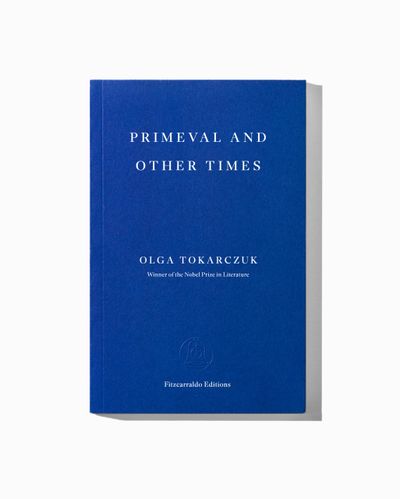
Primeval and Other Times
Translated by Antonia Lloyd-Jones
French paperback with flaps, 256 pages
Published 10 September 2026
Primeval and Other Times
Translated by Antonia Lloyd-Jones
THE TIME OF PRIMEVAL
Primeval is the place at the centre of the universe.
To walk at a brisk pace across Primeval from north to south would take an hour, and the same from east to west. And if someone wanted to go right round Primeval, at a slow pace, taking a careful, considered look at everything, it would take them a whole day, from morning to evening.
To the north the border of Primeval is the road from Taszów to Kielce, busy and dangerous, because it arouses
the anxiety of travel. The Archangel Raphael protects this border.
To the south the border is marked by the town of Jeszkotle, with its church, old people’s home and low-rise houses surrounding a muddy marketplace. The town presents a threat because it arouses the desire to possess and be possessed. The Archangel Gabriel guards Primeval on the town side.
From south to north, from Jeszkotle to the Kielce road, runs the Highway, with Primeval lying on either side of it.
On the western border of Primeval there are wet river-
side meadows, a bit of forest, and a manor house. Next to the manor house there’s a stud farm, where a single horse costs as much as the whole of Primeval. The horses
belong to the squire, and the meadows to the parish priest. The danger on the western border is of sinking into conceit. The Archangel Michael guards this border.
To the east the border of Primeval is the White River, which separates its territory from Taszów’s. Then the White River turns towards a mill, while the border runs on alone, through common land, between alder bushes. The danger on this side is foolishness, arising from a desire to be too clever. Here the Archangel Uriel guards the border.
At the centre of Primeval God has raised a large hill, onto which each summer the may-bugs swarm down, so people have named it Maybug Hill. For it is God’s business to create, and people’s business to name.
From the north-west the Black River runs south, joining the White River below the mill. The Black River is deep and dark. It flows through the forest, and the forest
reflects its shaggy face in it. Dry leaves sail along the Black River, and careless insects fight for life in its eddies. The Black River tangles with tree roots and washes away at the forest. Sometimes whirlpools form on its dark surface, for the river can be angry and unbridled. Every year in late spring it spills onto the priest’s meadows and basks there in the sunshine, letting the frogs multiply by the thousand. The priest battles with it all summer, and every year it benignly lets itself be sent back to its course towards the end of July.
The White River is shallow and sprightly. It spills down a wide channel in the sand and has nothing to hide. It is transparent and the sun is reflected in its limpid, sandy bottom. It looks like a great shining lizard. It swishes between the poplar trees, winding its way capriciously. It is hard to predict its capers. One year it might make an island out of a clump of alder trees, only to move far away from them for decades after. The White River flows through copses, meadows and common land. It shines sandy and gold.
Below the mill the rivers merge. First they flow close beside each other, undecided, overawed by their longed-for intimacy, and then they fall into each other and get lost in one another. The river that flows out of this melting pot by the mill is no longer either the White or the Black, but it is powerful and effortlessly drives the mill wheel that grinds the grain for bread.
Primeval lies on both the Black and White rivers and also on the third one, formed out of their mutual desire. The river arising from their confluence below the mill is called the River, and it flows on, calm and contented. (…)
‘The novel’s kaleidoscopic structure combines with its chronological sweep to create a portrait of a community that is at once epic and intimate, precise and universal. At times it has the feel of a dark fairy tale, with elements of magical realism and echoes of Hasidic folk legends; at others, we are unmistakably in the realm of historical reality. The “times” that cover the annihilation of Primeval’s Jews are stark and unsparing.’
— Rebecca Abrams, Financial Times
‘A constellation of eerie fables, focusing on the inhabitants of a single village, from a soothsayer to a coffee grinder…. If Tokarczuk’s work does have a single binding philosophy, it is one centred on all-encompassing empathy, and it therefore manifests in rich, authentic characters.’
— Sam Corbett, The Times
‘The specificity of the novel’s historical dimension and, ultimately, the characters’ inability to transcend it, is superseded by the Tokarczuk’s multidimensional, genre-defying and encyclopaedic vision…. Intimate portrayals of domesticity and labour, embellished with a wonderfully detailed, even taxonomic, approach to the materiality of rural life, are counterbalanced with universal themes related in a metaphysical register.’
— Tom Taylor, European Literature Network
‘A magnificent writer.’
— Svetlana Alexievich, 2015 Nobel Prize in Literature laureate
‘A writer on the level of W. G. Sebald.’
— Annie Proulx, author of The Shipping News
‘Olga Tokarczuk is inspired by maps and a perspective from above, which tends to make her microcosmos a mirror of macrocosmos. She constructs her novels in a tension between cultural opposites: nature versus culture, reason versus madness, male versus female, home versus alienation.’
— Nobel Committee for Literature
Olga Tokarczuk is the author of nine novels and three short story collections, and has been translated into more than fifty languages. Her novel Flights won the 2018 International Booker Prize, in Jennifer Croft’s translation. She is the recipient of the 2018 Nobel Prize in Literature.
Antonia Lloyd-Jones has translated works by many of Poland’s leading contemporary novelists and reportage authors, as well as crime fiction, poetry and children’s books. Her translation of Drive Your Plow Over the Bones of the Dead by 2018 Nobel Prize in Literature laureate Olga Tokarczuk was shortlisted for the 2019 International Booker Prize.


