
The Death of the Clinic: Radical Experiments in the Art of Medicine weaves together biography, memoir and cultural history in a groundbreaking exploration of five experimental clinics in recent Western history: a sex clinic housed in a stately mansion in Weimar Berlin; a preventive health centre in pre-NHS London; a post-war institute of psychiatry and medical philosophy in a French château; a feminist health centre born from the women’s liberation movement in Geneva; and a grassroots research initiative featuring clinical trials run by and for people with AIDS in 1980s–90s New York. Each of these clinics emerged in response to seismic political shifts and era-defining global events. Yet at their heart lie the stories of extraordinary individuals who dared to reimagine how we care for one another. At once deeply personal and sharply analytical, Benoît Loiseau’s investigation is anchored in his own encounters with medical care and in the quiet influence of one health worker who shaped his life: his mother. In moving and reflective interludes addressed to her, Loiseau illuminates the emotional and ethical stakes of medicine today. Reframing Michel Foucault’s seminal book, The Death of the Clinic is a radical invitation to rethink the clinic – not as a fixed institution but as a living, evolving practice rooted in care, resistance and collective imagination.
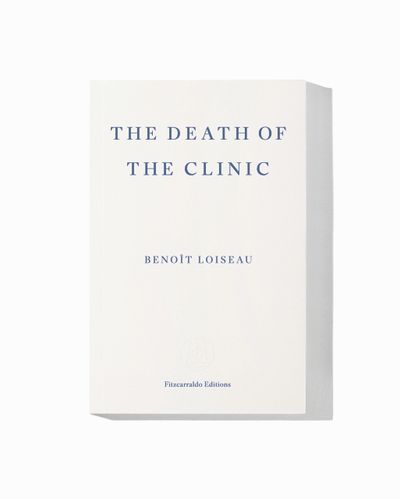
The Death of the Clinic
French paperback with flaps, 408 pages
Published 24 September 2026
The Death of the Clinic
This book explores such experiments through five clinics: the Institute for Sexual Sciences in Weimar Berlin; the Peckham Experiment in human biology of interwar London; the psychiatric clinic of La Borde in post-war France; Le Dispensaire des Femmes at the heart of Geneva’s women’s liberation movement; and the Community Research Initiative at the height of New York’s AIDS crisis. Much like yours, these clinics emerged from private initiatives on the margins, outside conventional hospital structures and against conservative orthodoxies. Despite their distinct contexts, they are bound by a shared political struggle for access and solidarity – by a commitment to an expansive vision of care that unsettles preconceived notions of health. I see a little bit of you in each one of them: in their protagonists’ political activism, their horizontal modes of being, their shared desire to bridge medicine and philosophy.
Together, these clinics outline a tradition rooted in resistance, pushing back against the dominant models of modern care that took shape in the West. As Foucault famously observed in The Birth of the Clinic (1963), it was towards the end of the eighteenth century that medicine underwent a profound transformation marked by centralization and isolation. In the wake of the French Revolution, the nationalization of medical knowledge, echoing the paradigm of the modern state, became associated with the eradication of disease. The war on illness required a defined territory, enveloping both the nation and the patient. Its weapon was the empiricism of the medical gaze, reducing bodies to specimens. Priests had been the guardians of the soul – now, doctors were the priests of bodies. Where they had once considered the patient as a whole, asking ‘What is wrong with you?’, in the nineteenth century, they asked: ‘Where does it hurt?’
Clinical medicine, of course, pre-dates the eighteenth century. The word ‘clinic’ refers to a relationship to the sick. It comes from the French clinique, which in turn derives from the Latin clīnicus (a bed-ridden person) and Ancient Greek klīnikós (pertaining to the bedside). In the fifth century B.C., Hippocrates and his followers defended the ‘art of medicine’, where ‘art’ (deriving from the Greek technē) referred to the creative and practical application of knowledge to craftsmanship. The art of medicine relied equally on skills and knowledge, which accrued through observation. Accordingly, the Hippocratics kept detailed notes of their clinical observations. They sampled their patients’ sweat and urine to describe their flavour, temperature, and texture: is it hot or cold, sweet or bitter, clear or cloudy? A diagnosis meant identifying an excess of one of the four humours – blood, phlegm, yellow bile or black bile – and a treatment aimed to restore the adequate balance between them. The art of medicine, they wrote, ‘is to do away with the sufferings of the sick, to lessen the violence of their diseases’.
By contrast, Galenic medicine – which dominated from the Roman era until the Renaissance – still followed humoral theory but favoured abstract reasoning, relegating clinical observation to a secondary role. ‘For he was grounded in astronomy,’ Chaucer says of the doctor in The Canterbury Tales. ‘He knew the best hours for the sick, / By the power of his natural magic.’ Stars, in the middles ages, had more to say about disease than our own bodies.
By the eighteenth century, metaphysical epistemology slowly gave way to empiricism, reviving ancient observational methods. Contrary to Hippocratic medicine, however, the modern clinic was organized as a body of knowledge, combining practical experience, analytical method and structured teaching. Indebted to imperial expansion and Linnaean taxonomy – grouping and naming living things hierarchically – the clinic would become a vehicle of classification. ‘Before being a meeting of patient and doctor, a truth to be deciphered and an ignorance,’ Foucault notes, ‘the clinic must form, constitutionally, a structured nosological field.’ The clinic was no longer merely about the care of the sick – about the methods and manners of the bedside – it became a site of knowledge that, through evidence and verifiability, gained authority and governing legitimacy. In other words, the clinic developed into a normative and regulatory power – one that speaks without naming itself – establishing its jurisdiction over the bodies and morals of the nation.
The nineteenth century was the golden age of the clinic: an age of great scientific discoveries and growing specialization. Thanks to such figures as the Scottish anatomist John Hunter, the tradition of the medieval barber-surgeon – once equally responsible for cutting hair, pulling teeth, and amputating limbs – gradually gave way to the highly trained surgical profession we know today. This transition required a steady supply of cadavers as training material. Death was in vogue and so were resurrectionists, snatching up bodies like there’s no tomorrow. Corpses were the coal of the clinical revolution: raw material to be mined, exploited and commodified.
Capitalizing on this development, the rise of pathological anatomy – the study of organs and tissues to determine the causes and effects of disease – forever changed the interplay between life and death. ‘Open up a few corpses,’ the French pathologist Xavier Bichat instructed his students in the early 1800s, ‘you will dissipate at once the darkness that observation alone could not dissipate.’ If the medical gaze had once merely scanned the surface of the body, looking for signs of disease like defects on a painting, it now penetrated the layers of death to uncover the knowledge of life. It is hardly a coincidence that one of the most popular novels of the time, Mary Shelley’s Frankenstein (1818), tells the story of a scientist who creates life by piecing together parts from dead bodies – a vitalist fantasy with a timely ethical dimension.
From the 1830s onwards, anatomy acts and other policies designed to regulate the use of human bodies were introduced to address shortages and curb body snatching. But other problems arose. Namely, the study of dead bodies was limiting, pushing many physiologists to turn to animals, more readily available and unburdened by ethical conventions. Vivisection offered the opportunity to observe living organisms in real time – to see blood pumping through the heart and muscles softening after nerves were severed. On his morning commute to the Collège de France, Claude Bernard – the father of experimental medicine – routinely picked up stray dogs for his laboratory experiments. On one occasion, he accidentally abducted the beloved pet of the local police superintendent, who did not appreciate having it returned in pieces. A hefty fine did little to deter Bernard – his curiosity was insatiable. So much so that his wife Fanny eventually left him after walking in on him dissecting the family dog on their kitchen table. (She went on to become a prominent animal rights activist.)
As the modern paradigm of the clinic took shape, so too did the role of the doctor as a state custodian of health and morality. ‘As a public and supervised activity,’ Foucault notes, ‘medicine would become a copy of the Church.’ It is telling that Dr Benassis, the protagonist of Balzac’s novel The Country Doctor (1833), hesitated between becoming a priest, a judge or a doctor: ‘the men of the black robe,’ he says – ‘The first heals the wounds of the soul, the second those of the purse, and the third those of the body. They represent the three principal elements necessary to the existence of society – conscience, property, and health.’ This alignment – upon which ‘the progress of civilization and the well-being of the masses depends’ – reflects the emergence of modern biopolitics: a form of power exercised not only through law, but through the regulation, management and optimization of life. (…)
‘The medical gaze is a form of political power, allowing doctors to circumscribe human beings until they become diagnosed, countable bodies. Benoît Loiseau’s engaging and reflective The Death of the Clinic investigates five twentieth-century western clinics that attempted to subvert this gaze through experiments in healthcare.’
— Gabrielle McClellan, Times Literary Supplement
‘Divergent and elaborate in the pursuit of its enthusiasms, balancing the personal and the intellectual, The Death of the Clinic is a book of hope and affirmation as well as of pain and grief. Loiseau interleaves a love letter to his mother with a rigorous and unorthodox history of five very different experiments in the art of care. He shows how the clinics we are obliged to use might be radically reimagined and made gentler, more humane, more equitable. He doesn’t shirk from scrutinizing a modern paradox: we need medicine to become more open-hearted, inclusive and holistic, while pushing back against the creeping medicalization of our lives.’
— Gavin Francis, author of The Unfragile Mind
‘Fifteen years ago, I called for The Death of the Clinic – a book that would ask what happens when the sick, the mad, the deviant, the unemployed and the undocumented take over the health system. Benoît Loiseau has written it: personal, rigorous, uncompromising. His political history of twentieth-century collective care is a landmark – and a future classic.’
— Paul B. Preciado, author of Dysphoria Mundi
‘Loiseau has crafted a profound book of personal and familial reflection and a rigorous historical analysis that reads like a page-turner. In a world where healthcare and the clinic remain a contested site of often invisibilized harm, Loiseau offers us a necessary path forward, if only we’re willing to take it. With urgent, personal, lyrical, and singular prose, this is a book of a generation with the potential to make, and remake, the world.’
— Joseph Osmundson, author of Spawning Season: An Experiment in Queer Parenthood
‘From the pre-war Institute for Sexual Sciences in Berlin to the Peckham Experiment in south London to the anti-psychiatric clinic at La Borde, Loiseau chronicles experiments in radical healthcare during the last century. Bringing together some of the most exemplary projects, The Death of the Clinic is an inspiring, essential book.’
— Chris Kraus, author of The Four Spent the Day Together
‘In The Death of the Clinic, Benoît Loiseau offers us a different way through twentieth-century queer and trans histories. Looking into the voids and absences of the archive, Loiseau finds buried treasure in the history of clinics. Naming them “radical experiments”, he turns away from the simple stories of experts and patients and finds sites of collaboration and care. This is a stunning book that juxtaposes fine-grained histories of medicine, anarchy, psychiatry and resistance.’
— Jack Halberstam, author of Anarchitecture After Everything: A Trans Manifesto
‘Intimate and erudite, breathtaking in its historical analysis and philosophical range, The Death of the Clinic illuminates bold experiments in non-hierarchical medicine, offering expansive possibilities for solidarity, self-determination and communal care.’
— Mattilda Bernstein Sycamore, author of Terry Dactyl
‘Benoît Loiseau’s eloquent and meticulously researched study of the clinic makes a pointed contribution, at once scholarly and personal, to deep thinking about what it means to give, receive or withhold care. A theory of “anarcho-organicism” grounded in mutualism and lived experience comes to the fore, making this study an urgent intervention into healthcare practice as well as a highly original historical examination of it.’
— Emily Apter, author of Unexceptional Politics: On Obstruction, Impasse, and the Impolitic
‘Benoît Loiseau has produced an extraordinary first book. Combining intellectual rigour with remarkable literary elegance, The Death of the Clinic offers a powerful rethinking of medicine through a constellation of forgotten experiments in care. By weaving together autobiography, philosophy, and political history, Loiseau succeeds in opening an entirely new perspective on the clinic as both an institution and a form of life. An original and deeply moving work.’
— Catherine Malabou, author of Stop Thief! Anarchism and Philosophy
Benoît Loiseau is a Belgian-born, Franco-British writer, critic and scholar based in Brooklyn and Paris. A founding editor of queer anthology The BitterSweet Review, he has written for ArtReview, frieze, the Guardian, the New York Times and The White Review. He read philosophy at the École Normale Supérieure (PSL) and is currently a postdoctoral fellow in French and Comparative Literature at New York University and Paris 8 University. This is his first book.


