
An archaeologist travels to a distant planet to spend time among a mysterious community, a people who live in temperature-controlled domes, worship a deity called Dog, and repeat an elliptical phrase from which they draw their name: mulai, the tree comes. The descendants of a long-forgotten space mission, the Mulai have abandoned the social norms that once bound them to Earth. Over centuries of isolation, their language has become more about change than stability, and the ways they eat, write, reproduce, bury their dead and understand gender have all transformed into something almost unrecognizable. As the archaeologist records his attempts to understand their world – a strange negative of our own – questions of translation, meaning-making and the ultimate precarity of civilization come to the fore. Drawing on Borges, Le Guin and Calvino, The Mulai is a mind-bending work of metafiction whose interlocking puzzles resound with Munir Hachemi’s singularly playful and eclectic style.
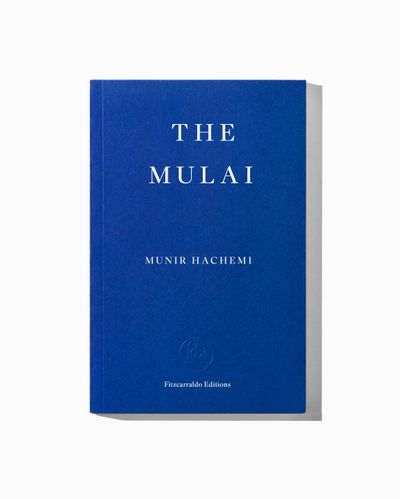
The Mulai
Translated by Julia Sanches
French paperback with flaps, 176 pages | Audiobook read by Jot Davies
Published 16 July 2026
The Mulai
Translated by Julia Sanches
I.
THE ARCHAEOLOGIST
Journal of Dr Cordovero’s second visit to the Mulai, circa the year 189
The future is over = the tree already came. The tree already came. The future is over. Future is over. What strange wordplay (all words are wordplay). Desert, the desert. I tried to teach Idri Spanish one time. She listened carefully. Idri, my Idri, where are you? Not in the desert. The desert erases everything, the desert is a verb, the verb erase. ‘You’re so silly,’ she said laughing, ‘that’s our language, Mulai!’ She was right. Though at the time I believed that she was wrong. I don’t know why. So silly.
Desert, deserter, deter, determine, uncertain, interned. In the desert of sounds, the wind blows… Words, dust that collects to form a sound, a letter. Idri, I mean Faida, where are you? If the desert only erases, then I am always retracing your steps, raining on water. The gaoshar once said: ‘Woman, archer, I need you.’ Where have I heard that before? It was now, tomorrow, in the desert. Flukeh, I mean Faida, are you there? Waiting for me? Mu, Sheipa? In his stories, the gaoshar used the words of the desert, of the future that already was. Faida, Faida, I mean Faida: I need you. (…)
‘The Mulai [is] Hachemi’s second short novel to be translated from Spanish to English by Julia Sanches, whose rendering of Hachemi’s prose always sounds alive and attuned to the nuances of the original … [I]t is both playful and hedonistic, and the work of a writer who takes an original approach to exploring the instability of language, identity and, in this extraplanetary experiment, what might lie beyond.’
— Max Liu, Financial Times
‘A meditation on the mutability of identity and language … wild, insightful and impressive.’
— Publishers Weekly
‘Hachemi is a skilled, imaginative and versatile writer, capable of shifting between academic vernacular and poeticism…. [W]hen the pieces fall into place, the results are gratifying.’
— Fonie Mitsopoulou, Literary Review
‘There are thoughtful and generative asides here – on etymology and morphology, on Chinese calligraphy, on AI, on humour, on shitting and pissing, on our underlying assumptions of sex as penetrative, on the notion of diaspora…. Hachemi frames reading, and writing, as a source of delight – an active, anxious and deeply transformative ritual of connection. It is a hopeful vision of what literature can look like.’
— Saba Ahmed, New Statesman
‘Munir Hachemi’s new work of speculative fiction manages to be many things all at once…. Much pleasure can be derived from reading between [the] gaps in years, voices and worlds, just as much hope can be derived from Hachemi’s construction of a new, imperfect but freer world.’
— Alex Howlett, Times Literary Supplement
‘Upending established notions of supremacy, truth and religion, this is a daring novel narrated in strange and twisting language. It is made up of bits of translated text, field notes, interviews and instances of human searching that are divided by generations. The revelations it proffers are life-giving. “Only when we encounter the other can we truly see ourselves” asserts The Mulai, a paradigm-shattering speculative novel set on a distant planet.’
— Michelle Schlinger, Foreword Reviews
‘In The Mulai, Munir Hachemi conjures a mythic future history with all the heartbreak, mystery and absurdity of truth. With cheeky brilliance (and with translator Julia Sanches as a hovering ghost-in-the-machine presence), Hachemi co-opts the tropes of ethnography and intergalactic colonialism to imagine a queer, eschatological Eden, where culture is story and story is an alchemical compost pile of language decomposed and recomposed.’
— Anne de Marcken, author of It Lasts Forever and Then It’s Over
‘A beguiling tale of Otherness that is not only a translation from another language but another planet, a story told so well that every familiar word feels as new as an alien horizon.’
— Anton Hur, author of Toward Eternity
‘Munir Hachemi has created an interplanetary cargo cult and I’m ready to sign up. This exuberant voyage through space and time destabilizes our understanding of human (and not-so-human) civilization and religion through endlessly inventive riffs on language, translation and intertextuality. Julia Sanches’ playful, acrobatic rendering is the perfect accompaniment to this wild ride.’
— Jeremy Tiang, author of State of Emergency
‘The Mulai is a fascinating exploration of the many languages, fears and desires that give rise to a culture – and to the very experience of what we call literature. Munir Hachemi writes with a fresh, original voice that calls to mind Saer, Borges, Calvino, and the finest speculative fiction.’
— Simón López Trujillo, author of Pedro the Vast
‘If Borges wrote hard science fiction, it might well look like this … You can almost feel the author grinning at you as you read, and I daresay you’ll end up grinning back by the end.’
— Drew Broussard, LitHub
Praise for Living Things:
‘[An] impetuous, upstart spirit infuses this short and spunky tale about young, would-be literary men who hit the road in search of adventure but find bleakness and exploitation…. Hachemi’s is the sort of writing that compulsively interrogates itself as writing, in which literary theorizing runs alongside the storytelling…. Hachemi’s documentary-style accounts of low-paid factory labour compellingly take us where most fiction writers would rather not go.’
— Rob Doyle, New York Times
‘Living Things turns out to be both highbrow and hair-raising (and exceptionally well translated by Julia Sanches). In only 120 pages it succeeds in several separate ways: as an eco-thriller exposing the horrors of industrialized meat production and agrochemicals; as a treatise on rendering truth in fiction; and, not least, as a “lads on tour” caper.’
— Miranda France, Times Literary Supplement
‘Living Things dips blithely in and out of genres and packs more ideas in its lean frame than seems possible. It’s a novel posing as a journal posing as a meditation on the function of the journal that playfully interrogates form and content in art, what it means to write, and what it means to care or not care about anything, or about everything. Munir Hachemi is a magician, and their marvellous book, deftly translated by Julia Sanches, defies adequate description.’
— James Greer, author of Bad Eminence
‘Startling, compulsive, and vibrant; Living Things reads like an ignition. The most honest thing I’ve read in a long time about being young and alive in a beautiful, horrible world.’
— Dizz Tate, author of Brutes
‘Heady, diaristic and compulsively readable in Julia Sanches’s perfect translation, four reckless and stubborn college students get themselves caught in the hell of factory farming in Southern France. To say that Living Things is a superb eco-thriller is both true and yet falls short of just how magnificently unclassifiable Hachemi’s novel is.’
— Jacob Rogers, The Center for Fiction
Munir Hachemi’s career as a writer began with them selling their stories in the form of fanzines in the bars of the Lavapiés neighbourhood of Madrid. They are the author of Living Things (2018) and The Mulai (2023), and are also a translator from Chinese and English. In 2021, they appeared on Granta’s Best of Young Spanish-Language Novelists list.
Julia Sanches is a literary translator working from Portuguese, Spanish and Catalan. Recent translations include Boulder by Eva Baltasar, shortlisted for the International Booker Prize 2023, and Undiscovered by Gabriela Wiener, longlisted for the same prize in 2024. Born in Brazil, she currently resides in the United States.


