
In Two Women, Jacqueline Rose fictionalizes and intertwines the lives of two remarkable figures whose stories trace the contours of the twentieth century: Edith Stein, the German-Jewish philosopher, Catholic convert and saint; and Gillian Rose, philosopher of German-Jewish thought, also a convert, and Jacqueline’s sister. Through a luminous weaving of fiction and history, Rose traces the parallels and distances between these women – their intellect, faith, suffering and courage – while also confronting the mysteries of love, loss and belonging that shape every human life. A deeply moving book, Two Women is at once an act of remembrance and a daring work of imagination by one of the most important feminist writers of our time.
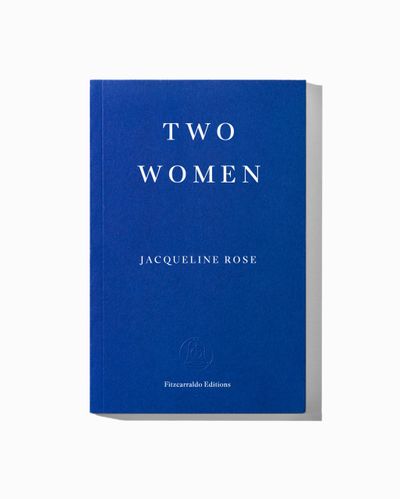
Two Women
French paperback with flaps, 332 pages
Published 5 November 2026
Two Women
Beginnings…
I have known my dear friend since our schooldays. Even if we have only intermittently been in touch since then, we matter to each other and have kept abreast of our most important life changes in so far as we could. When we said goodbye on our last day at school, we made one of those vows which you do not, or rather cannot, fully believe in, however seriously it is meant – that we would trust each other forever, come what may. So when, many years later, she came to me with her manuscript, I was not altogether surprised, though, as I turned the pages, I was genuinely taken aback by just how much of her life story I had surmised. Without her having to say a word, I knew that she was asking me to keep her sister, the distinguished philosopher, Rosa Edelblum, alive. When, not long afterwards, she brought me a second manuscript, this one written by that same sister, which told the life story of the famous German-Jewish philosopher and convert, Esther Felsenstein, I heard her warning cry. These women are unique beyond compare. They have their own tale of distinct creativity to tell the whole world if it chooses to listen. But their lives also recount a vaster story of the life and time in which they were caught, the destiny of Europe during and after its darkest hours, a story which, across the generations, they share. For some time now, I have slipped in and out of my attic, reading and rereading, picking out moments that rub against my heart, strip the flesh from my bone, like sticking plaster that peels away before the skin has healed. These moments give me succour while nourishing my deepest and most deadly fears. Here are the manuscripts.
I have allowed myself the liberty of interweaving the tales in order to bring the two of them close, or perhaps to show how close they already were. Above all else, please respect the gifts of Esther and Rosa, two women whose lives brush against each other time and time again in ways I would never have guessed, and whose extraordinary – and ordinary – stories have been placed, with such loving trust, in my care. (…)
‘I so admired it, in its depth and generosity of identification with these extraordinary women.’
— Rowan Williams
‘It’s really hard for me to overestimate how important [Rose’s] work has been for me… I don’t feel like that about very many writers.’
— Maggie Nelson
‘Jacqueline Rose has no peer among critics of her generation. The brilliance of her literary insight, the lucidity of her prose, and the subtlety of her analyses are simply breathtaking.’
— Edward W. Said
‘One of the most original and intellectually sophisticated minds at work today.’
— Eimear McBride
‘As a literary scholar and psychoanalytic thinker, Rose has long insisted that we pay close attention to the subterranean fears, fantasies, and narratives that structure our most pressing sociopolitical problems.’
— Merve Emre, The Nation
‘To read Rose is to understand that there is no border between us and the world; it is an invitation to a radical kind of responsibility.’
— Parul Sehgal, New York Times
Jacqueline Rose is internationally recognized as one of the most important living feminist and cultural critics. She is the co-director of the Birkbeck Institute for the Humanities, a co-founder of Independent Jewish Voices, and a fellow of the British Academy and of the Royal Literary Society. Rose is a frequent contributor to the London Review of Books and the Guardian, among many other publications. Her books include Sexuality in the Field of Vision, The Haunting of Sylvia Plath, States of Fantasy, Women in Dark Times, Mothers: An Essay on Love and Cruelty, On Violence and On Violence Against Women and The Plague.


