In 1967, shortly before Agustín Fernández Mallo was born, his father – a veterinarian from a village in León, and a firm believer in science and progress – travelled across the United States with the aim of bringing a herd of cows by plane to Galicia. Almost half a century later, Fernández Mallo makes his own journey through the American heartland, attempting to retrace his steps before his father loses his memory. Atom Heart Mother spans a century of Spanish history through a web of family stories and legends. A bracing intellectual elegy for a parent and for a world that is slowly slipping away, this chimerical work of historical reconstitution shows Agustín Fernández Mallo, one of the most ambitious and original Spanish-language authors, at his best and his most personal.
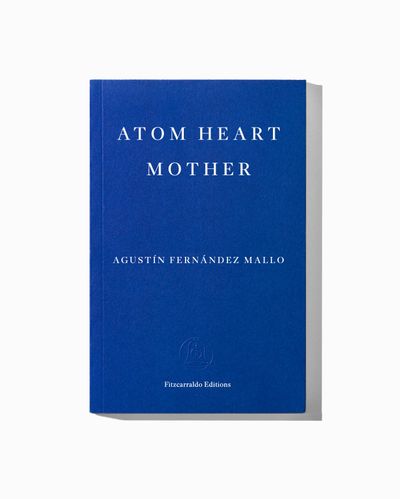
Atom Heart Mother
Translated by Thomas Bunstead
French paperback with flaps, 188 pages
Published 14 January 2027
Atom Heart Mother
Translated by Thomas Bunstead
BEFORE
An image comes to me: my father, still alive, says, ‘You can pick those blueberries, but go easy. They’re full of benzoic acid, even a wildcat like you could get sick.’
Today is 25 February 2024, and it’s twelve years to the day since my father died aged 87.
I worry this sounds like some kind of ship’s log, like the thoughts of an adventurer sailing waters that, no matter how extensively charted, they’ll always find strange, seas that culminate in a waterfall: life. As if I were speculating that the earth is flat. Sooner or later your mappa mundi runs out, and over the edge you go.
I could just as well have started with, ‘The years have died but nothing has happened to time,’ and that would be the truth because when someone dies, time pretends just to carry on like nothing’s changed.
Or else, ‘It might take some time to realize that people die in order to make themselves indispensable to the living.’ This too would be true. After twelve years of writing these pages I come to an unexpected and magnificent conclusion: death is a kind of resurrection, not an end but a starting point. The dead person will reappear, showing up in my life often and in a thousand different ways.
In any case, when you write about someone so close to you, you begin to question whether it’s someone else’s story at all, or whether you’re actually inside – an inseparable part of – their story, which is nonetheless unique and untransferable. There is a general rule, a kind of unwritten law, that one should never try to get back to former paradises. That way lies only disappointment. Paradises come into being with neither warning nor reason; they can’t be foreseen, they happen and that’s all. There is no science to paradise, nor to catastrophe either. Paradise and catastrophe are one and the same thing. The only science that exists, the only one worth thinking about, concerns the different sets and theatres we pass through. Every human begins and ends on a stage. We arrive on a stage that is the bare flesh of childbirth; we depart from one with flowers and an ornate tombstone as props.
I’ve come to La Coruña to see my mother. I’m sitting in my father’s old study, which still has his books and papers all around. We’ve got rid of a vast amount but there’s still a lot we need to sort through, something my sisters and I have been putting off; we know our mother will never get to it. Seeing a dead person’s things, everyday objects stripped of the specific value they assigned to them, produces the impression of a very precious, and yet useless, archaeological trove. I sit at his computer desk, a couple of feet away from his actual office desk. One desk for analogue and another for digital matters; worlds that, as so often with people of his generation, were never fully integrated. To the left of his former PC is the stack of printing paper he used for handwritten notes. One sheet is completely blank except for something printed at the bottom, so faint that I don’t notice it at first:
http://www.montevideo.com.uy/nottiempolibre_116072_1.html
In his later years, after we convinced him to retire – he was in his eighties when he finally acquiesced – the internet became a good pastime for him. We knew that when the time came to leave his job, he would replace his incessant professional activity with something else, anything else, as long as it insulated him from the process of personal and social desiccation that every brain undergoes in its final years. We encouraged him to use the internet. His character was typical of what we might generically call the twentieth-century human, with its unconditional faith in progress. Born on the cusp of the second-to-last monarchical regime, a child of Primo de Rivera’s dictatorship and the Second Spanish Republic and a teenager during the Civil War, he studied and began his veterinary career in the post-war period, a career that ended with twenty-first-century democracy in full swing – which is why, to him, progress was clearly our only route to technical and moral betterment. I suppose that’s why I was the first in my class to get a calculator. A huge, book-sized thing made by Texas Instruments. He brought it home one afternoon when I was about 7 years old. To my dismay – and his – I was forbidden from using it at school. I suppose this also explains the memory I have of him during those years, sitting in his study with a Grundig voice recorder – bought on one of his business trips abroad, and highly valued at the time in the liberal professions – dictating ideas about possible improvements for farms, or more effective treatments for certain animals. He would listen back to these voice notes and transcribe them on his typewriter. Even then, in those childhood years – when all is metamorphosis – it seemed to me that the voice on the playback didn’t belong to the same person who’d recorded it. A sonic transformation that in later years would prove significant. He brought home all manner of objects that nowadays, with the cynicism of hindsight, we might call pop technology, but were very much cutting edge at the time, their solid seriousness not yet swallowed up by commercial hype. When he found out about a domestic appliance called a microwave, he immediately went out and bought one; we still have it; it’s as big as a wardrobe, its four legs resting like a domestic animal, a four-legged pet, on the kitchen counter where it was first placed forty years ago. All the exercise it has ever needed is to spin around on itself, keeping warm inside while heating and tending to the family’s meals; yet more evidence – in this case of a technological kind – that nothing and no one can take care of others if they don’t first take care of themselves.
But he wasn’t interested in technology per se. He was no geek, blindly worshipping at the foot of techno-deities, but rather wanted to know what these innovations could offer in terms of specific goals – the common twentieth-century interest in progress I’ve referred to above. At the family dining table – the table in his study was too small for him and he was forever colonizing other surfaces in the apartment – he was constantly appraising all manner of measuring devices, from calipers to topographical plans and diagrams of industrial buildings, as well as consulting technical texts and journals on biological and veterinary sciences. Into a briefcase it would all disappear, and off to work he’d go, sometimes not coming back until after dark. In those years, the early 1970s, objects had a value and meaning very different from that which was soon to be imposed by mass consumption; there was a sense that they were endowed with a metaphysical aspect, that they’d been manufactured with a being inside them, a soul that accompanied them until they stopped working. Things didn’t get thrown away like they do today, but rather got patched up and put to use again like precious living beings. I see my father now in a cable-knit jumper my mother had made for him (he had an inexplicable liking for cable-knit jumpers); every night, after taking off his jacket and tie, he’d put it on for dinner. He always had an apple for dessert, which he would cut into four symmetrical pieces before peeling them. Each of those four portions he would eat in two mouthfuls, reducing the apple to those eight mouthfuls, to something countable. What cannot be counted, or what cannot be measured in some way, does not exist, seemed to be the suggestion; furthermore, it’s important to properly enumerate things, precisely in order that we may put them aside and allow ourselves to consider all that is not numerical, to access the dreamlike part in everything. Only as an adult did I understand that the huge array of materials he handled in his profession, as well as the range of tools he used in his work, did not correspond to ‘science’ in some homogeneous sense; rather, his particular approach was heterodox and highly personal, bringing together a multitude of different scientific branches. As William Carlos Williams once said:
There’s nothing sentimental about a machine, and: A poem is a small (or large) machine made out of words. When I say there’s nothing sentimental about a poem, I mean that there can be no part that is redundant… As in all machines, its movement is intrinsic, undulant, a physical more than a literary character.
I don’t intend any parallels here, and far less to foist biographical details on anyone, but I believe my father would very much have agreed with this sentiment. Once when he and I were alone, in the final stages of his illness, I read these lines to him; he said nothing in response, maybe he didn’t even hear; sometimes we speak to walls even though we know full well they’re nothing but stones. All his work materials, creative discoveries, professional successes and failures – there were those too – reflected a way of thinking in which technology and living organisms are of a piece: the dream of human and machine coupled. Then, later on, to the best of his elderly abilities, there was his participation in the technological utopia of the twenty-first century – the dissolving of humankind inside the internet. It is both bitter and a priceless life lesson to witness a mind expending the last of its strength in trying to understand something that properly belongs to a time that is not its own, while yourself being completely powerless to stop it; I witnessed a brain refusing to rest until complete exhaustion, even when it sees that the things it’s trying to grasp are of the future. Further confirmation of just how hard dying is – much harder, I’d say, than being born. Our lives are spent between two caves, that of the womb and that of the brain, and we never escape the latter. I believe that if he’d donated his organs to science, he would have asked that his brain not be included; I am the things I thought, I can imagine him saying. Two great impulses underpinned the last century – perhaps all centuries. The first is exemplified by a sentence attributed to Antonin Artaud: ‘I destroy myself to know that I am me and not all of you’; the second, inverting the first, would be: ‘I construct myself to know that I am me and not all of you.’ Clearly, my father was in the latter camp.
Nevertheless, the 2000s got off to a good start for him. He turned to the internet for one of his consuming passions at the time, which was the transformation of industrial and consumer waste into animal feed – what we would loosely term ‘recycling’. This interest had obvious personal and ecological motivations, but was based on something further – a kind of dream of extracting gold not from the soil but from the infra-soil that is the by-product of human activity. Early in the new millennium, his grandson, a physicist by profession and an environmental impact assessment specialist, learned of a system devised by scientists in Israel for recycling organic animal waste. My father had implemented just such a system on several livestock farms in years gone by. Despite his age, he was excited to get in touch with the researchers and offer his experience and knowledge. He was intensely interested in questions of animal and human nutrition, and in their evolution beyond a purely clinical or scientific setting; I remember all the time my father talked about Louis XIV coming up with the concept of the dining table. His predecessor, Louis XIII, had always eaten wherever he happened to find himself at midday; his servants would carry a table around the palace and set it up in any outdoor or indoor space, and there the king’s food would be served. But not Louis XIV. And this supposed shift from the moveable to the fixed place of eating, apart from my father finding it extremely funny, struck him as a fundamental evolutionary leap from a kind of ‘domestic nomadism’ to the stability required by all buildings intended for habitation. However, given his indefatigable work rhythm, he joked that he would have liked to be Louis XIII, with a table-carrying attendant following him around so he could sit down and eat wherever he happened to find himself when hunger struck. I feel like I’m hearing him now: the fact that the world is full of good ideas is now clear thanks to the internet, but an idea that isn’t put into practice is worthless, doesn’t properly exist. Indeed, there could be no faith in progress without its corresponding subsequent action; and herein lies the dialectical clash that forever connects humans with physical matter. I think this is why he never quite approved of my fondness for theoretical projects with no practical application whatsoever; for him these were mere diversions, a mock-up of reality in the same way that a doll’s house is just that, a home for inert beings rather than somewhere truly habitable. He also saw the novel as part of this useless theoretical limbo, a pastime for the unemployed bourgeoisie. When my writing started to become well known, he collected articles about me and interviews that appeared in the press. Unsurprisingly, he never attached much credit to my work as a novelist; on the other hand, he was very respectful of other genres such as the essay and poetry; in fact, he never congratulated me on any of my output as a novelist, and would only smile if I gave him a copy of one of my novels. His indifference towards my novels didn’t affect me in the slightest, which I took to be proof that I’d succeeded in freeing myself of the influence of the ‘father figure’; not only did I come to understand it, I ended up liking his detachment. He did, however, follow news about me online, including when I travelled abroad. Undoubtedly, the blank sheet of paper I referred to earlier, next to his desk PC with the web address at the bottom, was the result of a failed attempt to print one report or another that he’d seen in the Montevideo press, when I was on a promotional tour in Latin America in the summer of 2010. That was one of the most rewarding work trips I have ever been on. There, in Montevideo, a city that for some reason reminded me of Lisbon, I wrote and filmed a great deal of material that would serve me in later books. And yet the sheet on which he printed that web address, which is here in front of me now, is otherwise completely blank. I have been staring at it for several minutes, wondering if, by writing these lines, I am trying to fill that gap, that blank space. And I’ve also wondered if that blank space is really a disappearance, an allegory for what would happen a year after that trip to Montevideo: his loss of memory and, the following year, in February 2012, his subsequent death. I don’t know. Stupid questions. After the fact, things always take on whatever meaning we assign to them. Memory is literature or it’s nothing at all. Perhaps his views on the novel weren’t so far wrong after all.
If it’s true that all romantic relationships begin as something unreal, only to become real at a later point, then relationships with parents follow the exact opposite trajectory: from the moment we are born, the most empirical and fleshly reality systematically mutates into the realm of fantasy – that is, the idealization of our parents – whether this idealization be positive or negative.
(…)
‘There are certain writers whose work you turn to knowing you’ll find extraordinary things there. Borges is one of them, Bolaño another. Agustín Fernández Mallo has become one, too.’
— Chris Power, author of A Lonely Man
‘The most original and powerful author of his generation in Spain.’
— Mathias Enard, author of The Deserters
‘A profoundly personal novel that explores the enigma of family and memory with a philosopher’s eye. Illness, childhood, history, travel, all are seamlessly entwined into a moving requiem for the collective experience of grief. Atom Heart Mother is Mallo’s most impressive novel, emotional and humane, while still evocative of his earlier work.’
— Mark Haber, author of Lesser Ruins
‘A beguiling and deeply moving book. Fernández Mallo has the courage and intelligence to follow his curiosity anywhere, and the childlike faith that it will always lead him back to his father’s door.
— Adam Ehrlich Sachs, author of Gretel and the Great War
‘A book of tenderness and dread, a memorial that’s at the same time completely alive.’
— Sam Riviere, author of Doppelgänger
‘A tangled, tender meditation on memory and the limits of sense-making. Fernández Mallo gets to the heart of how grief can propel a search for comprehension. Who were our fathers and mothers? How might we unpick the knot that connects their lives to our own?’
— Thomas McMullan, author of Groundwater
‘A little masterpiece.’
— Berna González Harbour, El País
‘A mature book, written at the height of his powers – I would go so far as to say the best of his books.’
— J. M. Pozuelo Yvancos, ABC
‘Only Fernández Mallo, with his emotional irreverence and his intelligence, could write something this original and this dazzling about love and family.’
— Manuel Jabois, author of Malaherba
‘One of the best writers in Spanish, with an absolutely unique style and fictional world.’
— Jorge Carrión, New York Times in Spanish
‘A strange and original sensibility at work – one that combines a deep commitment to the possibilities of art with a gonzo spirit and a complete absence of pretention.’
— Christopher Beha, Harper’s
Agustín Fernández Mallo was born in La Coruña in 1967 and worked in hospitals as a radiation physicist. In 2000, he formulated a mode of literature that he theorized as ‘post-poetry’, which explores connections between art and science. His Nocilla Trilogy, published between 2006 and 2009, brought about an important shift in contemporary Spanish writing and paved the way for the birth of a new generation of authors, known as the ‘Nocilla Generation’. In 2018, his novel The Things We’ve Seen won the prestigious Biblioteca Breve Prize. In 2024, his novel The Book of All Loves won the Cercador Prize for best English-language translation. Atom Heart Mother is his sixth novel with Fitzcarraldo Editions.
Thomas Bunstead is a writer and translator of leading Spanish-language authors. Among other honours, he is a former Royal Literary Fellow and the recipient of the Cercador Prize, the McGinnis-Ritchie Award, an O. Henry Prize, and two PEN Translates Awards. He lives in Pembrokeshire, Wales.


