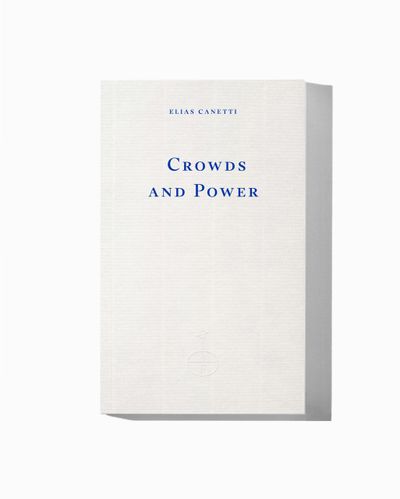
What is power, and what is the crowd? How do the two relate to each other? Crowds and Power is a striking and unclassifiable study of how human beings behave in groups and how collective forces shape history. Rejecting conventional sociology, 1981 Nobel Prize in Literature laureate Elias Canetti creates a unique framework that draws on anthropology, mythology, psychology, history, psychoanalysis and literature to explain why crowds form, how they act and what makes them so powerful. Drawing on his experiences in Vienna in the 1930s and a range of material spanning centuries and every continent, Canetti offers insights into the psychology of the crowd, the variety of religious experience, the paranoia of rulers and the pathology of power. A visionary and provocative book, Crowds and Power is a major work illuminating the forces driving mass movements and offers one of the most profound and startling portraits of the human condition ever written.
‘Marvellous … an immensely interesting, often profound reflection about the nature of society, in particular the nature of violence.’
— Susan Sontag
‘One of our great imaginers and solitary men of genius.’
— Iris Murdoch
‘Canetti led his life without compromise, fear, or guilt, and [reading him is] like discovering, without warning, a complex and satisfying work of art.’
— David Denby, New Yorker
‘Canetti invites – indeed, compels – judgement. His exacting presence honours literature.’
— George Steiner, New Yorker
‘The erudition is genuinely awe-inspiring.’
— Salman Rushdie
‘Before there was the mysterious W. G. Sebald, there was the even more mysterious Elias Canetti’
— Clive James, New York Times
‘[A] magisterial work by a polyhistor who knows how to reveal an overwhelmingly large number of viewpoints of men’s behaviour as mass beings.’
— Swedish Academy, Nobel Prize in Literature 1981


