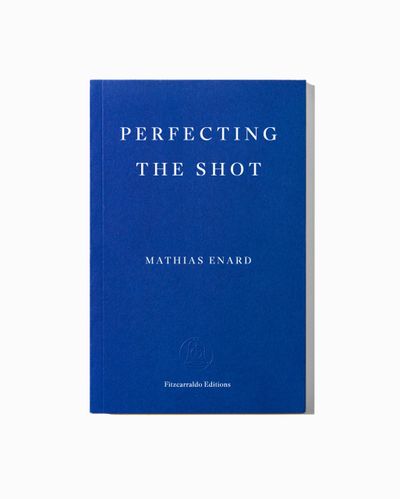
In a nameless city torn apart by civil war, a teenage sniper has only one goal: to fire the perfect shot. He sublimates himself into his weapon, learns to maintain impassivity, controls his breath, listens to his body and the beat of his heart. Lying in wait on rooftops, he takes aim at people below while his traumatized mother cowers in their flat. The violence eats away at any sense of morality as he kills civilians and combatants indiscriminately, for the sake of killing itself. His routine is disrupted by the arrival of Myrna, a fifteen-year-old girl hired to care for his mother, and his increasingly disturbing obsession with her soon threatens to push them all into the abyss. Now appearing in English more than twenty years after its original publication, Mathias Enard’s debut novel is a timeless study of how extreme violence corrodes the soul, tracking the convulsions of a brutalized mind in spare, unflinching prose.
‘Reading Mathias Enard, one doesn’t sense any anxiety about the fate of the novel.’
— Christopher Byrd, New York Review of Books
‘Mathias Enard is one of the best contemporary French writers, and his works – ambitious, erudite, multifaceted, surprising and unconventional – are always worth reading, because they always strike a perfect balance between the best that literature can offer: pleasure and knowledge.’
— Javier Cercas, author of The Impostor
‘Every novel by Mathias Enard reminds me of the reasons why I read fiction. He is ambitious, erudite, full of life, and a wonderful stylist to boot. He is one of the great novelists of our time.’
— Juan Gabriel Vásquez, author of The Shape of the Ruins
‘All of Enard’s books share the hope of transposing prose into the empyrean of pure sound, where words can never correspond to stable meanings. He’s the composer of a discomposing age.’
— Joshua Cohen, New York Times
‘A novelist like Enard feels particularly necessary right now, though to say this may actually be to undersell his work. He is not a polemicist but an artist, one whose novels will always have something to say to us.’
— Christopher Beha, Harper’s
‘The most brazenly lapel-grabbing French writer since Michel Houellebecq.’
— Leo Robson, New Statesman

Perfecting the Shot
Translated by Charlotte Mandell
French paperback with flaps, 172 pages
Published 24 September
Perfecting the Shot
Translated by Charlotte Mandell
The most important thing is the breath.
Calm, slow breath, the patience of breath; first you
have to listen to your own body, listen to your heart beat-
ing, to the stillness of your arm, of your hand. The rifle
must become a part of you, an extension of yourself.
Even before the target, the important thing is yourself.
You have to organize the space, whether you’re on a roof,
behind a window, anywhere, you have to control it, make
the space your own. Nothing more annoying than a cat
passing behind you, or a bird flying off. You have to be
yourself and nothing else, eye on the scope, the metal arm
stretched towards the target, to join it. From my roof I
survey the sidewalks, explore the windows, watch peo-
ple living. I can join them by pressing the trigger. It’s not
simple, quite the contrary, it’s a difficult job that demands
precision and concentration. People think only of the
gunshot and the result of the shot. They don’t know that
I listened to their heart beating through mine, that I held
back all emotion, that I stopped breathing, just before
pulling the trigger, as they say, but I don’t pull anything,
on the contrary, I set loose a metal hammer that strikes
a point of percussion that sets fire to powder that pro-
pels a projectile up to 1,200 metres and kills you. Or not.
Sometimes despite making the best shot in the world
there are imponderables, obstacles that stand between
you and the target; a gust of wind can make the shoot-
er’s weapon tremble imperceptibly, a noise in the street
distracts you, an explosion or a car backfiring surpris-
es you. But the shot itself is never the problem. I never
shoot unless I’m sure about it. I don’t fire often. Some
days I send a bird falling into the street after I’ve watched
it wheel in the air for an hour, time enough to prepare,
to foresee its movements, understand the motion of the
air mass beneath its wings, judge its distance, its flight.
Usually I aim at the wing and watch it fall, spinning, or
else I try to graze the bird without hitting it, brush against
it with a gunshot. And it falls all the same. When they’re
high enough, some right themselves before reaching the
ground, but most are shocked and crash down. It’s good
training. No one can shoot as well as I can, because I don’t
shoot often. Never more than ten cartridges a day. Not
because I’ve set myself a limit. But because I only shoot
when I’m absolutely sure of my shot. All the hard work
comes before.
I don’t know why, but I remember all my shots. I don’t
confuse them, they’re all different. I only choose the diffi-
cult ones. At first, when I was a beginner, I played around
like everyone else, but that was to hide my mediocrity.
I only choose the difficult shots because the pleasure is
greater. Those who don’t understand this and shoot at
anything that moves are idiots. (…)
Mathias Enard, born in 1972, studied Persian and Arabic and spent long periods in the Middle East. He won several awards for Zone, including the Prix du Livre Inter and the Prix Décembre, and won the Liste Goncourt/Le Choix de l’Orient, the Prix littéraire de la Porte Dorée and the Prix du Roman-News for Street of Thieves. He won the 2015 Prix Goncourt, the 2017 Leipziger Book Award for European Understanding, the Premio Gregor von Rezzori and was shortlisted for the 2017 International Booker Prize for Compass. Perfecting the Shot is his seventh novel to appear with Fitzcarraldo Editions.
Charlotte Mandell has translated over fifty books of fiction, poetry and philosophy from French, including works by Marcel Proust, Maurice Blanchot, Abdelwahab Meddeb and Jean-Luc Nancy. Her translation of Compass by Mathias Enard was shortlisted for the International Booker Prize and was the recipient of the 2018 ALTA National Translation Award in Prose. She was recently named a Chevalier de l’Ordre des Arts et des Lettres by the French government and has received the Thornton Wilder Translation Prize from the American Academy of Arts and Letters.


