
Practicing Dying opens with the narrator’s arrival at a Zen Buddhist monastery in rural France: she is emaciated, drug-addicted and disillusioned, having exhausted every conventional treatment route. Habituated to a life of benefits assessments, petty crime and sex work, she finds it difficult to submit to the discipline of the community she has joined. But against the odds, she begins to recover, while suffering numerous relapses. Eventually she decides to undergo ango, a three-month training period for Buddhist monks and nuns. As the story unfolds, she reflects on her past experiences, raising critical questions about the social origins of addiction, and why there may be vested interests in maintaining an individualistic understanding of it. Anarchic and provocative, darkly comic and self-deprecating, Practicing Dying upends the linear tropes of the addiction-recovery genre, and proposes an alternative approach to treating the ‘sickness of self’ induced by capitalist alienation.
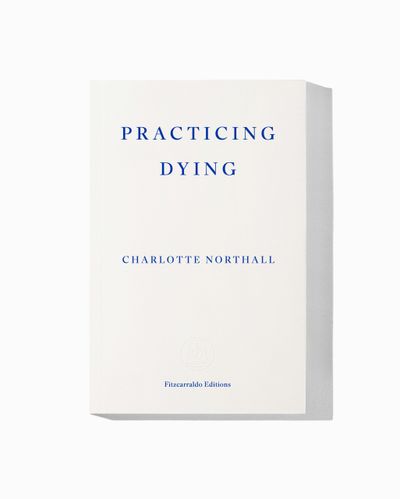
Practicing Dying
French paperback with flaps, 356 pages
Published 15 July 2027
Practicing Dying
PROLOGUE
Wandsworth Prison appears on the screen of my ringing phone. This produces a momentary panic, before I realize I am not in trouble. This realization is not made without effort. The world, I tell myself – sometimes out loud, multiple times a day – is not out to get me. Although it’s true that I still have a tendency towards paranoia, my anxiety is not unfounded. Years of drug use and dishonesty do not go unpunished. It’s been three and a half years since I last used codeine. Four, alcohol and cocaine. Almost eight since I took what I hope was my last hit of heroin. Although I have confronted what I can remember, my head is crowded with ghosts – without exception, demanding money or answers. My fear of retribution is born of experience. Experience now slowly being overwritten by objectively less hostile circumstances, which I can read with greater perspective, now that I’m no longer completely out of my mind.
Or rather, I’m no longer in pain. When pain arises, it dissipates. Uncomfortable feelings no longer necessitate performing the kinds of tranquilizing interventions that invariably served in the long term only to salt the wound. It is not, for example, worth releasing adrenaline by sticking a pin under my fingernail over a disagreement with an energy company. The fact I have any relationship with energy companies is, according to some, a measure of recovery. In a sense they are right. If I wasn’t busy writing, I might invest my time blowing up pipelines. There just aren’t enough hours in the day for good deeds. When feeling resentful, I remember the words of Flaubert; ‘Be regular and orderly in your life, like a bourgeois, so you may be violent and original in your work.’ What is indisputable is that a space has opened up – a crosshair-fine pause between emotion and reaction. Just time enough to hold fire.
It’s amazing what can flourish from even the smallest crack. A seed sown correctly can bring a building down. I pay bills and brush my teeth. I remember people’s names and ask questions about their lives. Depending on how attractive they are, I listen when they respond. Holidaying neighbours entrust me with keys. I feed cats and water plants. You wouldn’t guess that beneath my clothes I’m covered in scars. Or that as others might plan trips abroad, I daydream about getting sectioned. Still, the invitations to terror remain – brown envelopes, texts from the government welfare department, calls from unknown numbers. Any sign of an incursion by the superstructure. Ironic, given that I’m technically a council employee. At least, until they read this.
The phone continues to ring. There is only one person it could be.
The last time I saw him was nine months ago. The start of summer, one week after he’d stopped answering my calls. This was not unusual. The lives of addicts are often chaotic, especially of those without the means to support a habit. I’d tried his hostel. No one answered so I took a walk. I found Ratman John as expected, dressed in a grubby FedEx aertex and drinking cider under the Westway. Ratman hadn’t seen him. Neither had Nick the Brick. This much I surmised.Nick was barely conscious, slumped double on a cardboard reef drawn up beside a nearby hole-in-the-wall. I tried the hostel again. The staff member I spoke to was new, as is often the case. Often staff came from far-flung countries, hopes pinned on the Western economic promise. For someone with a master’s degree from a prestigious university being spat at for minimum wage is only tolerable for so long. I was told there had been an incident. That, yes, he would like to see me.
Daniel’s face was alcoholic red. Arms thinner than usual. His Manchester United shirt bore blood spots. We sat in the hostel’s communal kitchen on a pair of stolen chairs – him staring into space, me at the wall. Feeling and caring in a way that, as someone who’s dedicated most of their life to anaesthetizing themselves, I still experienced as genuinely unpleasant. With no real CV aside from experience, it is precisely feeling and caring that qualifies me for this job: supporting street homeless addicts into detox and rehab.
In the year we’d known each other, Daniel and I had grown close. I’d learned his date and place of birth, the names of his childhood pets and his parents. Beneath these superficial prompts lay his fears and insecurities – sanctioned benefits, missing teeth brawled out and eaten away by the pipe. Lastly, the traumas; his Nan, who’d raised him and always wanted to lose weight, died emaciated in his arms; during Covid his girlfriend, spirited away by hazmat-clad paramedics, died alone on route to hospital. We’d talked enough about childhood sexual abuse to know there was still more left unsaid.
Usually, he wore long sleeves and talked incessantly; today he was monosyllabic. His forearms spoke for him, lined with purple track marks and crossed with finger-wide slashes. Daniel was not OK. In the time I’d been unable to reach him, he’d jumped onto the underground tracks and been hospitalized and discharged.
Only a fortnight before, we’d been sat in the Pret a Manger opposite Nick the Brick’s pitch, laughing. Daniel told me the police had been called after he’d set fire to the hostel kitchen whilst cooking stoned. The manager – a hard-nosed Romanian woman with bulletproof hair – had a soft spot for Daniel. He was already on his final warning. Rather than being evicted, which would likely mean sleeping in the car park beneath the town hall, he’d been issued a two-hundred-pound cleaning bill.
To someone caught in the addiction-poverty-benefit purgatory, two hundred pounds poses a significant lifestyle conundrum. The thing about benefits is that they’re designed on the one hand to recompense the redundant worker, on the other, to support those whose complex needs aren’t adequately covered by a £368.74 monthly stipend. The very universality of Universal Credit makes it unfit for purpose: insufficient to sustain a family, and a poor substitute for the responsive, psychosocial care required by the dislocated addict.
Still, ever enterprising, Daniel contracted the job out to his alcoholic neighbour, Juan. Juan has OCD. Perhaps surprisingly, given his passion for order, his own room is a depressive shithole – stacked high with loose, mismatched drawers, crammed with scavenged dog-ends. For a tenth of the price, twenty pounds would buy Juan almost sixteen cans of his preferred, super-strength cider. Both parties seemed happy. Encouraged by his profit, Daniel told me he was thinking of setting up an agency. Second to quitting heroin, his greatest desire is to get rich.
Between getting clean and starting to work, I decided I wanted to know more about the condition that had almost killed me. Even using, I’d managed to read, carrying a paperback wherever I went. Partly to identify myself as more than a complete waste of space, and partly because, like drugs, reading allowed me to travel without going anywhere. For years I’d resisted learning about addiction, telling myself I didn’t want to lose any more time thinking about the two subjects that already obsessed me: drugs and myself. In truth, I didn’t want to discover anything that might challenge the self-narrativization upon which I depended. Invariably, I cast myself as either victim or heroine, depending on whom I was talking to, and why. My research started when someone I’d met at a twelve-step recovery group – and immediately moved in with – gave me a copy of Gabor Maté’s In the Realm of Hungry Ghosts. This was in 2021, during the last Covid lockdown, and second to fucking, reading was the next best source of entertainment. From there I read on, academic books, journal articles and papers, addressing the science, history and social factors surrounding addiction.
Most of what I learned confirmed my experience. It helped me understand theoretically what empirically I already knew. Not only about myself, but about others whose suffering I’d have previously dismissed if I’d noticed it at all. I began to see it everywhere. In the mindless scrolling of Tube passengers, in the hundreds of unworn garments with labels still attached in charity shops, in the all-nightly comings and goings from the twenty-four-hour gym. I learnt that addiction, which exists as a spectrum, is not a self-contained personal problem nor matter of dis-ease, but a response to environment. That, although we are responsible for our actions, our tendencies are heavily circumscribed by conditions beyond our control. Poverty, for example, has been shown repeatedly, to no real effect, to play a major role in creating and maintaining addiction.
‘Alright Char?’ says the voice through my phone in a thick Mancunian accent. He sounds chirpy. ‘I’m down to eight mls of methadone.’ We both laugh. The word “miracle” springs to mind, a word picked up in recovery circles, but which can be secularized to mean an improbable improvement. Daniel’s is a highly improbable achievement. Fragile insofar as it is contingent on the fact he’s locked up.
When I’d first heard he was in prison, a sorry chill passed through me. That day in the hostel kitchen nine months ago, he’d said this was what he wanted. Hospital had released him too early. He wanted to stop taking drugs. In a hostel filled with using addicts, this would be near impossible. He needed to leave the area, to go somewhere safe. Prison was, he decided, his best option. It would be a homecoming of sorts. With seventy-eight convictions, Daniel has the same prisoner number he’d been issued when first sent to a borstal aged thirteen. Since then he’s spent less than a fortnight clean, each time following a rapid detox on a wing. Now thirty-six, he is a year older than me. Two weeks after our last meeting, he’d got his wish, having beaten the shit out of someone so badly he’d been remanded.
He gives me a list of clothes he wants sent. They are in a bin bag at the hostel. Two grey Stone Island tracksuits and a pair of black Nike trainers, the ones with the air bubble all the way round. He has no pants or socks. He also wants some vapes. He’s locked in his cell twenty-three hours a day. When I ask why he’s alone, he tells me that he presents a security risk. He’s ‘been on more roofs than Santa Claus’. When I relay the conversation to a supervisor,I’m told it’s more likely because he’s vulnerable. Both reasons are probably true. Those who have yet to understand their suffering are dangerous. ‘All I think of is recovery,’ Daniel continues, despite never having known it. ‘How are you doing anyway?’ he asks. ‘Oh, I’m OK,’ I reply, and, despite the fact I am not only not locked up but drug-free, immediately think of everything that’s pissing me off. The NHS dental check-up at which I was surreptitiously marketed Botox. The tourists who block the pavements taking selfies along Lancaster Road. The fact I haven’t had sex for a fortnight, despite being in a new relationship. And that this work, which people congratulate me on doing, telling me that I am ‘now part of the solution, not the problem’, amounts to little more than a cleaning job: tidying away those society deems unclean without addressing the conditions that give rise to their hardship. For every person who makes it into rehab, usually only to relapse upon leaving, several others die.
At times, as a recovering addict and an ex-service user, I feel like a double agent. No longer drugged to the point of indifference, things I would once have barely noticed now strike me as disturbing. An elderly woman who looks dead where she lies, limbs sticking out from beneath a pile of bags, in a doorway off High Street Kensington. The state of Kevin’s swaddled legs, bandages blotted with leaking pus as he circles Earl’s Court in a pair of worn-down sliders. The sex-offending ex-client, who, having failed to engage with probation, is now bowling round the neighbourhood in a state of vengeful, shirtless psychosis. Looking around the Royal Borough, the richest in the country, in which I live and work, the term ‘poverty’ seems misleading. Luxury stores and absent billionaires’ homes co-exist with food banks and derelict tower blocks. Life expectancy is fifteen years higher in the affluent South of the borough than the North. Here, as globally, there exists more than enough to go round. The problem then is not poverty but inequality, driven by an unregulated greed so senseless it must be motivated by fear. This disparity provides the conviction that prevention rather than treatment is never the answer. The problem with prevention is that it would require a full-scale revolution, as necessary as it is improbable.
These days I write to transcend my feelings. To write is to state my objection; insurance against being overtaken by a fatal case of bad faith. ‘Are you still there?’, comes Daniel’s voice from what seems like a long way away. I stare at the device in the palm of my hand. ‘How’s it going with what’s his name?’ ‘We’re going on holiday,’ I admit, after a pause. ‘I bet you never thought you’d have this life,’ Daniel says, and I’m struck by how easy it is to forget that only seven years ago, I had almost no life left at all.
‘A revelation and a pleasure. I’ve passed it around to everyone I know. It’s the best-written document of addiction and withdrawal and an awakening. Maybe people will finally understand.’
— Nan Goldin
‘Practicing Dying is brilliant, rewarding and difficult. Northall offers the most brazen and shocking account of addiction I’ve ever read. Committing herself to the practice of Mahayana Buddhism, she eventually finds a way out, but only on the most rambling, circuitous path. Her account of addiction and loss, displacement and grief is profound and it proves that nothing is ever one thing.’
— Chris Kraus, author of The Four Spent The Day Together
‘The untamed offspring of Pema Chödrön’s The Wisdom of No Escape and David Wojnarowicz’s Close to the Knives, this is an addiction memoir that coolly refuses conventional narratives of addiction, trauma and recovery; an unflinching, no-holds-barred, seriously intelligent investigation into existence and how to survive it. A gut-wrenching, sublimely rewarding ride.’
— Olivia Laing, author of The Silver Book
‘Charlotte Northall’s Practicing Dying is extraordinary. It had me holding my breath. She writes in the same direct and uncompromising vein as Heather Lewis and Shulamith Firestone about the darkest corners of experience. But hers is ultimately a story of survival and even transcendence, one earned on every page. The existence of the book itself is hope.’
— Nate Lippens, author of Bastards
‘In intelligence, chaos and wit, [Practicing Dying] is unstoppable.’
— Catherine Taylor, Times Literary Supplement
Charlotte Northall is a London-based writer. Her debut, Practicing Dying, blends autobiography and cultural criticism to explore addiction, capitalism and spiritual practice. She is working on her first novel, a polyphonic work about bureaucratic violence and the lives it acts upon.


