In Rebecca Tamás’s remarkable second poetry collection, a grieving, unnamed narrator walks a broken hero’s journey through green woods and coastlines, accompanied by the elusive figure of the Fisher King, who nurses his own wound. The land they cross has been made sick by a capitalist economy and a growth-obsessed citizenry – an organic world at once degrading and replenishing. Drawing on the medieval story cycles of the Matter of Britain and giving them a contemporary, intertextual spin, The Fisher King gathers a litany of thinkers – from John Berger to St Silouan the Athonite to Anne Carson – who act as guides and interlocutors. Taking its cues from folkloric storytelling to conjure an enmeshed sense of being with and in the world, this mesmeric reimagining of the Arthurian tale makes the Fisher King’s immortal wound a metaphor for the gaping chasm between our human selves and the non-human world. How, the book asks, can we ‘be apart, but closely’?
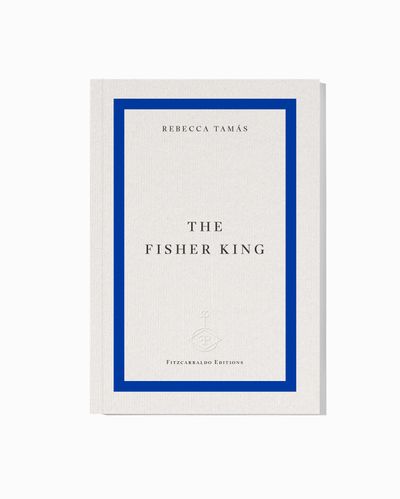
The Fisher King
French paperback with flaps, 112 pages
Published 28 January 2027
The Fisher King
ESSAY FOR THE FISHER KING
CORBENIC
I
This misfortune you find is of your own manufacture
The pond hardens into ice; the frozen leaves corrupt, smash into each other. Everything, however clean it appears, stinks of gangrene. The fisher king is laid low by the hole in his thigh, his trouser leg wet with blood, patience fraying; the ancient wound is unhealed, messy and sour. He is waiting for a knight to come and ask the right question, but there are no knights left in England and the metaphors have faded and he can no longer remember what needs to be asked.
I look out of the window into the flayed white garden where he is bent over pruning, weak snow falling against scuffed light.
His friends have had enough of him, and the grail is chipped. Around him, bone-tired, flint-hard land. Inside him, soggy and depleting flesh.
The dead with the dead, the living with the living
This is the limpid point where frost and flame meet. The path is long under the thick slate sky, the fisher king leaning on my arm, exclamations of his weary ashen breath. Pain does not always need a bloodletting. Freeze it over, ice up the thin silver trunks of trees, legs shivering, the dip and hum of movement through the frigid grass.
Up on the beacon, high as birds, the blue snow wraps the cairns and burial mounds with muffled gentleness. Midwinter circles us, carving rings through the trunks; new air is shucked from the sky, a cold oyster. A jackdaw’s feet make runes in the snow, tin can beat of a ghost jostling. They have always been here, but it’s only now that can I see them.
What has vanished has gone into hiding
The fisher king is my only neighbour, archaic as the silt beneath the house. We get to know each other – set up on the pitiless grass in fake fur jackets, throwing hopeful lines into the river. Over the stones I pour a libation of milk for the dead, watching as they crowd in along the corpse road through the woods. The dead are usually hard to see, but in quiet winter fields, there is nothing to block them. They come out of the ground that has been covering them, looking to balance the equation of past and present – equal parts of blood and water. We are outnumbered by the dead, creaking voices which unspool in metal threads.
Watching anything for long enough will spill its history: the piece of cloth dismantling back to factory, electric lights and timers, a young woman leaning to smoke on her break, stretching her stained hands, to the cotton plant mother, the hatching womb, the field that was forest, and before that lava, ash and mud. So too here the history comes up like sick, dead thrown back from the moor as they lap our milk, the smell of peat hanging in the air, first enclosures, stone circles, river full of broken mirrors.
‘A kaleidoscopic pilgrimage through a ruined and ruinous landscape during which the dead are reanimated powerfully through language. And yet “the wound has something to give us,” writes Tamás with a blistering certainty that the fisher king, the “Communist Ghost”, her chorus of raw-throated mystics might heal us – connecting us, rhizomatically, back to the landscape and to their hermetic, alchemical and forgotten knowledges. Like a twenty-first century Cassandra, Tamás “sees everything” and is “crying out”, and this book is her complex and prismatic song.’
— Richard Scott, author of That Broke Into Shining Crystals
Praise for WITCH
‘Rebecca Tamás’s WITCH … is filled with a sort of propulsive demoniac vitality that powers you straight through it, cover to cover…. She is wonderfully evocative, appealingly grouchy and possesses … visionary instincts.’
— James Marriot, The Times
‘Tamás explores the figure of the witch and her relationship to gender and the state in a way that feels strikingly true to the political and personal malaises of twenty-first-century life.’
— Rhian Sassen, Paris Review
‘As heretical as it is cerebral, WITCH rages ferociously through the occult to the obscene. From hexes on patriarchy to a spell for UN resolutions, Tamás upturns the world as we know it into “a small bright filthy song”. A fierce new voice, “red and pulsing”, which refuses to be silenced.’
— Poetry Book Society
Rebecca Tamás’s first poetry collection, WITCH was a Guardian, Times, Telegraph, Paris Review and Radio 4 Book of the Year, and a Poetry Book Society Recommendation. She is the author of The Book of Mysteries: Wild Time and the Ritual Year and Strangers: Essays on the Human and Nonhuman which was longlisted for The Rathbones Folio Prize. She was the 2024 recipient of the Sylvia Canfield Winn Fellowship for Environmental Writing.


