On a remote island in the Aegean, a billionaire named Morel is building a refuge for the super-rich from the chaos consuming the outside world. When a struggling journalist is hired to work on the spectacular exhibition that will inaugurate this exclusive new utopia, he jumps at the chance to restart a career that stopped with the death of his wife. Yet he comes to suspect that beneath the dazzling surface of this collaboration between art and power run currents of real violence. As the inauguration of the Floating World approaches, he finds it more difficult to distinguish dream from reality. Who is excluded from this paradise? On what traumas is it being constructed, and are they poised to return? And can art redeem us from the death of our loved ones and the end of the world? A dystopia, satire and Bildungsroman, steeped in ancient mythology and contemporary politics, The Floating World is a deeply moving, often hilarious and beautifully written debut novel that heralds an exciting new voice in contemporary fiction.
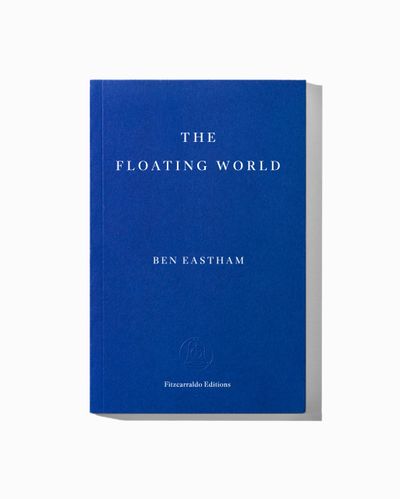
The Floating World
French paperback with flaps, 276 pages | Audiobook read by Greg Jones
Published 8 October 2026
The Floating World
Yesterday I planted a tree in the garden. A magnolia, to be precise, having fond memories of the flowers that used to enliven South London in spring. At the beginning of every April, having waited through winter for it to blossom, Cora would reward the tree at the end of our street with a kiss that, like sunlight, served to accelerate the process. She had a gift for these things.
I do not, and am already worried for my sapling. It stands this morning in a circle of ground painted white by a frost that I might have seen coming. The stream in the valley beyond is so bright in the low sun that I fear it has frozen over; the long black girders stretching from isolated trees fix the landscape in place. Nothing about this morning seems conducive to new life. Should I heat some water to defrost the soil in which the tree is planted? Should I shelter it beneath one of the tarpaulins covering stacks of peat by the shed? Probably I should go down to the village to use the wifi, but I don’t want to be ambushed by the news.
The woman at the garden centre had betrayed no such anxieties. Just find a spot with plenty of light, she’d advised, and the tree will take care of itself. Aoife was the only employee still coming into work, she told me as we walked through an arbour threaded with honeysuckle, payments not having cleared since the crash. But she had nothing better to do than to keep the plants alive through the winter, until normality resumed.
‘And if it didn’t?’
Resume, I meant, normality.
‘Oh things come and go,’ she said, ‘the sun continues to rise.’
I was to pound down the soil with the heel of my boot, being careful not to damage the roots. And would the tree bloom with white flowers in the spring?
‘Of course,’ Aoife said, ‘if you mind it properly.’ Perhaps I should have waited for an overcast day. The problem was that, having dug a hole in the ground when I got back, the temptation to put something into it was irresistible. I loved digging that hole. Earth yielding to my shovel, I was for those ten minutes a god, albeit one of those for whom they have to scrape the barrel of divine responsibilities: the god of small garden plots, perhaps, or the god of learning late in life how to use a shovel. As I danced around the tree to tamp down the soil that would bind it into the landscape, I felt as if I were remaking the world.
For the remainder of the afternoon, I read about how we see. Our retinas, I learned from the encyclopaedia in Reith’s study, are lined with two types of photoreceptive cells. ‘Cones’ are responsible for the rich and colourful world of daytime; when the light is too dim to stimulate them, the brain switches to the more sensitive but less complex ‘rods’, which can conjure from just a few photons a more basic black-and-white representation. This transition to night vision takes about twenty minutes of near-total darkness, so that most of us, who live within reach of a light switch and carry phones that double as torches, will never again enter the shadow world it reveals to us.
The moon was new in the sky and so, to find out whether this other way of seeing matched what I remembered from the Floating World, I decided after dark to go down to the stream. I took a flashlight, a sleeping bag and a thermos down the narrow road that runs over the stone bridge into which someone once etched a heart, and found a spot between the stream and the greyhound stables from which even the scattered lit windows on the
crest of the valley were invisible.
Lying on the bank of the stream, I first let my eyes settle into the dark. Then I searched the sky for the Pole Star. From there I moved down to the pan of the Plough and followed the bend of its back to Arcturus. An easily remembered pattern describes the Bear, the Lynx, Gemini, Castor and Pollux. In the time it took to trace this route, a thousand points of light had punctuated the sky and the world around me had begun to resolve into spectral grey shapes, like a developing photograph.
These shadows were for a long time so insubstantial that I suspected they were the work of my mind, like the shapes on the backs of your eyelids or the blurred scotomas that herald a migraine. And then, startlingly, the bough of a tree above me shimmered out of the black and I slipped into a perfectly realized, silverish realm of pattern and form. Features of the landscape around me appeared as pentimenti: a wavering bush like a phantom limb, a bend in the river scrubbed out to serve the compositional harmony. This shift from one way of seeing to the other I experienced as something like grace.
The sky above me, I realized then, was a screen onto which the history of the universe was projected in points of dazzling light. I watched stars burn a hundred thousand years ago and wondered whether the astronomers of some distant planet, armed with better telescopes than ours, might now be watching Cortés’ company set fire to Tenochtitlan in real time. And whether we might one day be able to intercept the same images as they are carried on moving tracks of light towards the edge of the universe.
By training my gaze on the right patch of space I might, from this same patch of grass, watch the storming of the Winter Palace or review the cloudless day on which Cora and I were married. Presuming, of course, that the sky on those other days had also been clear.
Lying on the bank of the stream, I watched a star fall into the ocean five miles to the west, throwing up the white frost that now threatens my sapling. I understood this to be a communication from that part of the sky through which the relevant dead were moving. The message was that I should get on with it. And so I returned to the house and sat down at this desk, looking over the fragile magnolia and the frozen stream, to write the story of the Floating World, as I was able to see it.
‘An immersing, crystalline debut novel that reaches out to a world in crisis; elegant, emotional, deeply serious and gloriously witty.’
— Deborah Levy, author of August Blue
‘Startlingly imaginative, The Floating World is at times like the work of a J. G. Ballard for the 2020s, at others like the reincarnation of Italo Calvino. Eastham is as deft with a finely observed comic riff as he is with a heart-stoppingly lovely description of a city, a gesture, a connection. In his hands, what could have been a satire of art-world hubris becomes something so attuned to the world – its wonder and its clear and present danger… I don’t want to sound mawkish, but ultimately it’s a novel about our boundless potential to connect, and what we should ultimately value.’
— Luke Kennard, author of Black Bag
‘The world – that is, the protagonist – floats through opaque settings of fateful money, violent strangers and ghostly love; a tender, guilty work of wish-fulfillment and the most valuable kind of first novel, documenting the author’s struggle to reconcile right action with the egomaniac work of writing books.’
— Nell Zink, author of Sister Europe
‘An astute satire about the absurdities of the artworld, a compelling mystery and an elegy, The Floating World is unputdownable: frequently funny, often moving and always intriguing.’
— Jennifer Higgie, author of The Other Side
‘By turns witty and lyrical, The Floating World is a compelling aftermath novel, in which the world is eventually forced into a shape that’s monstrous enough to express a man’s grief.’
— Barney Norris, author of Undercurrent
‘Novels like this don’t come around very often. Ben Eastham’s The Floating World is transporting in every sense of the word. A meditation on the brutal and beautiful nexus where art and money meet, an odyssey of grief and discovery, a rallying cry against the people ruining the world from those that are trying to change it. It’s a towering achievement.’
— Dominic Amarena, author of I Want Everything
‘Channelling Adolfo Bioy Casares, Eastham carries a vision of art’s complicity with power to its endgame. If Art Basel is now globalized, then so is Minneapolis. Looping civilization back to end where it began, in Athens, he proposes that the only counterforce to fascism is love.’
— Tom McCarthy, author of The Making of Incarnation
Ben Eastham is an art critic and editor based in London. The editor-in-chief of e-flux Criticism, and a regular contributor to the Guardian, he was previously a founding editor of The White Review and an editor at ArtReview. He has edited books on Luis Camnitzer, Arshile Gorky, Fabio Mauri and Stephen Spender, worked on exhibitions including the Shanghai Biennale and documenta, and is on the advisory panel of EVA International. He began his career as a journalist at the BBC reporting on global mass media and propaganda, and has lived in Athens and Rome. His previous book, The Imaginary Museum (TLS Books, 2020), is about how works of art change the way we see the world.


