In the winter of 2002, an aspiring writer is hired to review books for the cultural pages of a Santiago newspaper. What follows is an apprenticeship with his editor, David Tightwad: columns filed at midnight, two-hour arguments over a single adjective, long evenings drinking beer and talking about literature. Tightwad edits his protegé’s sentences, his commas, his enthusiasms and – on one unforgettable occasion – his facial hair. Then something small and unforgivable takes place, and the two men stop speaking. Twenty years later, over cold pizza in Mexico City, they try to work out what happened. A Christmas Story is a book with the beams exposed – introduced and footnoted by Alejandro Zambra’s very own editor, Andrés Braithwaite, and annotated again in English by Megan McDowell, who argues with her own editor in the notes. In her brilliantly playful translation and interventions, the story of the relationship between a writer and his editor takes on extra layers of meaning, revealing how conversations and doubts begin to overflow beyond the page, the text, the language, and the work itself, forging bonds that no longer cling to literature alone, but to life.
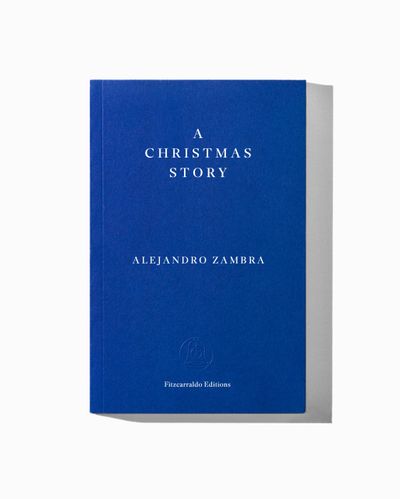
A Christmas Story
Translated by Megan McDowell, with an introduction by Andrés Braithwaite
French paperback with flaps, 64 pages
Published 19 November 2026
A Christmas Story
Translated by Megan McDowell, with an introduction by Andrés Braithwaite
FOREWORD: FROM FATIGUE
ANDRÉS BRAITHWAITE
Writing these lines feels particularly strange for me. I don’t like, and have never liked, writing forewords for other people’s books (nor my own: I don’t believe I’ve published any). Unless the book in question is, say, a philological study that needs to be contextualized with a certain care in order to be understood or enjoyed, you are doomed to pile on polite words – sincere or otherwise, no matter – which inevitably makes you into a propagandist cloaked in presumed authority. The strangeness only grows when the book to be praised stands perfectly well on its own, as in the case of this luminous work by Alejandro Zambra, and it’s further exacerbated when the author is prominent enough that he has no need for an endorsement from anyone else. To make matters worse, the unknown writer of these lines has penned little more – over the course of many years as a literary and journalistic editor – than a few brief ‘notes on this edition’, which he has only occasionally put his name to, and even then
just his initials.
Whatever the case, or for this very reason, my favourite pieces in the genre are those in which the writer of the foreword manages to precisely transmit the discomfort that engulfs him and from which he wants to escape as soon as possible: deliciously elusive texts that never come right out and say that the introduced work is admirable or at least worthy of attention. Unfortunately, this is a genre that seems to incite a barrage of implausible praise without a shred of subtlety or sobriety. It’s never enough to simply say that a book is good or very good or extraordinary (which, incidentally, is also the case at book launches). Moreover: the very adjective extraordinary has become ordinary, and even comes off as stingy. What has emerged, then, is a literary sub-genre of unbridled and meaningless hyperbole: the introducer must claim that this or that author is changing our lives, or, to avoid exaggerating – because even exaggeration has its limits – our way of reading.
The editors – very pleasant people, judging by their emails – were frank and pragmatic in letting me know that I was an involuntary participant in a negotiation: they wanted to publish a book by Zambra in a collection of works focused on the editorial process, of which I’d been previously unaware, but that already included several volumes, all of them slyly padded with their corresponding forewords. Zambra had agreed to the publication but he objected, fairly and reasonably, to the idea of a foreword. The editors insisted, unwilling to let one capricious author throw their editorial criteria overboard, and also – though they didn’t tell me this textually, I deduced it later – worried that Zambra’s story wouldn’t be long enough to make a book with a spine. Thus, not only did they require a foreword from me, they also requested that the text contain a minimum number of words that I clearly will not reach, a shortfall or deficit that will perhaps oblige them to turn to effective but ignoble tricks such as shrinking the text block or enlarging the type or expanding the line and indent spaces.*
* JT: We may have to resort to these too.
‘Alejandro Zambra and Andrés Braithwaite have devised a superb literary artefact: a revolving mirror in which they are both reflected. It is a riotously funny but deeply serious game in which, beyond the personal relationship between author and editor, what ultimately matters is the text itself.’
— Ignacio Echevarría, El Cultural
‘It is unusual for a footnote to transform a text radically, but that is what happens here…. The notes and the text converse with one another; there is a back-and-forth that expands the story into a metatextual realm…. Perhaps for the first time, we are able to see an editor at work, and this makes us think about those same words more deeply and vividly; it releases us from the enchantment of fiction and returns us to the work of literature itself.’
— Mercedes Halfon, Página 12
‘There are no solitary literatures; we write thanks to others. Braithwaite defines his profession as “a companionship that erases itself ”. The reader does not perceive it, but it is there. In an age that is far too literal-minded, we dispense with the hands-on editor: the necessary ghost. Alejandro Zambra has found the most fitting way to preserve him: by turning him into literature.’
— Juan Villoro, El Siglo de Durango
‘Every beat and pattern of being alive becomes revelatory and bright when narrated by Alejandro Zambra. He is a modern wonder.’
— Rivka Galchen, author of Everyone Knows Your Mother is a Witch
‘The most talked-about writer to come out of Chile since Bolaño.’
— New York Times
‘Strikingly original.’
— James Wood, New Yorker
‘When I read Zambra I feel like someone’s shooting fireworks inside my head.’
— Valeria Luiselli, author of Lost Children Archive
Alejandro Zambra was born in Santiago, Chile, in 1975. He is the author of the novels Chilean Poet, Multiple Choice, Ways of Going Home, The Private Lives of Trees and Bonsai; the short story collections My Documents and Childish Literature; and the essay collection Not to Read. The recipient of numerous prizes, including a Cullman Center Fellowship from the New York Public Library, his stories have appeared in the New Yorker, Paris Review, Granta, McSweeney’s and Harper’s, among others. He lives in Mexico City.
Megan McDowell is an award-winning Spanish-language translator. She has translated books by Alejandro Zambra, Samanta Schweblin, Mariana Enríquez and Lina Meruane, among others, and her short story translations have appeared in the New Yorker, Paris Review, Harper’s and The White Review. She lives in Santiago, Chile.


