
The city you grew up in is gone, as if sunk to the bottom of the ocean. So much has vanished with it – counterfeit watches, streets echoing with the sound of stilettos, and even some of your classmates and teachers. Then the disappearances come closer to home. Your mother joins a housewives’ protest over fake lotus roots only to be turned into a statue by the police. Your father is quietly absorbed into the enormous TV gifted by the government, reappearing in the background of soap operas. And didn’t you once have a little sister, before she flew away? As the police go undercover and transform your neighbourhood into a violent labyrinth you can no longer navigate, where does this leave you? Lucid, nightmarish and indelible, City Like Water is a wondrous tale of a city not so different from your own.
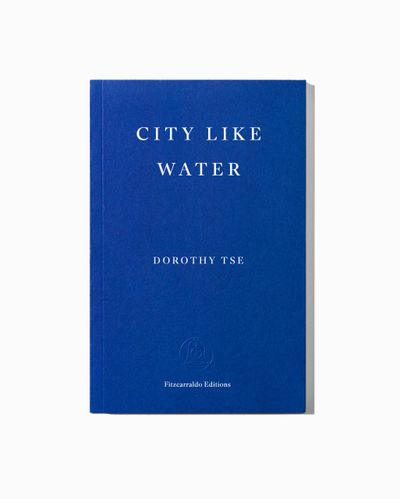
City Like Water
Translated by Natascha Bruce
French paperback with flaps, 92 pages
Published 12 March 2026
City Like Water
Translated by Natascha Bruce
IN A DARK GREEN BOAT
In the place I used to live, my rusty top bunk rocked like a boat. Night after night, it carried me off towards a secret crevice. Some nights the crevice unfurled a tongue to lick me, and barked at me, sending jolts of excitement through my narrow little life. Other nights it sneaked into my embryonic dreams and bared gleaming fangs, nipping at the nerves of my memory like a feisty lover. During the day, it healed over and became just another scar in the battered walls of our post-war apartment building, the vast and varied secrets of bygone eras held closely within.
The walls were grey, and the staircase that descended silently through the building was dark, opening onto a street where dust and sunshine ran riot. Plants and trees were few and far between, but all year long crowds of people sprang up from the street like mushrooms, their jumbled shouts and earthy faces constantly vying for attention. Meanwhile, meat-red plastic bags whipped round in circles, tied to the blades of fans to scare off flies, and sunlight spread itself evenly across the cratered surfaces of all the orange orbs on the fruit stands. I’d look on as the hands of counterfeit watches did their best to tick, and polyester scarves fluttered in the breeze. Inside a row of plastic eggs, electronic pet aliens awaited the right moment to hatch.
I can’t prove any of this. Those streets are unfindable now. Not because of some developer wiping them off the map, like smears from a kitchen table, or because of a corrupt political regime, or because of any other reason the internet might cook up. That world decided for itself. To evade serial numbers, imposed order and the stink of disinfectant, those sun-dazzled inhabitants gathered close their unspoken words and slunk into the cracks of buildings, where they transformed into cockroaches. With their antennae twitching, and their backs ridged with mysterious codes, they scuttled off into the dark.
Those streets are no longer on the city’s epidermis. They’re somewhere deeper, inside our muddied, contaminated memories, shielded by the seahorse coil of our hippocampus, that physical manifestation of the memory god.
My own memory is a mess. A ravenous, never-tidied storeroom, constantly in motion. A chaotic sea. But the tides of my sea must follow some kind of rule, some subliminal rhythm, because some things sink forever beneath the waves while others keep bobbing to the surface. Among them, an old drawing of mine: the city’s metal become one with its living flesh, genitalia melded and thrust into the air, like a giant black peony in full bloom.
In this memory, I’m still in primary school. All afternoon, the sun has been lying on the classroom floor like a snoozing dog – fluffy, gentle, well-behaved, but jerked awake every so often by Peggy the English teacher with the perm, the one we call Piggy, clacking up and down in her high heels. As she approaches my desk, reality drifts back to me on a cloud of rose perfume. First come the pointy tips of her shoes and then, through her flesh-toned stockings, the creases between her squished-in toes.
A single line of that mysterious toe cleavage is almost enough to win me over.
‘Your drawing is very futuristic,’ says Piggy.
‘It’s not about the future,’ I reply. ‘It’s about the past.’
I don’t tell her that the drawing is about my longing for the city’s industrial age. For heavy machinery, steel fists, fantastical steam.
I wasn’t around to witness the happy days when they say success came to those who worked like ants. Those days melted into air. Now they exist only in textbooks and late-night reruns of black and white films, in which the legend of our city’s golden age becomes stronger with every retelling: the people who arrived fleeing the North were the engines that powered the transformation. They made the cogs turn faster.
If it was a time when anyone could succeed, then the three of us – my mum, my dad and me – must have been the only ones who defied the laws of this science. We were stowaways inside a dark green boat, cramped up and holding our breaths, perpetually waiting to reach land. In the gloom, our long slender eyes were wide and vigilant as a cat’s. Our claws pierced only our own flesh, and we held our invisible tails stiff, anxious for our humble lives to avoid detection.
I silently copied out history textbooks that reflected nothing of history, in which the successes and failures of whole eras were recounted from the perspective of imperial rulers, according to whom a silent, compliant populace was a blessing, a sign of long-term peace and stability. I committed all this to memory, mouthing passages while at the same time being enveloped by them, terrified of the real history I found lurking inside. It was like entering one of those new-build indoor wet markets, the floor slick with foul-smelling waste that glistened like fish scales. Somewhere, a chicken’s throat was slit, its lingering final squawk absorbed by the blare of our home television.
On our television, my parents watched the Mark Six lottery balls spinning in a transparent wheel. Kenny Ng was always there in his bow tie, announcing each disgorged plastic ball, each ball with its own number, each number an emblem of hope. My parents grasped their tickets and stared raptly at the screen, as if their numbers were inside waiting for them, and a door about to appear on our flimsy wall to lead them to a whole new world. I hid in my room and memorized the lies from my textbooks as if they were computer code, all the better to insert myself into the giant mechanisms of the city.
I knew that the heavy machinery had lost its voice. The era of industry-in-plain-sight had vanished. But I didn’t realize that she would vanish too – Piggy in her high heels, along with the breeze through the acacia trees on the school grounds, and the playground where we didn’t have to sing a national anthem while watching the raising of a flag, and the hollow sounds of balls landing on tarmac. Certain kinds of factories remained: school factories, home factories, language factories, face factories, consciousness factories, hope factories. Huge, impenetrable universes and microscopic cells.
I can still picture the afternoon sun flooding the street and the old uncle on the corner slicing up cow entrails, the rich smack of his cleaver opening a glistening, fragmented world and the folds of his plaid shirt concealing countless shadows. Something must have gone wrong. Not some small miscalculation, but an abject failure. The city murmurs through the parted lips of the cow-entrail uncle, through the saliva dripping from the corners of his mouth. I start hearing thuds. Every so often, the news reports another depressed teacher jumping to their death, and all I can think of is Piggy with her eyes closed, palms wide as if nailed to a cross and, as she plummets, her Burberry coat puffed out like a sail.
‘Through the vibrancy of his account, Tse binds us to our narrator, even as he remains apathetic to the damage mounting before his eyes. Strip away the magical devices, and the novel describes the loneliness that enfolds and isolates people as popular movements flag, as the gravity disperses, and brighter possible futures are extinguished. In City Like Water, Tse suggests that so long as its citizens conserve the memory of their distinct and irrepressible city, whether in prison or exile, a chink of hope remains.’
— Katherine Waters, The Telegraph
‘The seductive beauty of Tse’s writing has won her awards, and is perceptively captured by Natascha Bruce, who also translated Tse’s much praised first novel, Owlish. Dazzling imagery carries the narrative – and the city itself – far out to sea, as Kafka and Borges, old masters of the surreal and avuncular figures, look on approvingly from the shore.’
— Lee Langley, Spectator
‘For all its undefined setting and its allegorical atmosphere, City Like Water brims with specific details – for instance, oblique references to umbrellas, emblems of political protest – reminding us that the storytelling here, too, is fuelled by rage. In her translation, Bruce once again delivers an English version infused with both beauty and terror, showing how easily the language of dreams can become the language of nightmares.’
— Ángel Gurría-Quintana, Financial Times
‘[The] evocative imagery is testament to Tse’s ability to capture the immediacy of home with so few words and such taut prose, and to Natascha Bruce’s brilliantly rendered translations…. With wit, fury, and astonishing inventiveness, Tse has again delivered a clear-eyed parable of state power and political violence, fusing satirical realism with terrifyingly lucid surrealism, fiction masquerading as fact.’
— Sharon Chau, Oxford Review of Books
‘City Like Water is a synecdoche for wider realms of social and political unrest. But by the end of its nineteen chapters, the novella devolves into a twisted tale of mutilated memories and shifting realities in a post-protest, increasingly authoritarian city…. In the face of structural censorship, all that remains is the remembrance of things past…. Tse knows that memory is ever-rippling, uncapturable, and more inclined to the minor, passive tremors of everyday life than the major events that mark the act of narration.’
— Michelle Chan Schmidt, Words Without Borders
‘[A] captivating novel with memorable, grotesque visions of the distorted reality of living under an authoritarian government.’
— Foreword Reviews
‘City Like Water is playful, and it is sinister. Tse blends these moods and twists inside a surreal, hypnotic cityscape, accented by ferocious bursts that will describe – for example – the thud of a falling body using the image of a meteor that bores through the narrator’s skull, turns it to coral, and crushes her at the bottom of a black ocean. Tse’s piece, short enough to call a novella, is experimental without pause. But its maze of impressionistic anxiety, sensory overload, and random reality shifts are not purely aesthetic. The maze and its terrors are means for insight into a place in time where place and time – and the will to live, the why to live – are becoming unmoored.’
— Angus Stewart, Asian Review of Books
‘Strung together via dream logic, this startling experimental novel from Tse forays into a bizarre Hong Kong vanishing around its inhabitants…. [A] rewarding exploration of change and loss.’
— Publishers Weekly
‘Dorothy Tse’s matter-of-fact magical realism is, wonderfully, the perfect, precise tool for conveying how contemporary Hong Kong slipped into its current political climate…. Tse is doing something very tricky: capturing the sensations of those caught up in terror, people disappearing, people in hiding, people left behind, a little sister floating away on an umbrella…. Tse has a brilliant handle on the specifics that stick in the mind, too, whether that’s a maze of bricks, “tasteless time” or toe cleavage.’
— Sophie Charara, Shortlist
‘To be ushered into Tse’s hallucinatory city is a revelation, an unnerving gift.’
— China Miéville, author of Embassytown
‘In Bruce’s dizzy, delightful translation, Tse summons a world that magnifies and probes the seam between dark dream and heart-rending reality. Engaging and exhilaratingly inventive, encrusted with beguiling detail, City Like Water paints a metropolis like no other – and every other.’
— Polly Barton, author of What Am I, A Deer?
‘How to describe a city when its very existence is at odds with a dominant narrative? In City Like Water, Dorothy Tse conjures a corroded reality inhabited by strange (and estranged) citizens, seductive illogic and bizarre meals of haunted lotus roots and rice. With shimmering prose – gorgeously rendered by Natascha Bruce – Tse evokes the disquieting collision of revolt, nostalgia and desire’
— Kaliane Bradley, author of The Ministry of Time
‘Gritty and fragile at the same time, City Like Water addresses a central horror of our times: the overtaking of our cities and people by the powerful. It does so without surrendering to the tamed version of reality, but by renaming the fear and re-envisioning resistance. That is exactly what poetic lucidity is supposed to do.’
— Yuri Herrera, author of Season of the Swamp
Praise for Owlish
‘Through the dark rearview of Tse’s fiction, Hong Kong’s past collides with its future.’
— Louisa Lim, New York Times Book Review
‘Owlish wittily captures a recent crisis moment in Hong Kong, exploring a discombobulating state caught between civilisation and its discontents.’
— Kit Fan, Guardian
‘In Owlish, nimbly translated by Natascha Bruce, there are several nods to Franz Kafka and Tse offers a powerful vision of government repression…. Tse combines the banal and the fantastic to terrific effect. Full of striking imagery, Owlish is a vertiginous tale of a people sleepwalking into catastrophe.’
— Lucy Popescu, Financial Times
‘Owlish is the story of a city as much as it is the story of Q. Between his correspondence with a strange figure known only as Owlish and a ballerina figurine who has come to life, the professor is immersed and distracted enough not to notice the city and his university emptying out around him as the political situation deteriorates and falls into chaos. Tse’s style in Owlish, with its magical elements, suggests a more overtly political Italo Calvino, or Salman Rushdie with a lighter touch … the story is engrossing and the prose, translated by the always satisfying Natascha Bruce, a delight.’
— Jessa Crispin, Telegraph
Dorothy Tse is a writer from Hong Kong. Her debut novel, Owlish, was a finalist for the National Book Critics Circle Gregg Barrios Book in Translation Prize, and her short story collection, Snow and Shadow, was longlisted for the Best Translated Book Award. A cofounder of the literary journal Fleurs des Lettres, she has received the Hong Kong Book Prize, the Hong Kong Biennial Award for Chinese Literature, and Taiwan’s Unitas New Fiction Writers’ Award.


