
Jeremy Cooper, the author of Brian, returns with Discord, a subjective journey through the world of classical music. On a night in August, an audience at the Royal Albert Hall attends the first ever concert of Distant Voices. The Proms performance is the culmination of a year’s work between the middle-aged composer Rebekah Rosen and the young star-saxophonist Evie Bennet. Alternating between both perspectives, Discord charts the course of their intense and at times fractious relationship, the resonances and dissonances both women find within one another, as well as the struggles and satisfactions that accompany an artistic life. At the heart of the novel is an inquiry into the generative force behind creative collaboration. In what ways does the inexpressible – that amorphous space of friction and unity between musicians – become indelible? And by what process do flawed individuals create works of transcendence? Deeply insightful, at turns poignant and wry, Discord affirms Jeremy Cooper’s status as one of the most interesting fiction writers at work today.
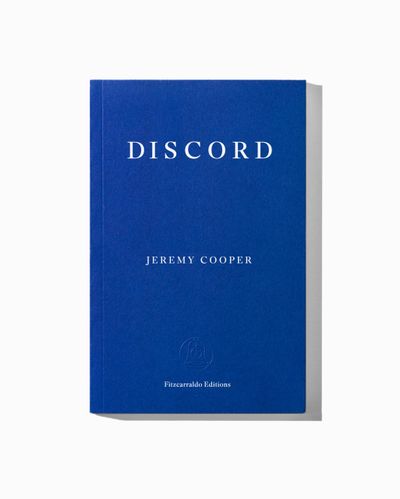
Discord
French paperback with flaps, 248 pages
Published 12 February 2026
Discord
QUEEN’S PARK (I)
Rebekah was travelling by train from her home in Devon up to London for a week’s work at the Horticultural Society in Peckham. Possibly longer, depending on the outcome of a meeting the next day in Queen’s Park, on the other side of town.
Front-facing window seat a necessity, booked by telephone to be certain of no mistake. Her trust, in others as in herself, had always been tenuous, the years of consequent unease registered in lines across the bridge of her nose and thinning head of once-dense auburn hair. A sigh of relief to find the adjacent seat unoccupied, her canvas holdall placed beside her to discourage use by another traveller. Though she disapproved of this antisocial act, her guilty conscience was a price worth paying to prevent proximity. In the course of her professional life as a musician, Rebekah had developed an amplified sensitivity to sound and by now, at the age of almost fifty, she found close to intolerable the noises made by the mildest fellow passenger. Gratuitous little coughs, the munching on a sandwich, a lick of the fingers to turn the page of a glossy magazine. The silk chafe of thighs crossed and uncrossed. Not long ago, on a crowded train travelling from Paddington to Penzance via Tiverton Parkway, her stop, she had been forced to move seats to escape the breath-beats at her side of a snoozing accountant – as she had reckoned he must be, from the tombstone briefcase at his feet. Even without these human intrusions, actual silence did not of course exist, least of all on the railways. It was just that Rebekah found it harder under certain circumstances than others to cut from consciousness extraneous noise. Paradoxically, in solitary time she sought out sound, listened with obsessive attention to the clamour of nature, to variations in the wind’s whisper through the leaves of diverse trees and to the calls of the ewes on her husband’s Exmoor farm, the notes and pitches of which she transcribed in the notebook she carried with her everywhere. Learning to listen and to hear was her forte, she felt, prominent in her mission to compose memorable music.
As she settled into the familiar rhythms of the train journey up from the West Country, taken countless times, Rebekah gave some thought to the hopes for this second visit to the Peckham Horticultural Society. Inspiration tended in her case to surface from unexpected directions, instinctively convincing and at the same time hooded in bewilderment as to how it might practicably be possible to harness the revealed material. The purpose of her initial visit to the Society a month ago, arranged when they eventually opened their doors post-pandemic, was to study a series of nature diaries she had read about online, kept during the war by a widowed mother of three, recording life on her allotment in a fenced-off corner of nearby Peckham Rye. The diaries were unillustrated, non-literary, devoted to numerical detail of annual variations in the date her extensive crop of vegetables and fruit – berry bushes, mostly – reached maturity and the quantities produced over the documented period. Rebekah found herself captured by the idea, which she knew was farfetched and had mentioned to no one, that the seasonal notes taken meticulously throughout the later years of the War by this independent working woman formed abstract patterns of natural truth. If only she could crack nature’s code and identify the system. At the very least the diaries fuelled Rebekah’s desire to experiment with shifts in musical time and rhythm that transcended routine notation.
More than this – and more importantly – she was convinced that a specific beauty resided within these purposeful numbers.
The place itself appealed to Rebekah, in particular the Edwardian library and its long oak table at which readers worked, facing leather-fringed bookcases fitted floor to ceiling around the walls, overfull, volumes stuffed horizontally in gaps along the top of the vertical rows of books. Schoolchildren visited in small groups and were guided through the building by affable assistants. Apart from the Head Librarian, almost everyone was a volunteer, Rebekah suspected, including disparate teams busy in the gardens and herbarium, men and women of mixed ages working together, she noted, in surprise and admiration. A contradictory part of Rebekah drew strength from the hubbub in the library, the opposite of concentrated silence in the classical music collections in which she normally studied, where speech was banned and disposable latex gloves obligatory in the handling of manuscripts. At the Horticultural Society, Rebekah on occasion interrupted her reading to listen in to the conversations.
‘With all the building work at London Bridge Station I get lost. Don’t you?’ someone said – not to Rebekah, to somebody else.
‘It’s because of the Shard,’ the other woman commented from behind a pile of cookery books. ‘Worth it, though. Landmark building.’
Maybe because of her pleasure at the Shard’s belated British debut by Renzo Piano, one of her architectural heroes, Rebekah found herself joining in.
‘Once, looking for the Peckham Rye train,’ she said, ‘I was swept along to the wrong platform by a crowd of commuters.’
The warmth and inclusiveness of the women were not qualities which Rebekah normally noticed, or particularly liked when she did, and she wondered what made the difference to her here.
Nothing. As far as she could see.
A mystery.
Through the carriage window Rebekah checked progress.
The train was passing Frome Livestock Market, where they sometimes sent their sheep from Kilham to auction. Westbury soon.
She picked up the novel she was currently reading, which she was beginning to see as a narrative of psychotic withdrawal, an absolute cutting off.
How personal to the author, she wondered, to what extent autobiographical.
Bound to be, to some degree. All the art to which Rebekah was drawn, in music, fiction, film and theatre, exposed the self in one form or another. Her own work too, presumably.
She turned to her bookmarked place, recalling with pleasure the author’s reference to buildings, which were, along with sheep, Rebekah’s main non-musical interest. Without reading a word, she closed the book and put it back down on the hinged tray, returning in her mind to the Society and the vital place she expected the analysis of the diary numbers would take in her big new composition. With this source as her guide, it was impossible not to hope for something decent to happen. Improvement on the past, if nothing else.
(…)
‘Although the novel twinkles with humour, Cooper never signposts what we should think; his crisply managed scenes, borne chiefly on drifting tides of thought and memory, let us draw our own conclusions about the characters’ crisscrossing temperaments…. His unsolemn yet wholly unsatirical treatment of his characters’ seriousness is key (as in Brian) to the powerful emotion Discord generates…. And for a book without a plot, our anticipation is electric when, with 40 pages to go, we realize we’re still weeks away from the performance; the ending, when it finally comes, is exquisitely poised.’
— Anthony Cummins, The Observer
‘Jeremy Cooper’s most recent books have amounted to a cogent and quietly fascinating project: to represent the day-to-day reality, and the consistent application required, of a serious artistic life…. In a largely jargon-free but erudite register, Cooper frames the endeavour of both committed artists as they struggle to execute the ideas in their heads. He avoids the clichés of an “unlikely partnership” story…. If they change one another, it’s in barely perceptible ways, the most subtle and ambiguous of which is saved for the final cadence: just the right amount of imperfect. This is a working relationship that is peripatetic and fleeting, but which, for a while at least, alters both lives.’
— Jonathan McAloon, Financial Times
‘Cooper charts the ebb and flow of the women’s relationship with meticulous precision [and] richly conveys the intricacies of artistic collaboration.’
— Micheal Arditti, Spectator
‘In his mesmerizing 2023 novel Brian, Jeremy Cooper told the story of a reclusive middle-aged council worker who is rescued from loneliness by watching nightly screenings at the National Film Theatre…. The same transformative power is at work in Cooper’s latest novel, Discord, but here the lived experience of art is seen from the inside… [As] the world premiere at the Royal Albert Hall approaches, and Cooper fills in his parallel narratives with common themes and leitmotifs in the two women’s very different back stories, the reader begins to sense a kind of contrapuntal harmony underpinning their collaboration, and the significance of discord in music as well as in life.’
— Hugh Barnes, Arts Desk
‘Discord charts the collaboration – Rebekah at the piano, Evie on her saxophones – and their resulting conflicts over matters such as reconciling the personal and the musical, devotion to craft and how art should recognize and respond to the wider world…. Cooper offers a hopeful view, hinting that creativity may reside in exactly those gaps and imperfect connections – not just between artist and muse, notes and words, but between performer and audience, manuscript and concert hall, head and hand.’
— Rachel Armitage, Literary Review
‘Cooper’s novels remind us that an artistic life is all about practice, a way of living: observation, questions, uncertainty…. As a material existence, an artistic life offers little more than the aesthetic trappings of bourgeois security; but as a practice, an artistic life is one of risk, chance, missed opportunities, discordant notes…. The success of the public performance that frames the novel’s trajectory and marks its climax, stands alongside the narrative of a more complex artistic journey for both characters that asks whether success and failure are even the right weights with which to balance the value of artistic practice.’
— Thomas Chadwick, Review31
‘It’s very hard indeed to write fiction about music but Jeremy Cooper does so with triumphant aplomb. Discord is a tremendous, quietly enthralling achievement.’
— William Boyd, author of The Predicament
‘Jeremy Cooper’s Discord is as nakedly truthful a novel as you could ever hope to read. Its characters are completely and utterly convincing and their interactions with one another are filled with all of the loveliness and foolishness and tenderness of real life.’
— Aidan Cottrell-Boyce, author of The End of Nightwork
‘Quietly, irresistibly compelling. Jeremy Cooper’s interior worlds fill you up, become the air around you, conduct the sounds of every day – while you are reading, and while the book waits for you to pick it up again. Discord is an enthralling human melody.’
— Ben Pester, author of The Expansion Project
Praise for Brian
‘Easily the best novel I’ve read this decade.’
— Olivia Laing, Guardian
‘Brian is affecting, funny and, at 184 pages, a skilfully compressed chronicle of one man’s life and the cornucopia of film that enriches it.’
— Max Liu, Financial Times
‘Cooper does a superb job of inhabiting this singular character’s point of view, and of deftly weaving into the narrative Brian’s thoughts and feelings about the films he sees. I was delighted by the book’s gentle humor and lucid prose style, and I can think of no finer exploration of what can happen when a person is fully open and attentive to art, and how a shared passion for art can connect people to one another.’
— Sigrid Nunez, New Yorker
‘There’s a strange magic to Jeremy Cooper’s writing. The way he puts words together creates an incantatory effect. Reading him is to be spellbound, then. I have no idea how he does it, only that I am seduced.’
— Ben Myers, author of The Offing
‘What makes Jeremy Cooper’s seventh novel appealing and convincing is the author’s serene prose and tender, understated empathy…. This is an affectionate, thoughtful portrait of a gentle soul.’
— David Collard, Times Literary Supplement


