In August 1939, a ship flying the Polish flag docked in Buenos Aires. On board was a delegation of businessmen, diplomats and journalists. Days later, the captain received orders to return home with all crew and passengers in light of the imminent outbreak of the Second World War. But one man, fascinated by the city, chose to stay at the very last minute. Thus began the unexpected twenty-four-year Argentine exile of one of the twentieth century’s major writers: Witold Gombrowicz. Drawing on his writings and interviews with surviving disciples, writers and scholars, Mercedes Halfon’s Outsider Everywhere traces Gombrowicz’s Argentine years in elegant, pared-back prose, and composes a vivid account of mid-century bohemia in Buenos Aires. Brilliantly translated by Rahul Bery, Mercedes Halfon’s Outsider Everywhere is a gripping portrait of a literary figure on the margins who rose to prominence late in life to become ‘one of the greatest novelists of our century’ (Milan Kundera).
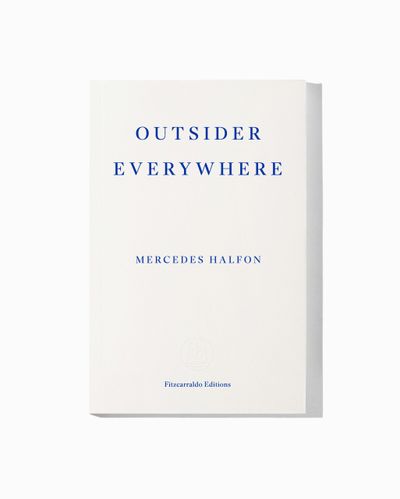
Outsider Everywhere
Translated by Rahul Bery
French paperback with flaps, 152 pages
Published 23 April 2026
Outsider Everywhere
Translated by Rahul Bery
The scene is something like this: one leaden winter morning the Chrobry, a luxury liner that set sail in Poland and has been travelling across the Atlantic Ocean for over twenty days, approaches Buenos Aires. The passengers include diplomats, businessmen, politicians and writers invited by the shipping company to cover the vessel’s maiden voyage. They include Witold Gombrowicz, a young avant-garde writer with piercing eyes and a disdainful grimace. From the estuary of the River Plate, the city looks mysterious, almost smudged, its lines seeming less refined than those of Paris but more modern than Warsaw’s. The passengers disembark to discover this distant country, cold and damp, their hands in their pockets. Beyond the new port’s small promenade Retiro, the Torre de los Ingleses and Calle Florida appear. Some go back onto the ship, where they are met with multiple receptions laid on for ambassadors and personalities from the Polish and Argentinian community. But not Gombrowicz. He keeps walking. He returns to the ship to sleep before going out again. Over several days, he exhausts those streets, those faces, those features of the men and women of the South. Something opens. Or breaks, perhaps. Something becomes detached.
Much later, in Trans-Atlantyk, he will write: ‘I was looking as if through a Telescope, and, seeing Strangeness everywhere, Unfamiliarity and Puzzle.’
As the warm welcomes, teas and receptions continue, news comes in from across the ocean. The tension between the major countries is rising. Germany and the Soviet Union sign their non-aggression pact. War seems imminent. The Chrobry is ordered to return to Europe with all its crew. Gombrowicz goes to the port, puts his luggage on the ship, says his goodbyes and boards. But when the alarm sounds, indicating that the ship is ready to depart, he acts on impulse. Carrying his two cases, he quickly descends the gangway onto the dock. He will not return to Poland, to the war that seems so likely. He has 200 dollars and just a few changes of clothes. He hardly knows anyone. And no one knows him.
Some say it was 20th, others 21st, others 22nd August 1939. He himself gave different dates in his Diary, in the book of interviews called A Kind of Testament and in the novel Trans-Atlantyk. The story, which he also told in person to anyone who would listen during his time in Argentina, is that the outbreak of war anchored him to this distant land. But that wasn’t exactly the case. The anchor was dropped on impulse a few days after the war started.
Much later, he wrote in his Diary: ‘I don’t know if I will be speaking lucidly enough when I say that from the first, I fell in love with the catastrophe that I hated, that, after all, also ruined me. My nature told me to greet it as an opportunity to join with inferiority in darkness.’
Later still, he said that walking off the ship that afternoon holding his two cases, trying to understand what he had just done, was the most tragic moment of his life.
‘Writing about Gombrowicz poses a singular challenge for any biographer who chooses to write about him. Halfon takes it up admirably and manages to go beyond the life he lived and the way in which he constructed himself to get to the truth of his character…. A perfect portrayal.’
— Martín Kohan, Revista Ñ
‘One of the most interesting voices in contemporary literature.’
— Pedro Mairal, author of The Woman from Uruguay
‘With the sensitivity of a keen observer, Halfon speaks of herself when she speaks of the world, and vice versa.’
— Alan Pauls, author of The Past
‘Some authors seem to work by following the ellipses of a previously established canon. And there are others who seem to be guided by a sort of intuition, a pulse that is a mix of desire, desperation and fearlessness of the unknown. Mercedes Halfon belongs to the second category.’
— Mauro Libertella
‘Halfon’s work achieves something that rarely happens in these types of biographical texts: it brings Gombrowicz back to life, makes him walk again through Buenos Aires, allows him to inhabit his everyday life.’
— Imanol Subiela Salvo, Página/12
‘A book that can almost be read in one sitting, where the reading revives the experiences of the Polish writer and makes us want to seek out all his work.’
— Andrés Manrique, ANRed
‘An atypical writer herself, as demonstrated by the subtle El trabajo de los ojos and Diario pinchado, Halfon does not sugarcoat the peculiarities or contradictions of her subject. Gombrowicz was a difficult man. Those seeking the origin of the myth will find it, but they will also find tools to think about literature, its behind-the-scenes world, and forms of consecration and circulation.’
— Raquel Garzón, Cuadernos Hispanoamericanos
Mercedes Halfon was born in Buenos Aires. She has published three novels, six poetry collections and one work of non-fiction. With Laura Citarella, she directed the film Las poetas visitan a Juana Bignozzi (2019), which won the Best Director award at the Mar del Plata International Film Festival and the Silver Dove award at the DOK Leipzig Festival. She curated the theatrical cycle ‘Invocaciones’, held at the Centro Cultural San Martín and the Teatro Nacional Cervantes. She teaches in the Writing Arts programme at the Universidad Nacional de las Artes and writes for the Radar supplement of the newspaper Página/12, among other outlets. Outsider Everywhere: Witold Gombrowicz in Argentina is her first book to appear in English.


