Set during a single twelve-hour night shift in a factory, plastic is a book-length poem exploring the life of the industrial worker turned poet. Bringing together memoir, ekphrasis and satire, plastic is based on Matthew Rice’s experience working in a plastic moulding factory for ten years. Illustrating alienated twenty-first-century Irish labour in poetic form, plastic engages with the inflictions and implications of a ‘post-industrial’, ‘post-Troubles’ society, all while weaving in depictions of factory work from literature, film and the visual arts. Time-stamped to highlight the claustrophobia of the worker’s experience, this is a poem about feeling a calling while being submerged in the world of menial labour – making plastic airplane parts by night, making poetry by day, uniting what Jacques Rancière calls the ‘labourers in love with the intellectual nights’ and those ‘intellectuals in love with the toilsome and glorious days of the labouring people.’ plastic’s evocation and lucidity moves with grace through working class realities and hopeful imaginings.
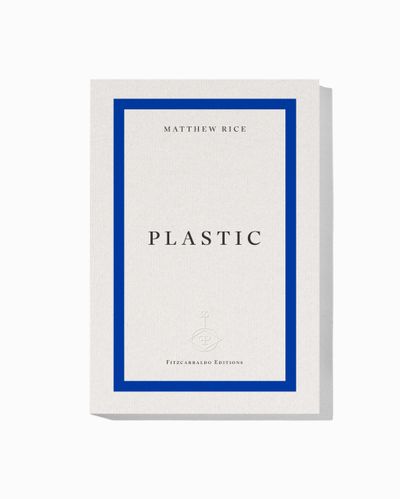
plastic
French paperback with flaps, 112 pages
Published 29 January 2026
plastic
Just as accidents wait
for boredom,
as illness waits
for health,
as comfort waits
for unemployment,
and salary cuts for wealth,
so may I, driven
to the industrial gate,
look for the treasure
buried
in my father’s field.
I wake at 3 a.m., the hour no one
wants. Really, it’s my heart that wakes me
beating its way out.
I pace the floor and sing under my breath
the song of the calm
and wonder if the factory is doing this.
It’s Monday tomorrow, it always is when dreams are alarms.
How twenty-first century
the factory we pull ourselves out of bed for
the cliffs inside us crumbling into the ocean,
nozzles purging old material for moulded births,
frequent-flying formaldehyde greeting our lungs
the clock-in machine says thank you thank you
thank you to our fingerprint;
our grateful fifteen minutes at ten o’clock
the fresh air of a cigarette.
Bobby the Spark parallels the hours ahead
with a marathon, not a sprint, to be countered
with an ultramarathon, not a marathon,
as the weekly wage puts us back in the black;
we see it out till eight, the day shift finish at five,
laying down their dustpans and brushes, emptying the bins.
[Night shift]
Always on the drive to the factory I visit
somewhere I’ve never been, Amsterdam
sometimes, a gust of gulls sown
over the Singelgracht; or to Ronda maybe,
another timeline where the matadors
for good lay down their muletas.
The car park’s uninsured Novas
slumber like peccadilloes and amid
night’s tranquil abuse confectionaries of light
mean the moon to us sleepless
for the sake of the sleeping – this strange
hour this strange roost some fowls flutter
into, whose word you’d take
as you would a diamond.
19:57
The French horn of the snail
in the car park is equal
to the aperture of the wind
and silent as a bell.
Though no winter breath halos
above its head,
its pumpenvalve trail
glistens a path beyond the dead.
20:00
Abbots Cross Primary, rain-driven commutes,
butterflies in the back of a Talbot Sunbeam,
all becoming one with the promise of ordinary things.
The ’80s have been and gone leaving only my disdain
for the factory radio blaring
Tina Turner’s ‘The Best’.
Once, in this building, a kid clocked off night shift
for good at the end of a rope,
another’s heart gave out at 3 a.m.
performing a task as menial as mine.
I think
of the Rue de Seine,
ne travaillez jamais
eroding into the wall.
20:01
It’s been fifteen years
since he arrived
with a few empty phrases
to work through the night,
a shaft of morning sun
warming his fleece
when, near the big machine,
they found him hanging
at the first klaxon.
(…)
‘In Matthew Rice’s furiously everyday and erudite book, all senses of plastic are in play, but this is first of all a (seemingly autobiographical) study of the rigours of work in a plastics factory in the poet’s native Northern Ireland…. In the end, [plastic] is also a poem about knowledge and art: the words and music and imagery that live alongside the night’s labour, that make it bearable and at the same time highlight its violence.’
— Brian Dillon, 4Columns
‘Whether Rice is observing the enforced machine-order of the production line, evaluating his own thoughts about cinema, music and literature, or empathizing with the other workers, each individual short poem is a cherished fragment of perception seeking a moment of freedom from the tyranny of its time-stamp… [T]he poems in plastic both honour and transcend their traditional factory setting, and remind us of how much there could be to gain in the dawning digital era.’
— Carol Rumens, Guardian
‘This sardonic, bleakly moving book interrogates ideas of working-class masculinity and intergenerational trauma, with “hell as an idea of what work could be”; there are glimpses of hope in poetry itself, “the treasure buried in my father’s field”.’
— Jennifer Lee Tsai, Guardian
‘plastic … is perhaps the most realistic poetic depiction of industrial work since Philip Levine’s seminal What Work Is…. plastic is by no means some mere drudge’s journal. It is as much a document of the moments that punctuate the in-between space of shift work as it is a rote description of labour itself. Rice’s hours are filled with daydreams, doodles, snatches of song, conversations, bathroom breaks, contraband books, cups of coffee, cadged cigarettes and, yes, finally the “bagging and tagging” of the job itself…. Beautiful.’
— James Patterson, RTE
‘[F]orceful… plastic by Matthew Rice is that all-too rare thing – poetry about work…. [It] deserves to be recognized for its attempt to both portray the despair of low paid, alienated labour and try to sketch a way out, despite the decline of working-class militancy which has resulted in such an oppressive, futureless, fractured workplace…. Resistance can, as a start, be composing a poem in the jacks. It can be reading Gawain in the boss’s time.’
— Nick Moss, Culture Matters
‘Matthew Rice’s plastic goes where poetry seldom does: the factory floor, the canteen, the night shift, and it does so astutely and with insight and grace. This is real and vital work.’
— Nick Laird, author of Up Late
‘In plastic, the hours are “bent out of time” and slowed to their minutes on a factory night shift, where workers are churned in liminal borderlands and clocked by the ever-present spectre of death. Here, the relentless and precarious cycle of avoiding getting fucked over or worse in “far too narrow” circumstances. Rice is attuned to sound, and in these moving, visceral and formally precise poems, we are given dazzling glimpses of whole worlds lying just beyond the relentless tightrope of these dented, “bastarding jobs”. At the outset, the speaker confides: “Really it’s my heart that wakes me”. In this way, genuinely beautiful moments of hope and revelation spring from cracks in the strange and ominous like sparks from a grinder: crisp packets “doin’ the tango”; a smiley on the window; twin hares in an industrial park; machinists as concert pianists in another life, another universe. Rice’s book is one of deep compassion and vulnerability. plastic is 4am light in dark times.’
— Dawn Watson, author of We Play Here
‘plastic confronts the daily realities of work and labour, revealing how the body endures the relentless grind. Yet within these poems are flashes of light, moments of grace and a quiet, fond sensibility. This continuous narrative offers a hopeful, heartfelt reorientation, reminding us of the vitality found in the overlooked lives of many. Surprising, tender and true.’
— Hatty Nestor, co-author of The Aching Poem
Matthew Rice was born in Belfast. Poems have appeared in The Poetry Review, Poetry Ireland Review and The Forward Book of Poetry 2022 (Faber). He holds an MA in Poetry from Queen’s University, Belfast, and a PhD from The Seamus Heaney Centre at Queen’s. His debut collection, The Last Weather Observer (Summer Palace Press), was published in 2021 and was included on the Arts Council of Northern Ireland’s top ten books of the year.