What does it mean to lose yourself – and is that something you should be aiming for? A young woman with little interest in games takes up a job in Frankfurt at a famous gaming company, naively set on reinvention. On her morning commute, in the familiar clutches of tedium and self-loathing, she encounters a nice-eyed stranger who returns her forgotten umbrella and finds herself catapulted into a dizzying, year-long whirlwind of obsession – not just with this endlessly attractive spectre, but also with the feverish karaoke trips from which she draws the ultimate solace. With astonishing existential acuity, Polly Barton’s formidable debut novel renders the paradoxes of modern life in all its complexity, in deliriously self-conscious prose that is at once propulsive, titillating and bitingly funny. Echoing with the sounds of Whitney Houston and The Cure, reaching for the sublime in dark, sweaty boxes, What Am I, A Deer? is an exhilarating exploration of authenticity, fantasy, romance and intoxication.
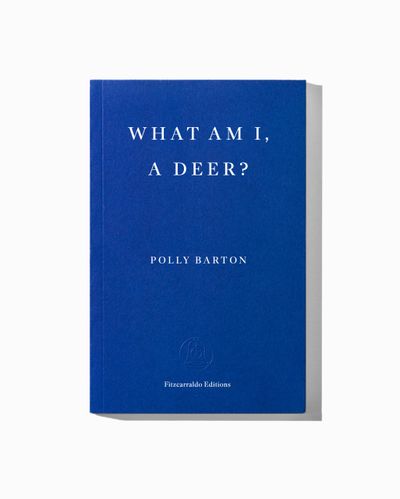
What Am I, A Deer?
French paperback with flaps, 248 pages
Published 9 April 2026
What Am I, A Deer?
You are a girl, twelve years of age, still small enough to fit into your mother’s gold satin nightie, still too far removed from puberty’s comprehensive rewiring of reality to suspect that someday that might not be the case, still so perfectly and utterly flat-chested that the nightgown’s plummeting neckline seems destined to be either a sad mockery of your figure or an inappropriate choice for a pre-pubescent girl, depending on your view, and yet neither of these, as it happens, turns out to be your view, which is likely bound up with how neither seems to be your mother’s view either, when you slip it on she nods once, deeply, then laughs in approval, a reaction which seems to come down at least in part to the way that the pieces of satin are stitched together, which is to say, when you step over to the mirror you realize with a shock that the slight darting at the bust has made it look as though there is something more than just air down there – but no, it’s not just that, it’s as if the satin nightie has moved you into a world where you do have breasts, allowed you to believe that you really do have them, a magical sort of belief which is very closely related to the feeling that in fact anything is possible, any transformative feat of the imagination is possible, and it’s on that basis that you decide that the garment will do for the occasion in question, namely, your transformation into Céline Dion. You’re in your first year of senior school, it’s your class’s turn to do (the only verb ever used) an assembly, and you’ve decided to do Top of the Pops – in all your enthusiasm you’ve misunderstood the remit, failed to realize that you’re not just there to put on a grand old show for everyone to enjoy, a point that in fact will not become clear to you until after the big day has been and gone, and you are cautioned by your form tutor for the fact that your assembly didn’t have any kind of educational content, albeit a head-hanging, don’t-shoot-the-messenger sort of cautioning, because of course he had watched the whole spectacle unfolding, been in attendance at all the planning meetings and rehearsals and not once suggested that you might want to include some kind of moral or takeaway or message, so for him to turn around and say that now is pretty hypocritical and he knows it – and everyone has volunteered to do the acts that they want to do, mostly they have teamed up with other people to form bands, but what you want to do is Céline Dion, who is of course a solo act, although you’ve asked two friends, one of whom is the other person who always gets top marks in French class, and they’ve agreed to be your backing dancers.
It’s not only that it’s Céline Dion, that’s the thing, it’s that you’ve decided that the song you must sing is the song you are utterly obsessed with at the moment, which is in French, and as you are in year seven and only have a few months of school French behind you, you don’t really understand a lot of the vocabulary, or the grammar, but you have spent a long time poring over the lyrics and the sound of them is lodged in your head and you know that the song is very desperate and very romantic, an impression which is – naturally – exacerbated by the fact that you don’t properly understand it, but it seems, in the context of the assembly, like an interesting enough bid, and besides, although the class was supremely keen on the idea of doing Top of the Pops, and it was voted for against the other proposed ideas by a majority of thirty one in a class of thirty-five, the number of people prepared to put their necks on the line and actually sing turns out to be pretty small, so really, whatever you want to do goes, if you’re impervious to being shamed. And you’re not impervious, definitely not impervious, even at this age, but somehow in this case your determination outstrips your porosity. You will sing Céline Dion in a revealing gold satin nightie with a hairbrush as a microphone. Your hair is a bit like hers as well, at least in some photos from when she is young, although by the time of the photograph used on the cover of D’eux, the album from which the single ‘Pour Que Tu M’Aimes Encore’ is taken, she has cut it a bit shorter than yours.
What happens on stage, more specifically, in the wings of the stage, is ludicrous. Looking back you think it must be a set-up, although you also doubt the people in your class would have had the temerity to pull off something so blatant, but in any case, it emerges that your tape won’t play – just your tape, none of the other performers’ tapes – and later it transpires that the side of the twin tape recorder into which your tape was inserted had its volume turned down, and nobody had noticed, thought to notice – really, you think, are you serious – and so you have to make a decision on the spot whether to abandon the whole thing or to go on and sing without accompaniment, and you decide that you will do it, you’ve been rehearsing for this for a long time, but your backing dancers baulk at the prospect and drop out, because not only is it not cool to sing solo but it’s also not cool to be seen with someone so disastrously uncool, so you shuffle onto the stage alone in your gold satin nightie, and sing, in French, a cappella, to a thousand people.
If someone had said to you before that day that it was possible to tell whether silence in a room was benevolent or hostile, was warm or cold, you would have looked at them in confusion, but that morning, even though you know you are doing something bold enough that even your backing dancers would rather not risk being seen with you, you can also feel that the silence is receptive, lets your voice in as a slice of cheese left out for too long accommodates the knife, willingly. Which is not to say that it is taken with total straightness, of course, or that the silence is complete, because there are whoops and cackles, and you are told afterwards that your French teacher was wiping actual tears of laughter from her eyes, but when it finishes there is a round of applause that from where you’re standing is infused with something you can only really describe as a ferocity, the growl and the silver glimmer of a wolf ’s howl, and what that does to you is also not easy to describe, but it’s something to do with blood vessels all across your body, and this feeling that – you don’t want to say everything is good, it’s not that, but maybe more like – things are as they should be.
For the rest of the day people keep coming up to you in the corridors, turning around and looking at you and then coming up to you, and what they say, extraordinarily, is: hey, you’re a really good singer. Which is weird, because of the multiple things you are, a good singer isn’t one of them. You can accept that you were brave to do something like that, but that’s quite a different thing, and even hearing it from them doesn’t change your mind on that, there doesn’t seem any factual leeway for it to be changed. Your school isn’t an unmusical place either, there are good singers and choirs and stuff there, you’d think they’d know, but they seem not to, it’s genuinely odd, and what forms over the course of the day is the inkling of a truth which you will spend the next decade of your life forgetting: if you’re sufficiently brave and sufficiently nuts then it serves to delude people about your levels of talent.
Really the weirdest thing, though, the thing that feels best of all, is not becoming a school celebrity for the day, or being deemed a talented singer, but rather the fact that you haven’t been pulled to shreds. What you did on that stage – when you overlook the part with the satin nightie, which even very shortly afterwards starts to seem a bit weird and salacious – was to expose the very nerdiest part of you, the part of you that memorized French love songs and stared at Céline’s album covers and waited impatiently for her videos to appear on MTV during the short spurts you got to watch it at your friends’ houses, and which, if it were a colour, you feared would be a sort of brown. You showed your weird shameful scantily clad brown part to the world, and here you are, walking up and down the stairs of the school, and people are smiling at you as though they don’t find you disgusting. As though they are not disgusted by your body, your face, your voice, your obsession, your weird, acquisitive desire to memorize things, even if they’re in a foreign language. They smile at you in familiarity and some kind of admiration. There is nothing to suggest that they don’t accept you.
(…)
‘Polly Barton’s What Am I, a Deer? is a beautiful piece of writing. An expansive, ambitious, witty stream of consciousness, this is a novel of, and about, translation – not just linguistic translation, but the acts of self-translation we are called upon to perform constantly in the modern world; translating our experience via the disparate languages of personal history, intimacy and class. This a novel that confronts formally the fractals of the self, in a voice that feels confident and yet insecure, cerebral and yet vulnerable. I loved it.’
— Susannah Dickey, author of Common Decency
‘I’m nuts about this book – a romantic comedy in the most wildly open and profoundly honest sense, a tour-de-force of the telling detail, an electrifying contemplation of our capacity for risk.’
— Jeremy Atherton Lin, author of Deep House
‘What Am I, A Deer? is profound, funny and true. With biting precision, Polly Barton marries the mundane with the transcendent, asking whether we can ever truly escape ourselves and the societal structures around us. Her prose is incisive, moving and beautiful – I loved it.’
— Jessica Andrews, author of Milk Teeth
‘In this sparkling novel of ideas, Polly Barton illuminates the shame of loving what other people love. How embarrassing to find your feelings perfectly summed up in a cliché, to sing a pop song and mean every word! In Barton’s hands, the cringeworthy passions become tools of self-knowledge and keys to a philosophy of the glorious banal. Gaming, karaoke, drunkenness, romance – there is nothing more revealing than the everyday escape.’
— Sofia Samatar, author of Opacities: On Writing and the Writing Life
‘A tender and nuanced novel exploring love, obsession, alienation, work and language with an immense sense of interiority. Polly Barton is capable of capturing fleeting, seemingly unremarkable feelings with perfect precision that cuts through to the reader’s very core – it made me stop and gasp several times as I recalled feeling exactly this way. It speaks to how we yearn to connect but often fail to truly see each other, and to the fundamental, gargantuan power of a crush. Karaoke will never be the same again!’
— Anastasiia Fedorova, author of Second Skin
‘The protagonist of What Am I, A Deer? finds herself both Schrödinger and his cat on entering the Frankfurt tram, the office, and the ‘black box’ of the karaoke booth; inside and outside simultaneously, trying to figure out whether she exists and in a state of tingling oscillation. Polly Barton is the maestra of controlled dissolution.’
— Jen Calleja, author of Fair: The Life-Art of Translation
‘What Am I, A Deer? is a playfully and obsessively observed novel about the pleasures and humiliations wrought from the foolhardy desire for recognition. Barton’s style of address strikes a brilliant balance between a camp-ish hyper-attention to the currents of power driving language and culture, and an earnest attention to the nuances of yearning. Like a Bernhard novel, What Am I is rich with inference, wacky enmity and genuine delight, the most striking of which is Barton’s exquisite command of her sentences.’
— Ellena Savage, author of Blueberries
Praise for Porn: An Oral History
‘I found my time with Porn: An Oral History unexpectedly moving. Barton’s candid, generous style as an interlocutor allows her subjects to move fluidly between their sometimes contradictory instincts and intellectual approaches in a way which feels revelatory and totally honest and human. A pleasure to read, and a vital new work for anyone interested in sex and its representation.’
— Megan Nolan, author of Ordinary Human Failings
‘I wasn’t expecting nineteen conversations about porn to make me feel as I felt after reading this book: grateful and hopeful and wide-open. Porn is a generous, intimate commentary on how we relate to one another (or fail to) through the most unlikely of lenses.’
— Saba Sams, author of Send Nudes
‘Porn is a fascinating, timely and humane testament to the value of uninhibited conversation between grown-ups. Its candour and humanity is addictive and involving – I couldn’t help but join in with the pillow talk! Reader, be prepared for your own store of buried secrets, stymied curiosities, submerged fantasies and shadowy memories to shamelessly awaken.’
— Claire-Louise Bennett, author of Big Kiss, Bye-Bye
‘Porn is many things – a prompt for dreams, the outsourcing of fantasies, a heuristic for the construction of desire – but it is often omitted from our “spoken life”, to use Polly Barton’s wonderful phrase. In Porn, she manages to get people to talk about this subject both omnipresent and omnipresently swept under the rug, peeling off her informers’ ideological armour to get at what they really like and why, and invites us to ask, without forcing any answers, what it means for an entire society to possess an entire guilty conscience surrounding a genre now constitutive of our understanding of what sex is.’
— Adrian Nathan West, author of My Father’s Diet
‘Polly Barton is a brilliant, learned and daring writer.’
— Joanna Kavenna, author of ZED
Praise for Fifty Sounds
‘Witty, exuberant, also melancholy, and crowded with intelligence – Fifty Sounds is so much fun to read. Barton has written an essay that is also an argument that is also a prose poem. Let’s call it a slant adventure story, whose hero is equipped only with high spirits, and a ragtag band of phonemes.’
— Rivka Galchen, author of Everyone Knows Your Mother Is a Witch
‘This book: a portrait of a young woman as language-learner, as becoming-translator, as becoming-writer, in restless search of her life. It is about non understanding, not-knowing, vulnerability, harming and hurt; it is also about reaching for others, transformative encounters, unexpected intimacies, and testing forms of love. It is a whole education. It is extraordinary. I was completely bowled over by it.’
— Kate Briggs, author of The Long Form
‘It seems fitting, somehow, that this marvelous study of the expansiveness and precarity of human communication is so woefully ill-served by a literal description of its contents. As in all great works of genreless nonfiction, all of the subjects Fifty Sounds is putatively “about” – Japan, translation, the philosophy of language – are inspired pretexts for the broad-spectrum exercise of an associatively vital and thrillingly companionable mind. This is a gracious, surprising, and very funny debut from a writer of alarming talent.’
— Gideon Lewis-Kraus, author of A Sense of Direction
Polly Barton is a writer and literary translator from the Japanese. Her translations include Butter by Asako Yuzuki, Hunchback by Saou Ichikawa, Where the Wild Ladies Are by Aoko Matsuda and There’s No Such Thing as an Easy Job by Kikuko Tsumura. She has published two works of non-fiction, Fifty Sounds, for which she won the 2019 Fitzcarraldo Editions Essay Prize, and Porn: An Oral History. What Am I, A Deer? is her debut novel.


