
A friendship is a filiation we choose. It holds love and laughter; it can extend our sense of the possible. Moved to honour a form of relation often subordinated to romantic and familial ties, and to explore a part of her own history, Hélène Giannecchini pieces together an alternative genealogy of queer ancestors. In searching and sensitive prose, she sifts the past to bring existences deemed ‘marginal’ into communion with each other, traces of which may remain only in memory and archival fragments. Roving from Casa Susanna, a space of freedom from persecution in McCarthyite North America, to the diary of a man living with HIV in France, and to the life and work of pioneering lesbian photographer Donna Gottschalk, each narrative counters oblivion through loving acts of witness. A slantwise gathering of queer life and activism in the twentieth century, interspersed with images encountered by chance, An Army of Lovers Cannot Fail establishes friendship as a vital political force and offers a moving testament to its liberatory power.
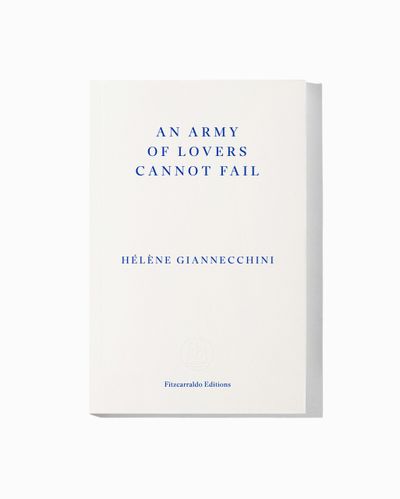
An Army of Lovers Cannot Fail
Translated by Anna Moschovakis
French paperback with flaps, 204 pages
Published 26 March 2026
An Army of Lovers Cannot Fail
Translated by Anna Moschovakis
MAKE AN EFFORT TO REMEMBER
There is a part of my history that I was never told. We don’t explain to children what we have not ourselves lived, we don’t prepare them for what they might become, but which we did not. My parents spoke to me of their lives, of their love affairs – how they’d begun and how they ended – of their friendships, of their convictions, of their doubts, even of their failures; they described the settings of their childhoods, recalled the professions of this or that relative and the countries where those who came before me had once lived. Of course, they must have kept some details to themselves, but no question I asked went unanswered. And still, I maintain: a part of my history was left unspoken.
Knowing my own family was never enough for me. I had a need for other affiliations, to expand and augment the primary ones: affiliations that had nothing to do with blood. I sought out people who, before my time, had built their lives around shared hopes and desires. I know how much I owe them, that they made my life possible. How to characterize this history I am pursuing: feminist, marginal, queer? Perhaps. It is a political history, a history of struggle and of friendship, of ‘minor’ attachments that are not inscribed in the archive, that disappear when those who embodied them disappear. It is a story that is still being written, still being reconstructed from often fragile traces, and must extricate itself from silence and from shame. I need it; without it, solitude takes hold.
For a long time, I believed I did not exist. Had I been looking for them, I would have discovered books, allies and witnesses, but no one set me on their track. This was as true of my family as it was of my school: in neither space was there talk of Magnus Hirschfeld or Sojourner Truth, of the suffragettes or Stonewall. It wasn’t until I fell in love, at nineteen, that a girl with round glasses and cropped hair explained to me that the Pride march where we had just spent the day dancing and chanting was a tribute to riots sparked in 1969 by trans women in a New York City bar – the Stonewall Inn – to resist police violence.
It was this same young woman who, in her subsidized university residence, handed me my first Monique Wittig book; it was she who introduced me to Judith Butler and explained that gender and sex were distinct concepts, and constructed. These ideas were such fuel for desire, they justified and grounded it so completely, even now I can’t disentangle them. I remember how, lying beside her in her twin bed, I felt intimidated and dominated by the unfamiliar names and her expression – so serious – as she pronounced them, by her blonde curls and revelatory ideas, by the desire that coursed through me and by these books I had never heard of, though they spoke to my experience. With her, I came to understand that our lives take on meaning through becoming linked to the lives of others. And that these others had, first, to be found.
Our relationship didn’t last, but what she gave me I have never lost. From then on, I understood how many words had gone missing, that some stories almost always remain untold. I understood that history is written in the voice of the majority, and for the majority’s sake. I went searching for my history so I could offer it to myself. It was Monique Wittig who set me on the path, she who had made that appearance in my first lover’s student bedroom: ‘You say there are no words to describe this time, you say it does not exist. But remember. Make an effort to remember. Or, failing that, invent.’* Simply to point to a missing history was not enough, was tantamount to defeat. At least this was how I understood Wittig’s words. If silence did not suit me, it was my responsibility to break it. Words were missing, yes, but facts and lives – these existed in abundance, waiting to be seen and spoken. So I listened to Wittig, I made an effort to remember, to seek out what I had not been given. And, when the sources contained too many gaps, when I was not able to fill in the blanks, I continued to follow her injunction: I invented. After all, family stories earn their name well: they are fictions in which we choose to believe. They are subjective and constructed, and that is what can make them beautiful. And relative. This simple fact gives us the right to invent alternate versions; if it’s all just stories, I’ll write the one that fits.
This form of memory that blends fact and fiction is, for me, a necessity. While deprived of a past, I am fragile, full of doubt. When Wittig’s amazons make the effort to remember themselves, ‘[t]hey speak together of the threat they have constituted towards authority’, they remind themselves of their strength and that ‘[t]heir conjoint power has menaced hierarchies systems of government authorities.’ To cut us off from the power of our history allows for our power to be minimized; the stories of marginalized groups are suppressed because they contain subversive possibilities.
So I created another family for myself to add to the one I had, a family of a different sort, expansive and political, a family that reminded me of how menacing and powerful we are. I chose all of its members. I was the one who composed my lineage, the past did not impose itself on the present as it normally does. I travelled to meet my elders, to listen to them, to consult their images and visit their archives. I returned from these trips with a little more of a past, and with a new sense of depth to my life. Much of the time this new amplitude propels me forward; sometimes it weighs me down. What I have accumulated is threaded through with power and joy, but also with profound violence. There are nights when I am depleted by all that I take in, all that I struggle to absorb, by these lives so burdened by norms they sometimes break.
I remember the last transatlantic flight I took, loaded up with the most precious of cargoes. The cabin lights went out, engulfing us in night. The plane shuddered with turbulence from the moment of take-off, and I fought against my fear. My seatmate, a woman of about fifty in a turquoise sweatsuit, was sleeping deeply with a mask over her eyes, and I glanced at her periodically to reassure myself: if there were any real danger, she could not be so relaxed. I tried not to move, to accept the roiling and the anxiety, the vague desire to vomit. I shut my eyes, summoned comforting images and let them parade behind my lids: rolling around with a friend in the snow; a brick row house in Brooklyn; mountains and an old house nestled in a valley; a T-shirt being removed to reveal a tattoo I touch lightly with my hand. I had unfolded the fleece blanket provided by the airline in order to disguise the backpack that, instead of being stowed under the seat in front, remained in my lap. I tried to visualize its contents. Whenever I thought we were about to fall, I clutched the pack a little tighter. It was this cargo that prevented the plane from taking a nose-dive and vanishing, of that I am certain. I couldn’t die on my way home from the United States with hundreds of the photographer Donna Gottschalk’s negatives in my possession: entire lives, traces of a history that unfolded before my birth and in a different country, but that I was sure was somehow also mine. She had made me swear to keep the package on my person – Keep it always with you – and I held to my word. Donna was only a year older than my mother, I often think. They were girls at the same time, in the 1950s, one in New York City, the other in Marseille. They embodied the two parallel affiliations that frame my life. Donna is an alternate version of my mother; I could have been raised by a lesbian photographer born in New York City. Why not?
Donna Gottschalk photographed the people she loved, with whom she shared her life: working-class lesbians, trans people, labourers, people living in the margins. She has said that she photographs the people no one looks at, those who are forgotten. As I feel the sharp corners of the archive boxes press into my stomach, I tell myself that if I am inventing new family narratives of my own, there’s no reason not to connect them with those of others.
*Monique Wittig, Les Guérillères (1969; tr. David Le Vay, 1971)
‘An Army of Lovers Cannot Fail is a florilegium of countersexual kinmaking, survival strategy, lesbian comradeship, dinner parties full of queer ancestors, fugitive photography, transfeminist acting-up, insurrectionary eroticism and pieces of anonymous queer archival ephemera from many lands, brought alive with the help of critical fabulation. The domination of the couple-form over human life can and must be brought to an end, and Giannecchini deftly points to all the places where it is already dead (or perhaps always was). At the heart of this beautiful book lies a deceptively incendiary critique of capitalist society. It asks a direly urgent question: can humanity rise to the challenge of the term “friend”? If not, how do we propose to live together?’
— Sophie Lewis, author of Abolish the Family
‘We could be friends, we could be lovers, we could be comrades. Queer people are specialists in the art of chosen families because we have to be. Giannecchini’s book is not just about such bonds, it’s made by making them. In a world intent on crushing us all into isolated particles, this is an essential guide for everyone in how to glue together a fuller and deeper life.’
— McKenzie Wark, author of Love and Money, Sex and Death
‘As someone who has long struggled with conventional ideas of family and marriage, I felt relieved and hopeful reading this searching text. Hélène Giannecchini swings open the doors to a great hall of kinship, camaraderie, companionship and neighbourliness. She writes with love and optimism and a desire that we may all become part of communities in which we endeavour, as friends, to hold one another up. This came at a difficult moment in my own life, a period shaped by the death of my father, and I am grateful to have been able to read it.’
— Lara Pawson, author of Spent Light
‘At once a memoir and a sociology of friendship, kin, and chosen family, An Army of Lovers is lucid, impassioned and reasoned to a fault. Alternating between intimate, personal narratives and research-based models of kinship, Hélène Giannecchini reflects on their myriad permutations and outcomes, and provides us with an urgent, amorous manual for living.’
— Moyra Davey, author of Index Cards
‘What a stunning, deep book! Giannecchini has dug down to the marrow, to find the sparkling cells that queer people through the ages have always made – the lights we’ve used to find each other. I am so relieved that this book found me, because life without books like these, as without friends, is lonely. Giannecchini’s work is to listen hard, to the voices of our queer elders, and to the signals from her own heart, and to share her findings with the world – we are all richer for her work. The writing shines; it is always brief, but never fast. Always thoughtful, but never heavy. I couldn’t stop reading, and I want to start again immediately.’
— Adam Zmith, author of Solemates
‘Giannecchini believes that friendship is a way of binding ourselves to others: it allows us to step outside the idea we have of who we are and to change our position. In this movement she finds a vector of joy and power. I like that. I like it because I had thought in recent months that we’d already said everything there was to say about friendship, and it turns out we hadn’t. This book fell into my hands just in time.’
— Pol Guasch, author of Paradise Burns
‘A tender treatise on the importance of queer friendship that offers alternative modes of being to resist the dual forces of capitalism and the heteropatriarchy, this book extends hope and solidarity through its considered, thoughtful prose. Through narrative intervention, both fictional and factual, Hélène Giannecchini illuminates the role archival work such as this can play in shaping queer life into a more optimistic future while acknowledging all that we owe to our past.’
— Elizabeth Lovatt, author of Thank You For Calling the Lesbian Line
‘This book is a small revolution in contemporary French writing.’
— Collateral
‘Hélène Giannecchini never gives the impression of appropriating the stories of others…. [T]he quality of the author’s focus draws from the resources she mobilizes to write about friendship: her curiosity and sensitivity towards fragile lives are combined with an imagination that grants dignity to that which is forgotten by history, and allows us to talk about those ties that have no name.’
— En Attendant Nadeau
‘Hélène Giannecchini invites us to explore the thousand and one ways of composing an alternative genealogy. Essay, non-fiction or novel? We can’t decide and we don’t need to, because this book is so powerful.’
— L’Humanité
‘A compelling work, between investigation and narrative.’
— Le Monde
Hélène Giannecchini is a writer, curator and lecturer in history and contemporary art theory at the University of Lille. She is the author of Alix Cléo Roubaud: A Portrait in Fragments, tr. Thea Petrou, Voir de ses propres yeux [Seeing With Your Own Eyes] and An Army of Lovers Cannot Fail, all published in France by Éditions du Seuil.
Anna Moschovakis is a poet, novelist and translator. Her translation of David Diop’s novel At Night All Blood Is Black won the 2021 International Booker Prize. Her third novel An Earthquake Is a Shaking of the Surface of the Earth was published in 2024.


