Set in what may be the future, and centred on six women sharing a space in some sort of crumbling apartment tower, Ruins, Child is remarkable for its irresistible sweep, wit, and prickly splintered truth. Giada Scodellaro’s novel is like a precious old mirror: dropped, looking up at you, flashing light and bits of the undeniable. With the pulsating sway of its liquid mosaic narrative, the novel may recall Virginia Woolf’s The Waves, but is entirely its own animal: kaleidoscopic, pointedly disorienting in its looseness, and powered along by snatches of speech from its compelling ensemble cast, often vernacular, often overheard. It’s a book seemingly drawn from deep wells of Black American reality: Scodellaro’s female protagonists push back against authority in the very vivacity of their telling, setting afoot a freeing-up and a mysterious inversion of marginalization. A surreal musing, Ruins, Child uses the lens of urban infrastructure, social commentary, folklore, choreography and collective listening to create an ethnography of place and an ode to communal ruins.
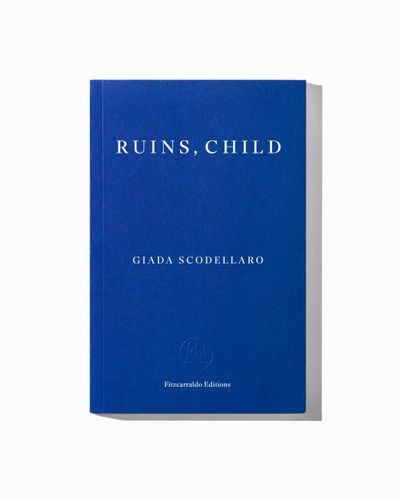
Ruins, Child
French paperback with flaps, 176 pages
Published 26 March 2026
Ruins, Child
THE LEG, A LINE.
A close up of a woman’s leg. And the leg is seen because the woman is tying her shoes.
Isn’t the leg a line?, she’s heard saying. Tying up the laces. There’s a certain name the neighbors use when her leg sticks out of place. Out of place for a woman, you know. Out of place for how the body should be presented, even while tying a shoe. She hears voices from the front room. A little skin of the upper leg being shown outside of its intended context, that’s when the neighbors take it upon themselves to call her out of her name.
She’s fast, someone says in a low register, or it’s just about the way her thighs push together when she bends, and her ass, her titties sitting.
Are we wrong to lament the condition of those structures?
—And aren’t they ours?
In the footage the woman bends, loops her fingers around the laces, once, twice, grass stains on her knees. She stands, the people stare. Or she moves about, this figure, pushing the shopping cart and they all go at her pace.
The camera lens is covered in grease, we notice, there’s an amateurish quality to all this. It’s nighttime. The woman is lit up by the fluorescent lighting. She knows the store well, the butter beans are over there, she says, pointing.
The volume on the television is up loud. We follow her down aisle five. She checks the ingredients on the label, her long nails tapping the cans, later brushing her forearms against the fresh produce, the mustard greens. A swiping of a card, and they all pause for the sliding door. It is only when she’s ready that they exit.
Lit up by streetlight; silver around the forehead. We’re sitting on the living room carpet watching the 168 hours of footage. The schools are closed up for the Holiday. The footsteps of the children are heavy, running wild. We’re watching the part of the film when the woman is running errands and the like. Our community mostly walks, and there was a time when this woman walked about: back from the market, to the gardens, barefoot from the lake, on the community center table, to the bridge, in the mud, dragging her soles (dirty) around the house—though now she is bedridden. Confined to bed, riding the bed.
We sit up in her house and watch her go still. We watch the footage, and watch her lead the others through the streets. It doesn’t seem right how much the woman walks in the film, the ease of movement, arms swinging, not unlike a piece of metal, the metal metal, metal of waiting, the neighbor Dionne Brand says, or how often the woman remains on her feet.
She’s carrying a purse on her shoulder, a faux-leather, black. Her purchases bagged up by a teen. She carries loads of mustard greens, prune juice, ginger ale, vaseline, butter beans.
And they shadow her. They gather around her, this elusive figure, don’t she move quick? The six of them scale her. They move in unison. Do you know about that? About moving as a unit? It’s harmonious. Here come the six, they used to say, the six mix, here they are: the six fix, six peas in a pod, the six horsemen, the six kings-men, the neighbors would say. Here they come.
And when the woman drops down to tie a shoe they wait for her to finish. And the audience waits, in the living room the children quiet down their games. They check their own little shoes to see if they need tending.
Her thigh is out of place and shiny with oils. She’s gotten the necessary things—the turkey neck, the cowpeas, white vinegar.
The volume is raised up too high, It must be explained, the woman says, yells, profile to the camera, thighs sticking, strawberry skin, razor bumps showing, the mini skirt, climbing, tattoo peeking, walking slow, and all of them walking side by side—it must be explained how the Hill is raised but almost flat, not at all hilly, she says, mouth wide, and it sits on a salt marsh that is known to be sinking. Named after a certain somebody, a politician or something, a something something Hill, the woman says. Do you know about this place?
The group speeds up their walking to keep time with her. Yes, one of them says. Perhaps it was an Augustus Troy Hill or a Jamaal Amenite Hill, we don’t really know.
The woman is beginning to forget, to misplace things, and the others, the six, they let her tell them again, again, A something something Hill, though they know this speech. On her feet: tennis shoes.
The valley is familiar, it is the same now as it was then, during the taping, and before. So we’ve known it and the surrounding flatness for many years, decades. It is sinking a little, but then everything is going down, so today we tell ourselves it is fine, and just the same there is the Holiday, or there is an urge to preserve something. This film, it’s about place, community, she says, being rooted in the Hill, the way we are rooted, okay, and it’s about our Holiday or about tradition, and your place here—you.
Okay, they say. Okay, okay.
The group never uses the word unless there is something silly going on. To sit in the grasses, to talk to the neighbors, to excavate, the woman tells the six. Okay, they repeat. They walk on. They walk behind the gigantic head of this woman, this too tall woman. And get my good side, she says. She towers over them like a pine. There are hills in the distance, and the fog is down low. The camera captures this. Her pace does not give her age away. The woman is old, and she is with child.
It is what it is, the woman says, or the name has stuck.
The name?
Yes, honey, the name, The Hill.
The geese, which are aggressive and almost completely gone, stomp when they are near, demanding something. The six, the six bits. And they do film the animals, the birds, and are somewhat distracted by them, even though they are not the focus of the project.
And the woman says, film the ducks, film the geese, oh yeah. Capture something good, the ducks are full of good.
We sit on the living room floor, on the sixteenth floor, watching the footage. Do you get it?The wide shot of the buildings, how they exist on the very end of the salt marsh, the artificial lake, the high school, the market, the cemetery, the hospital, the thick asphalt. Asphalt so thick and suspended that we all have difficulty climbing across the street, this whole place is cool to the touch. The prison sits empty.
It is a tradition to watch it, you understand, and the thing is so long that most of us have only seen bits and pieces. The movie is all out of order. I have seen it all, memorized it. Would I not know a thing that covers?
Those who are tired get up to leave. The neighbors are off to church or going straight to their bed, to praise or to rest, respectively, and the film is forever playing in the background.
Leaving and returning, taking turns. This will go on for a week or so. The woman with her bare feet in the soil, sitting on a stoop or in the grass. The woman on her knees. The six are swarming around her. Sometimes it is quiet and still. Moss, the grasses, which are dry and yellow, weeds, weeds. Yellow, or golden, like wood can be golden. And furniture being cut from pine, molded, sewed, finished. The pine trees swaying.
And the woman’s name is Vonetta!.
Vonetta!, though the neighbors call her something else entirely ( fast! ), and we mostly refer to her as she exists (the woman! ). Oh, but I don’t like to be reduced.
It’s Vonetta!, she says when she introduces herself to any man or woman, or child. With an exclamation point at the end, the woman continues, an aircraft moving past.
Some stragglers have joined, they adjust themselves on the carpeted floor, finding a free space, or a gap, the arm of the plastic couch. They sit up straight to watch this thirty year old film. Vonetta!, this is how the name is written on the birth certificate, I can show it to you, though it might fall apart a little more in our hands, yellowed.
Vonetta!, the woman explains, is the name given by my mother to prepare me for how I would be called out, or how I would be erected, enacted, blamed. The punctuation at the end like a nail left in a wall.
Sometimes in the living room we fall asleep.
When we wake the children are gone, maybe to school, and the apartment is otherwise packed with new faces.
The gals (6) as they stand on the corner waiting for the bus to pass. And the street is paved with asphalt so thick that the sidewalks are not aligned with it. They (6) wear clothes that reflect the decade. Someone beating a carpet from an open window just out of frame while we beat the carpet from the next window. Just behind—the Hutchinson River/the Hutchinson River. There is some repetition going on. How to explain it? Everything we did once, we still do.
There are some preparations going on that have always been going on: the lights being arranged upon the branches of the sweetgum. We are all squished inside the apartment, preparing, watching/waiting for a glimpse of ourselves.
Climb up, the bus driver, Charlie, says.
Charlie is dead. He is captured in the scene as we remember him: eyebrows touching, goatee, low sideburns, waves, hair connecting over his surfaces. There’s so much traffic. To get on a bus is to spend some time climbing aboard, or being pushed from behind, or being pulled up by the armpit.
Climb on sweetie pie, the bus driver calls out to the six.
Bitch, the bus driver calls out.
Fuck you Charlie, they say, one at a time. They climb up one at a time. They help the woman climb up easy. She is careful to show the thigh. There is something graceful about the gesture, a child comments. More chatting, the camera turns away to shoot some B-roll. The six voices harmonize. They go around the loop, Einstein Loop. The bus is clean. Things moving fast outside, and they watch the lights coil in the red maple, and the milk thistle leaning over or resting.
We are losing interest. Milk thistle is good for the liver disease. The sky is grey. We move to the kitchen to watch the others play spades. Isn’t this her floor, her ground?
Windows open, we sit upon chairs upholstered in green materials. It is hot as hell. On the television the earth is frozen solid. Camera is heavy, hell, they take turns resting the equipment upon different shoulders, a muffled sound, The earth is frozen solid, they say in unison. The picture is shaky, with the image pointing all the way up—hands turned solid.
‘Mesmerizing… The novel has little by way of plot, but much to offer in terms of beauty. For readers willing to surrender to the sway and creep of Scodallero’s prose, it can feel much like watching an art house film, where, as one of the novel’s characters puts it, “we are lost in the potential of this scene”. The result is an arresting work by a writer unbound by constraints of the expected.’
— Publishers Weekly
‘This finely crafted web of overlapping viewpoints forms a multilayered portrait of the Black woman figure and her life – and the effect is undeniably original. The collage of scenes holds an array of arresting detail that is striking, humorous and surrealist in nature. Scodellaro breaks the novel form to experiment with its limits.’
— Loré Yessuff, Brooklyn Rail
‘Giada Scodellaro’s newest masterpiece, Ruins, Child, endows the concept and form of the contemporary novel with new force and meaning. Cinematic and prismatic, like a camera constantly in motion and yet incisive in its close portraitures of a community of Black women and femmes surviving and living amidst the future urban, eco-dystopic, queer ruins of our society, Scodellaro’s novel breaks new ground in spectacular fashion.’
— John Keene, author of Counternarratives
‘Giada Scodellaro is one of the most astonishing writers of her generation and Ruins, Child is a visionary novel. Scodellaro refracts and redefines the canon of Black culture, the archive of Black experience. The result is a masterpiece that lives and breathes on the page, every sentence shimmering with wit, musicality, brilliance and verve.’
— Katie Kitamura, author of Audition
‘Ruins, Child reads like wild and textured wind, like seeds dispersed, like focus pulled then blossomed outwards, like bodies leaking, thumping, persisting, cleaving: together, then apart. This is a book of breath and people, of the precious metrics of language with all its lakes and tales that flows between and towards women. Giada Scodellaro has written fierce magic, wet earth, hot limbs; it is urgent and beautiful.’
— Helen Marten, author of The Boiled in Between
‘Scodellaro’s brilliant prose breathes strangely. She captures and conjures a world and a set of characters so unlike anything I’ve ever encountered before, and there’s a quiet terror furring beneath the story.’
— Mona Arshi, author of Somebody Loves You
‘Ruins, Child takes us to the crumbling architecture of a future past; a future past that is possibly now. In this work of fractal seeing, we encounter women in lives that are simultaneously lived, reenacted, and observed. Ruins, Child is conceptually rich, prismatic, and choral, embodied, and surreal, cinematic and textual. Giada Scodellaro writes us Black life watching Black life.’
— Dionne Brand, author of A Map to the Door of No Return
Giada Scodellaro was born in Naples, Italy and raised in the Bronx, New York. Giada’s writings have appeared in the New Yorker, BOMB and Harper’s Magazine, among other publications. Her debut collection, Some of Them Will Carry Me, was named one of the New Yorker’s best books of 2022.