
The writer known as M. is living in exile while her home country wages war on a neighbouring state. Wracked by shame and severed from her language, M. finds herself unable to write, unmoored in a present where the future feels unknowable. When she travels to a nearby country for an event, a twist of fate leaves her stranded in an unfamiliar city, phoneless and untraceable. In this rupture, she feels a flicker of liberation – the possibility of starting over – but memories of childhood, books, films and tarot cards pull her back, the last fragments of a vanishing world. Then she meets a troupe of circus performers who invite her to join them. For a moment, reinvention seems within reach. Oscillating between reality and dream, written in rich, hypnotic prose, The Disappearing Act is a haunting meditation on identity, language and the fragile desire to disappear by Maria Stepanova, one of Russia’s greatest living writers.
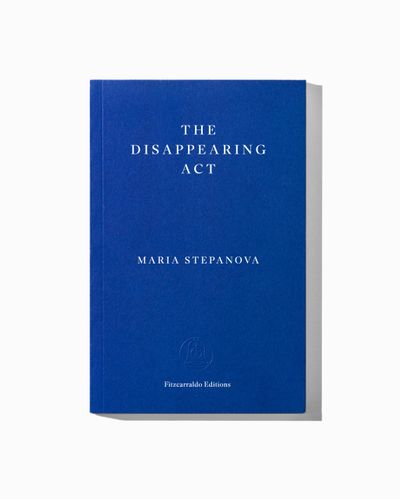
The Disappearing Act
Translated by Sasha Dugdale
French paperback with flaps, 136 pages
Published 26 February 2026
The Disappearing Act
Translated by Sasha Dugdale
1.
In the summer of 2023 the grass carried on growing as if nothing at all was wrong. It grew as if that was simply how things had to be, as if to demonstrate once again that, no matter how much killing took place on the face of the earth, the grass at least intended to keep on stubbornly pushing up through the soil. Perhaps it was a duller green than usual, perhaps it lost the milk-white tinge of its tips almost immediately, but still it grew on undeterred. Almost as if the lack of water forced the grass to cling tighter to the earth, sending out ever-newer shoots that dried and withered before they could reach their full growth.
In the summer of 2023 the planet experienced its hottest day since records began. Picture the scene: generations of Lilliputian scientists pressing themselves against Earth’s vast body, measuring her temperature day and night, gathering samples of the sweat at her brow and taking particular pleasure in noting the parts of her that were coldest. All this information they recorded in a logbook, presumably finding consolation in the steady breathing of the sleeping giant; the way in which extraordinary rushes of fever and chills were quickly followed by what might be called normal temperatures; or the condition of her hair and nails, which was as good as could be expected for someone who had lain motionless through the ages, allowing others to do with her as they wished. Perhaps long ago she had shifted into a very different state of mind, one in which she was no longer provoked to anger or dismay by our actions, and now feels herself to be a star, pierced through with fire and already smouldering; or a swathe of cloth, boundless and featureless, indifferent to everything, like a stage curtain in the darkness. Or, who knows, perhaps she’s amused by the way we assume nothing new will ever come of her, that we continue to expect our daily and yearly deliveries of milk and honey like children expecting breakfast, yawning children who scramble to the kitchen and wait for their mother to put bowls of yoghurt or cornflakes on the table in front of them. But what if the bowls suddenly contained scorpions, or writhing grubs, or bluebottles? What if the thermostat was turned right up, so the kitchen was stiflingly hot, or what if frogs rained down from the sky, slapping against the windows? What if a plague on the firstborn began? This is a game that can be kept going for a good while, especially if it begins with almost imperceptible changes: the grass that withers a little early, or the trains that seem to forget the timetable, delayed for hours or else rushing ahead with preternatural speed, only to stand silent on a wide plain, waiting for their allotted arrival time.
It was on such a train that the novelist, who went by the name of M, sat waiting, wondering just how late she was going to be. The yellowing fields outside, the net on the seatback with an empty Coke bottle jammed into it, even the occupant of the seat next to hers – all were portents of a delay she could not avoid. Trains now behaved as if they were living creatures, free from human control; all one could do was hope for their good will, although it was unclear how or even whether this differed from the good
will of humans. Ticket inspectors had all but disappeared from the trains, and no one seemed to care any longer; you could go a long way without having to show a ticket.
Still, the novelist M, who was travelling from one country to another, confidently expected to arrive at her destination, if not on this train then at least on another. She was armed with a ticket and a seat reservation, and she’d picked up an avocado sandwich from one of the more upmarket station kiosks where the bread was fresh and the coffee strong. She’d once heard that an action only needed to be repeated twelve times for a new and enduring habit to be formed. For example, if, after a day’s work, you were to go to a café with a river view and drink a simple glass of white wine, then on the thirteenth evening the habit would suddenly manifest itself, like the head of a seal emerging from the water, and you’d be a new and different person: the sort of person who sits sipping wine in the evening, without really knowing why, waiting for the new words that fit this new life like a glove, and that will in time appear in your mouth together with the taste of wine.
In any case, as M sometimes reflected, they say that the human body has a habit of replacing all its cells with new ones every seven years. After seven years you wake up a completely different person without even noticing and only continue to think of yourself as a familiar and predictable creature because you aren’t paying attention. But then again, she wondered, turning away from the occupant of the seat next to hers with his expanse of newspaper, and looking crossly out of the window, could one really call this behaviour a genuine habit, when in most cases the human body doesn’t manage to renew itself the full twelve times. By the thirteenth you’d be over ninety, a rare achievement for the human organism, and at that age a person is facing inevitable transformation into a handful of ashes in an urn, or a box whose contents we’d prefer not to think about.
She’d certainly passed through the city’s main station twelve or more times. So her desire to join the morning queue for coffee and a paper bag filled with something warm and nourishing (and from one particular kiosk) could by now be considered a habit rather than a passing whim; and she herself looked like a woman who knew what she wanted, placing her paper cup decisively into its carton tray and pressing on the correct lid. For M, who hadn’t lived in this city long, precision of movement and the knowledge of one’s future trajectory (the underpass to platform five for northbound trains and platform one for southbound) had a particular importance, as if guaranteeing that she had a place both on the waiting train and the journey towards it, as well as in the new life itself, to which she had not yet been entirely reconciled.
Judging by the number of times she’d had to travel somewhere and work ‘as a novelist’ in different cities and countries and then travel back, pulling her light suitcase easily from the luggage rack each time, then she clearly did have a place in this new life, many places in fact, and in each one people wanted to ask her about the books she had once written; and then, with far more curiosity, about the country she’d come from. This country was currently waging war against a neighbouring country, killing the inhabitants with missiles, with fire from the skies, with bare hands, and yet it still couldn’t conquer it, nor accept that its opponent was not going to offer itself up on a plate.
Sometimes – fairly frequently, in fact – this country of hers also found time to kill its own inhabitants, seeming to consider them nothing more than mutinous body parts that had become dangerous distractions from the acts of hunting and feeding. The foreign city where M now lived was full of people fleeing from both countries, and those who’d been attacked by her own compatriots regarded their former neighbours with horror and suspicion, as if life before the war had ceased to have any meaning and had simply masked a similarity with the devouring beast.
(…)
‘M describes the country she comes from as a “beast” waging war against its neighbour. We can guess her meaning without turning to the author’s biographical note. Maria Stepanova – whose masterly In Memory of Memory combined family memoir, essay and fiction – left her native Russia after its full-scale invasion of Ukraine in 2022. We might also wonder how closely The Disappearing Act tracks her own life. But the novelist M is not here to discuss autofiction – she has more important things to reflect on…. Wherever her escapade brings her next, she is proof that it takes a novelist with poetic imagination to capture the nature of the beast.’
— Anna Aslanyan, Guardian
‘Essential… Written with deep insight, despair and an intrinsic sense of the alarming recurrence of the present’s failure to learn lessons from the past. The Disappearing Act, expertly translated by Sasha Dugdale, is the dreamlike testimony of a novelist, known simply as M, who is witnessing from exile her country of origin’s invasion of a separate sovereign state. Creatively and psychologically paralysed by the horrors of war seen at a distance, M can no longer write; every innocuous image becomes superimposed with horror, and so she retreats into self-erasure and memory in order to survive, never mind evolve.’
— Catherine Taylor, Irish Times
‘The Disappearing Act is about what happens when the story of one’s life cleaves in uncomfortable, incongruous ways…. Much of the novel exists on this symbolic plane. But Stepanova is equally adept at building a physical world that evokes the experience of exile…. If there is a through-line to Stepanova’s work, it is not some grand, totalizing vision but rather the habit of looking closely at what falls through the cracks.’
— Matthew Janney, Financial Times
‘The success of The Disappearing Act lies in how these diverting scenes inform larger questions about what makes us who we are when we’re without possessions and places and work, or how we categorize people in the absence of other identifiers, through nationality, for example… The Disappearing Act toys with the reader through oppositions and contradictions. Its setting is both specific and general; it draws on the author’s own experiences but places her alter ego in increasingly fanciful scenarios. But the greatest switchback is how it shows that if Stepanova, like her avatar M, is now a novelist in name only, she can nonetheless still do the job very well indeed.’
— John Self, New York Times
‘Stepanova’s wonderful In Memory of Memory was a weighty consideration of family legacy through objects and images; at first, this slim novella of disconnection appears markedly different. But a similar dream-like atmosphere prevails, and there are also thematic resemblances. Even as she fantasizes of obliteration, M is pulled back to the past…. But this time, these memories are tinged with horror, inevitably and rapidly leading M to think about the beast and its workings.’
— Rachel Andrews, Irish Times
‘Stepanova deliberately withholds clear answers, and this ambiguity is what makes The Disappearing Act so compelling. It is driven by uncertainty, the unwillingness to face oneself, and the sense that one’s language – and, of course, their whole world by proxy – is collapsing beneath one’s feet…. [T]he novel can be marked as one of the first major works of the new Russian literature, a cogent exploration that is never prescriptive nor totalizing, but simply captures something of the diffuse, unfinished, and hopelessly divided moment.’
— Sam Bowden, Asymptote
‘Political evil has re-emerged across the West, imposing agony upon all people of conscience, and new challenges on writers and artists. In her incandescent poems and essays, Maria Stepanova has never shirked the weight of history long borne by writers from Russia, Asia, Africa and Latin America. Her artistic, intellectual and spiritual resources seem even richer in her first novel, The Disappearing Act. I have not read a novel that attests, with such melancholy precision, to the shame, absurdity and confusion of being human today, or describes so acutely the immense but too often frustrated craving for radical self-transformation.’
— Pankaj Mishra, author of The World After Gaza
‘A profound, unsettling meditation – at once lucid and mournful – on political exile, reinvention after the rupture of belonging, the writer’s reckoning with collective responsibility, and the beasts we carry – national, ancestral, unnamed – that shape us even as they threaten us.’
— Lea Ypi, author of Free
‘The Disappearing Act is a witty, unsettling and profound reflection on belonging and estrangement.’
— Abdulrazak Gurnah, 2021 Nobel Prize in Literature laureate
‘In this captivating and capacious novel from Stepanova (In Memory of Memory), a 50-year-old novelist experiences a bizarre and liberating metamorphosis while in exile from her unnamed home country, which has just started a devastating war with its neighbour…. Far from a literary gimmick, the novel comes across as an urgent call to resist complacency and recover one’s vitality in the face of injustice. It’s a stunner.’
— Publishers Weekly, starred review
Praise for In Memory of Memory
‘Extraordinary – a work of haunting power, grace and originality.’
— Philippe Sands, author of East West Street
‘Intentionally the memoir is meandering, digressive, cumulative, compendious – a mind moving around its wide world. Dugdale’s translation appears heroic, to this reader with no Russian, in its sustained careful attentiveness…. [S]o much of what Stepanova has saved for us is remarkable and rich with meaning.’
— Tessa Hadley, Guardian
‘A luminous, rigorous, and mesmerizing interrogation of the relationship between personal history, family history, and capital-H History. I couldn’t put it down; it felt sort of like watching a hypnotic YouTube unboxing-video of the gift-and-burden that is the twentieth century. In Memory of Memory has that trick of feeling both completely original and already classic, and I confidently expect this translation to bring Maria Stepanova a rabid fan base on the order of the one she already enjoys in Russia.’
— Elif Batuman, author of The Idiot
‘There is simply no book in contemporary Russian literature like In Memory of Memory…. [A] truly major European writer. I am especially grateful to Sasha Dugdale for her precise and flawless translation which makes this book such a joy to read in English. This is a voice to live with.’
— Ilya Kaminsky, author of Deaf Republic
‘Stepanova’s tour de force blends memoir, literary criticism, essay and fiction. Although this is a personal and intimate work using photographs, postcards and diaries, it succeeds in mining a universal theme in contemporary Russian cultural life: how does a family – or a country – process the events of the past 100 years?’
— Viv Groskop, Guardian
‘Dazzling erudition and deep empathy come together in Maria Stepanova’s profound engagement with the power and potential of memory, the mother of all muses. An exploration of the vast field between reminiscence and remembrance, In Memory of Memory is a poetic appraisal of the ways the stories of others are the fabric of our history.’
— Esther Kinsky, author of Seeing Further
‘This remarkable account of the author’s Russian-Jewish family expands into a reflection on the role of art and ethics in informing memory.… Stepanova is both sensitive and rigorous.’
— New Yorker
Maria Stepanova is a poet, essayist, journalist and the author of ten poetry collections and three books of essays. She has received several Russian and international literary awards (including the prestigious Andrey Bely Prize and Joseph Brodsky Fellowship). In Memory of Memory won Russia’s Bolshaya Kniga Award in 2018. Sasha Dugdale’s English translation was awarded the Berman Literature Prize and was also shortlisted for the International Booker Prize, the Warwick Prize for Women in Translation and the James Tait Black Prize for Biography. In 2022 she was awarded the Leipzig Book Prize for European Understanding 2023 for a book of poetry, Mädchen ohne Kleider (Girls Without Clothes). She founded and was editor-in-chief of the online independent crowd-sourced journal Colta.ru, which engaged with the cultural, social and political reality of contemporary Russia until the full-scale Russian invasion of Ukraine when all dissenting media in Russia were forced to shut down. As a prominent critic of Putin’s regime, she had to leave Russia and is now living in exile.
Sasha Dugdale is a poet and translator. Her sixth book of poetry, The Strongbox, was published by Carcanet in 2024. Dugdale’s translation of Maria Stepanova’s prose work In Memory of Memory was shortlisted for the International Booker Prize and won the MLA Lois Roth Award, among other accolades. She has translated two of Stepanova’s poetry collections and work by a number of Russian-language women poets, including Elena Shvarts and Marina Tsvetaeva.


