
In the year following 7 October 2023, Samar Yazbek met with hundreds of survivors from Gaza, asking each of them about their experiences of that day and the months of destruction and displacement that followed. From these encounters comes Your Presence Is a Danger to Your Life, a selection of twenty-six testimonies from ordinary civilians aged thirteen to sixty-five, whose lives have been irrevocably altered by what may one day be remembered as one of the most savage military offensives of our time. Adapted from warning flyers dropped moments before a bombing, the book’s title captures the impossible reality of life for Gazans. That reality is laid bare in accounts marked by unimaginable loss – homes shattered, loved ones vanished, limbs obliterated – and mechanisms of cruelty that defy comprehension. In gathering these testimonies, Yazbek brings into focus the human lives behind the headlines, and the survivors’ determination, even amid devastation, to speak and to be heard.
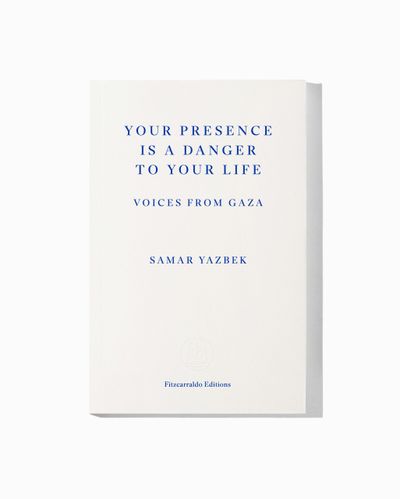
Your Presence is a Danger to Your Life
French paperback with flaps, 256 pages
Published 21 May 2026
Your Presence is a Danger to Your Life
INTRODUCTION
It is noon. I pause, resisting the haziness of vision that transforms the stone buildings into white arms trembling in the breeze, then continue moving along the wide avenue, trying to seek shelter from the burning midday sun. A few seconds later, I open my eyes as wide as they can go. I stare at the end of the street where black silhouettes are coming closer, moving oddly, shapes with uncertain features that blur and vanish into the mirage as if flying. I try and bring them into focus, struggling to grasp what is happening at the end of this unfamiliar road.
At the time, I wasn’t very familiar with this place. The map of the area was an enigma, and my sense of what was happening there was confused. I found myself, as intended, at a government office in Thumama. There, survivors of the Gazan genocide were gathered; people with amputated limbs in complex and critical states of health. Together with the family members caring for them, they numbered more than 2,500. This fantastical scene was taking place in a quiet city called Doha, but in those moments, the destruction in Syria was re-enacted for me. The silhouettes of the victims, the very same moans – it was disaster, all over again.
There wasn’t a living soul around. The cruel, oozing midday sun was burning my forehead, and strange qualms began to wrestle me in the desert noon. I looked away at first, trying to escape the thoughts taking hold, but then took a few steps closer, trying to distinguish those black shadows, and realized they were wheelchairs being pushed by others. I turned around, only to see a woman in black pushing a chair that carried a young woman in the prime of life. It occurred to me that the whole world had come to this: missing body parts, people with amputated limbs, half-bodies living on the margins of life like remnants of a bygone age. I felt like we were on board a ship hovering in mid-air, suspended within a destiny of impotence and loss, among delusions and ghosts I couldn’t quite make out. The sun was pitiless, and I had to head to the administrative offices to meet some officials. A train of thought transformed what I was seeing into an image from a novel, an attempt to maintain my equilibrium in the face of this reality. And to drive from my mind the interwoven scenes of ruin, the confusion between which was Syria and which Palestine.
A strange grief nearly swallowed up the spectacle, as if the place was rendered unreal by the excess of its tragedy. Who can bear such agony?
It was no coincidence that I saw the devastation conveyed by these wheelchairs, so like flocks of black birds and carrying the resounding suffering of the Palestinian people – a people plucked out by the root and left to dangle in limitless space. Those phantoms embodied a recurring symbol of humanity’s defeat, as if Palestinians had become Syrians and Syrians Palestinians, across a shared space of brutality that I have witnessed, written about and buried in my heart.
I found myself facing those wheelchairs and the people who had survived the torments of genocide, impelled to try and understand their pain. I felt called upon as a writer trading in words and narrative as a means of empathy, of effecting change and, most crucially, of understanding the dangerous world around us, thinking of a better, more humane future. I was still panting in the wake of these racing thoughts, still drawn towards these people by the ideas so deeply rooted within me. These people meant a great deal to me. One way or another, Syria was before me at that moment and, as always, I held fast to the imperative of not leaving the victims alone, the imperative of movement and action and feeling; these are the conditions of our existence, and by necessity our humanity.
I was stuck, suddenly, by a searing question – what happened to the people of Gaza who survived the genocide? Is it even right that we consider them survivors? Where does human pain go when justice is absent? How did they lose parts of their bodies and embark on new forms of existence? How can we deal with their sufferings? How can it be that the lives of ordinary people, having dwelled for years in an open prison, have vanished forever since that infamous day, 7 October? There is something else in the speed of this disappearance – destruction and a redoubled, unfathomable barbarity have settled over these people. Why do we drone on and on about their issues in political and ideological slogans, far removed from their subjective, individual pain?
These questions were troubling, but I did my best to collect myself that desert afternoon as I walked towards them. I said a greeting, and received some weak smiles and diffident glances in reply. Instantly, I realized that I was going to stay here. I was going to live among them, try to grasp the details of their lives and sit by their side with their grief – the grief that has made me come to recognize them as heroes and honourable people who resist so as to stay alive. (…)
‘While narrating death and destruction, the witnesses Yazbek spoke with still found a way to illustrate that, in the words of Palestinian poet Rafeef Ziadah, they taught life. Many insisted on showing Yazbek pictures of their families and of themselves when their bodies were still whole; some entrusted her with a list of names of the people they lost; they defied erasure by every means available to them…. Yazbek’s collection of testimonies, spanning the shattered lives of children as young as thirteen to the weary wisdom of the elderly, refutes the diminishment intended by the airdropped leaflets. If the leaflets claim their presence is a danger, Yazbek proves their erasure is the true catastrophe.’
— Ibtihal Rida Mahmood, Arab Lit
‘A work of profound ethical significance, a direct offering of words from voices that should never be silenced. Your Presence Is a Danger to Your Life is almost too painful to read, but so deeply humane and important that it compels us not to look away.’
— Preti Taneja, author of Aftermath
‘These testimonies of the unconscionably injured are among hundreds of thousands such testimonies emerging from Gaza since 7 October 2023. Despite Israel’s genocidal drive to silence Palestinian voices, despite Western complicity in this silencing, these twenty-six testimonies – shared with Yazbek and translated by Price – now exist as pages. If, like me, you have the means and the capacity to read them in all their blistering detail, and if you too have no personal knowledge of the unspeakable zannanat that plague these pages, then you – we – have a particular duty: not only to read these precious words, but to act on them.’
— Natasha Soobramanien, co-author (with Luke Williams) of Diego Garcia
Praise for The Crossing:
‘Powerful and moving…bears comparison with George Orwell’s Homage To Catalonia as a work of literature, Yazbek is a superb narrator … this is how she crosses the line from journalism to high literary art.’
— Andrew Hussey, Observer
‘An eloquent, gripping and harrowing account of the country’s decline into barbarism by an incredibly brave Syrian.’
— Barry Andrews, Irish Times
Samar Yazbek is a Syrian writer and journalist. She was born in 1970 and studied Arabic literature at Latakia University. Yazbek has been a prominent advocate for human rights and more specifically women’s rights in Syria. In 2011, she took part in the popular uprising against the Assad regime and was forced into exile soon after. In 2010, Yazbek was selected as one of the 39 most promising authors under the age of 40 by Beirut39, organized by the Hay Festival. In 2012 she was awarded the PEN/Pinter Prize ‘International writer of courage’ for her book In the Crossfire, and received the Swedish Tucholsky Prize and the Dutch Oxfam/PEN Prize the following year. In 2022, Yazbek was chosen by the Royal Society of Literature as one of twelve International Writers. Yazbek has published two short story collections, seven novels and four non-fiction literary narratives, and has been translated into over twenty languages.
Leri Price is an award-winning literary translator of contemporary Arabic fiction. She was a Finalist for the National Book Award for Translated Literature in 2024, 2021, and 2019. Her translation of Khalifa’s Death is Hard Work also won the 2020 Saif Ghobash Banipal Prize for Arabic Literary Translation.


